






Definition & Meaning
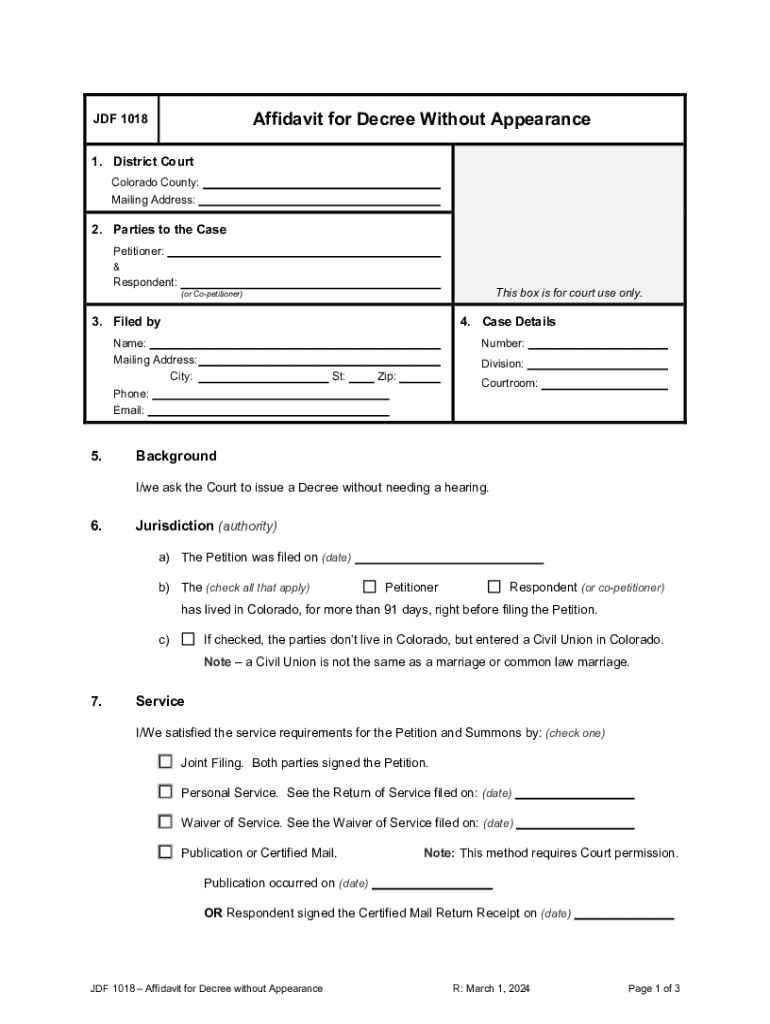
The JDF 1018 Affidavit for Decree Without Appearance is a legal document used in the Colorado District Court. It facilitates the issuance of a divorce decree without the need for either party to appear physically in court. This affidavit allows the petitioner and respondent (or co-petitioner) to finalize their divorce or dissolution of a civil union under specific conditions, such as when both parties agree to the terms, or when there are no contested issues. The aim is to streamline the process and make it more convenient for individuals to complete their divorce proceedings efficiently.
How to Use the JDF 1018 Affidavit for Decree Without Appearance
-
Check Eligibility: Before proceeding with the affidavit, verify that the circumstances meet the requirements set by the Colorado court. This includes having no contestable issues in the divorce and mutual agreement on the dissolution terms.
-
Complete the Affidavit: Fill out the JDF 1018 form with accurate information about both parties involved. This involves entering personal details and confirming understanding and agreement on the terms of the divorce.
-
Service Requirements: Ensure that the service requirements for the Petition and Summons have been satisfied. Choices include joint filing, personal service, or a waiver of service.
-
Submission: Once completed, the form can be submitted to the relevant court for review. It may be submitted electronically or through traditional mail, depending on local court procedures.
-
Await Decree: After submission, if everything is in order, the court will issue the Decree without requiring a physical appearance. The timeline for this step varies depending on court schedules and caseload.
Steps to Complete the JDF 1018 Affidavit for Decree Without Appearance
-
Gather Information: Obtain full legal names, addresses, and other pertinent details for both parties to ensure accuracy when filling out the form.
-
Fill Out Parties' Details: Enter the names and roles (e.g., petitioner, respondent) of the individuals involved. This section certifies that all involved parties are correctly identified.
-
Indicate Service Type: Mark the appropriate box indicating whether a waiver of service or a service by publication is applicable. Documentation supporting the chosen service method must be attached if required by the court.
-
Address the Children Clause: Check the appropriate box regarding minor children. If there are no children involved, this must be explicitly stated.
-
Detail Property and Financial Agreements: Indicate whether there is a written agreement concerning the division of property and finances. If there is no marital property or debts, note this and confirm that no spousal support is requested.
-
Sign and Notarize: Both parties must sign the affidavit, declaring under penalty of perjury that the information provided is true. The form may require notarization to validate the signatures.
Key Elements of the JDF 1018 Affidavit for Decree Without Appearance
-
Jurisdiction and Authority: Confirmation of the court's authority to issue the decree, based on the residency of the parties or the location of the civil union.
-
Service of Process: Details on how the involved parties were notified of the proceedings, ensuring they have been properly served according to legal requirements.
-
Children and Parenting Plans: Information on any minor children and corresponding arrangements, such as a filed parenting plan if applicable.
-
Property and Financial Divisions: Specification of how marital assets and debts are divided, ensuring fairness in the absence of dispute.
-
Name Restoration: Parties may request a restoration of their prior full name post-divorce, ensuring that this change is not intended to defraud creditors.
State-Specific Rules for the JDF 1018 Affidavit for Decree Without Appearance
-
Colorado Residency Requirement: At least one of the parties must have resided in Colorado for 91 days prior to filing for divorce using this affidavit.
-
Civil Union Consideration: If applicable, specify that the parties entered a civil union in Colorado, highlighting the legal distinction from marriage.
-
Compliance with Colorado Revised Statutes: Parties must acknowledge the guidelines, particularly those found in C.R.S Section 14-10-114 concerning spousal support, to ensure compliance with state laws.
Legal Use of the JDF 1018 Affidavit for Decree Without Appearance
The affidavit is used legally to:
-
Streamline Divorce: By removing the need for court appearances, it reduces stress, saves time, and minimizes cost implications for parties involved.
-
Ensure Agreement: Both parties agree voluntarily on the dissolution terms, ensuring the decree can be entered without further legal proceedings.
-
Provide Legal Protection: The affidavit serves as a legally binding document protecting both parties' rights and ensuring the divorce terms are fair and equitable.
Examples of Using the JDF 1018 Affidavit for Decree Without Appearance
-
Mutual Agreement Divorce: A couple mutually agrees on all divorce terms and prefers to avoid court hearings. They successfully file the affidavit, resulting in a decree issued without appearance.
-
Out-of-State Petitioners: Parties who entered a civil union in Colorado but currently reside elsewhere, utilize the affidavit to finalize their dissolution under Colorado's jurisdiction without traveling back to the state.
Who Typically Uses the JDF 1018 Affidavit for Decree Without Appearance
-
Couples with Mutual Consent: Those who agree upon divorce terms and prefer not to appear in court.
-
Individuals in Long-Distance Arrangements: When parties reside in different states or countries, this affidavit allows for smoother legal proceedings.
-
People Seeking Efficiency: Those who value a streamlined process and prefer to handle the legalities of divorce with minimal intrusion into their personal lives.