






Definition & Meaning
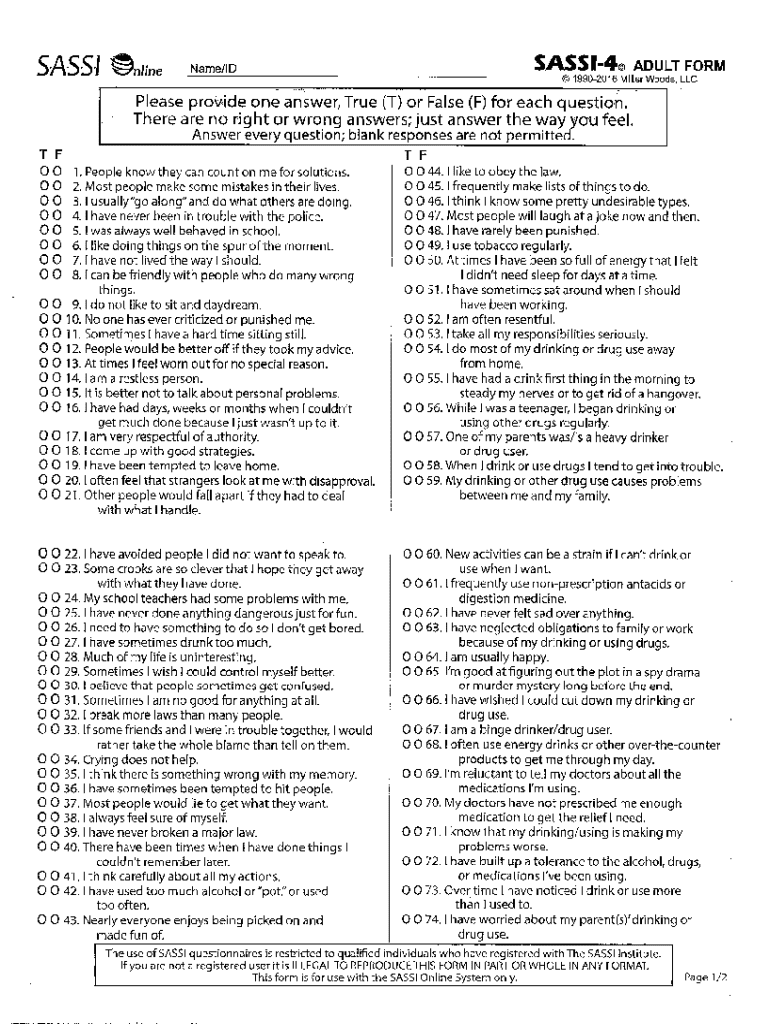
The Substance Abuse Subtle Screening Inventory (SASSI) is a self-report tool designed to identify individuals who may be at risk for substance dependence disorders. It provides a subtle, indirect method of screening by evaluating the client’s responses to various questions that assess attitude, behavior, and emotional states related to substance use. This screening tool is particularly useful for professionals in clinical and counseling settings to get an early indication of substance use issues in both adults and adolescents.
How to Use the Substance Abuse Subtle Screening Inventory (SASSI)
- Select the Appropriate Version: Choose between the adult and adolescent versions of the SASSI, depending on the age group of the individual being screened.
- Administer the Test: The individual completes the inventory independently, ensuring honest and spontaneous responses.
- Score the Inventory: Use the designated scoring system to analyze responses. Each item on the SASSI contributes to a comprehensive profile based on empirically derived scales.
- Interpret the Results: Review the scored inventory to determine the likelihood of substance dependency. Interpretations should be conducted by trained professionals who can accurately discern the subtle cues embedded in the inventory.
How to Obtain the Substance Abuse Subtle Screening Inventory (SASSI)
- Purchase from Authorized Distributors: The SASSI kits can be purchased directly from authorized distributors specializing in psychological assessment tools.
- Check Licensing Requirements: Ensure your organization meets any licensing requirements necessary to administer the SASSI.
- Training and Certification: Consider engaging in training programs to understand the nuances of the inventory and to improve accuracy in administration and interpretation.
Steps to Complete the Substance Abuse Subtle Screening Inventory (SASSI)
- Provide Instructions: Explain to the individual how to fill out the questionnaire, emphasizing the importance of honest answers.
- Allow Ample Time: Ensure that the individual has enough time to complete the inventory without feeling rushed.
- Collect and Review Responses: After completion, gather the responses and proceed to score the inventory.
- Secure Confidentiality: Handle all information in compliance with privacy and confidentiality standards.
Who Typically Uses the Substance Abuse Subtle Screening Inventory (SASSI)
- Mental Health Professionals: Counselors and psychologists utilize the SASSI to gain insights into clients’ substance use issues.
- Substance Abuse Treatment Centers: Facilities use the inventory to identify individuals who may benefit from treatment programs.
- Court Systems: Legal entities may employ the SASSI in cases where substance abuse is a factor to determine program eligibility or compliance with court mandates.


Key Elements of the Substance Abuse Subtle Screening Inventory (SASSI)
- Empirical Scales: Items are categorized into scales that assess different risk factors associated with substance use.
- Self-Report Format: Designed to minimize defensiveness and encourage honest responses.
- Diverse Items: The inventory includes a range of questions touching on behaviors, attitudes, and life circumstances that indirectly correlate with substance use disorders.
Legal Use of the Substance Abuse Subtle Screening Inventory (SASSI)
- Confidentiality: Administer the SASSI with adherence to confidentiality laws like HIPAA to ensure clients’ information is protected.
- Informed Consent: Ensure that individuals understand the purpose of the inventory and consent to their information being used for assessment.
- Court-Admissibility: In some legal scenarios, the SASSI may be used to assess risk factors; however, its results must be interpreted within the context of other evaluative information to ensure fair legal proceedings.
Examples of Using the Substance Abuse Subtle Screening Inventory (SASSI)
- Clinical Settings: A therapist working with a client showing signs of substance use might rely on the SASSI to guide treatment planning.
- School Counseling: School counselors might employ the SASSI to address potential substance issues among adolescents, providing early intervention.
- Rehabilitation Programs: Assessment using the SASSI helps tailor treatment plans specific to individual risk profiles, enhancing efficacy.
Versions or Alternatives to the Substance Abuse Subtle Screening Inventory (SASSI)
- Older Versions: Earlier models of the SASSI may still be in circulation, but the updated versions provide enhanced accuracy and relevancy.
- Alternative Tools: Other screening tools such as the Alcohol Use Disorders Identification Test (AUDIT) can complement the SASSI in broader assessments of substance use.
Important Terms Related to Substance Abuse Subtle Screening Inventory (SASSI)
- Substance Dependence: A condition indicating an individual’s reliance on drugs or alcohol characterized by an inability to abstain consistently.
- Risk Assessment: Evaluating the likelihood that an individual is misusing substances.
- Empirical Measurement: The use of data and statistics to create measurement tools that accurately predict certain behaviors or conditions.