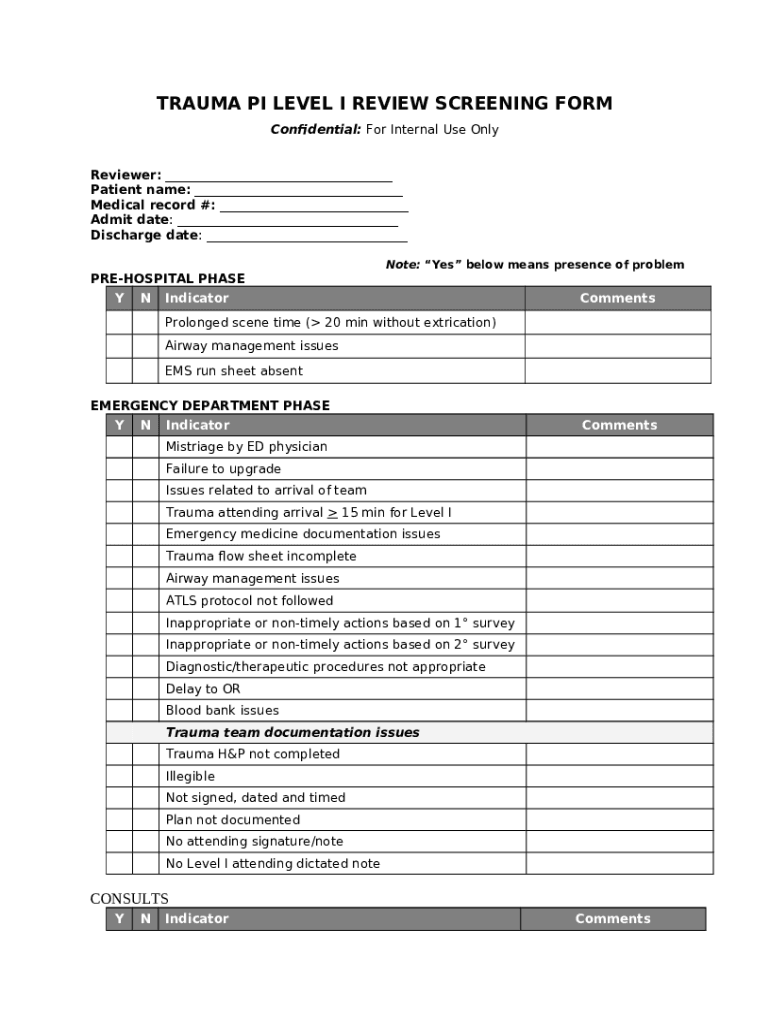







Definition and Meaning of the TRAUMA PERFORMANCE IMPROVEMENT REVIEW FORM
The TRAUMA PERFORMANCE IMPROVEMENT REVIEW FORM is an essential document used in healthcare settings, specifically in trauma centers, for the purpose of assessing and enhancing the quality of care provided to trauma patients. It serves as a systematic tool that captures critical data related to patient management, outcomes, and areas where improvement is necessary. By evaluating this information, medical professionals can pinpoint specific practices that require modifications to boost overall patient care. The form is a pivotal part of a quality assurance program in trauma care, ensuring that the treatment provided aligns with the latest standards and best practices.
How to Use the TRAUMA PERFORMANCE IMPROVEMENT REVIEW FORM
Using the form involves a series of methodical steps that begin with the collection of data from patient records. Each segment of the form targets specific aspects of patient care, such as initial assessment, diagnostics, treatment interventions, and follow-up protocols. Healthcare professionals need to meticulously review each patient's journey from admission to discharge, noting any discrepancies between ideal and actual care procedures.
- Data Collection: Gather comprehensive information from patient charts and medical records.
- Evaluation: Assess the treatment process against established clinical guidelines.
- Identification: Highlight areas of care that did not meet the expected standards.
- Recommendation: Draw insights and propose actionable suggestions to rectify identified issues.
This form is instrumental in fostering a culture of continuous improvement, where data-driven decisions are a cornerstone for enhancing patient outcomes.
How to Obtain the TRAUMA PERFORMANCE IMPROVEMENT REVIEW FORM
Accessing this form typically requires healthcare professionals to be part of a certified trauma center or healthcare institution. The form can be requested from the hospital’s quality assurance department or obtained digitally through the organization’s internal documentation management system. For those needing the form for educational or research purposes, contacting the hospital administration or a certified trauma system network in the United States may be necessary. It is important to ensure compliance with hospital policies and legal requirements when handling such sensitive documentation.
Steps to Complete the TRAUMA PERFORMANCE IMPROVEMENT REVIEW FORM
Completing the TRAUMA PERFORMANCE IMPROVEMENT REVIEW FORM necessitates a thorough understanding of trauma care protocols and patient management practices. Below is a detailed procedure for form completion:
- Preparation: Verify access to all relevant patient data and prior assessments.
- Section Review: Address each section of the form methodically—initial assessment, diagnostic measures, treatment protocols, and follow-up care.
- Detail Recording: Accurately record all patient interaction details with attention to clinical decisions and timelines.
- Summarization: Provide a concise summary of findings, emphasizing critical incidents or deviations from standard procedures.
- Final Recommendation: Offer final insights and recommendations for improvement, ensuring they are specific and actionable.
Why You Should Use the TRAUMA PERFORMANCE IMPROVEMENT REVIEW FORM
Utilizing this form is vital for maintaining a high standard of care in trauma settings. It helps healthcare providers systematically analyze their treatment protocols, which leads to:
- Improved Patient Outcomes: By identifying flaws in current practices, staff can enhance patient recovery processes.
- Accreditation and Compliance: Regular reviews using the form are often required to meet accreditation standards set by healthcare authorities.
- Professional Development: Employees can use feedback from the review to develop their skills and knowledge.
- Enhanced Communication: The form fosters a standardized approach to patient care discussions across medical teams.
Who Typically Uses the TRAUMA PERFORMANCE IMPROVEMENT REVIEW FORM
The primary users of this form are professionals within trauma centers, including:
- Clinical Staff: Doctors, nurses, and paramedics involved in direct patient care.
- Quality Assurance Teams: Individuals tasked with overseeing the adherence to healthcare standards.
- Hospital Administrators: Those who manage resources and oversee the implementation of care policies.
- Healthcare Educators: Facilitators responsible for training new medical personnel using real-world case studies.
These stakeholders rely on the form to pinpoint areas for enhancement and to ensure that trauma care meets established benchmarks.


Important Terms Related to the TRAUMA PERFORMANCE IMPROVEMENT REVIEW FORM
Understanding the terminology associated with this form can improve its application:
- Clinical Guidelines: Recommended practices based on research and expert consensus aimed at optimum patient care.
- Audit Trails: Records that document the history of activities taken with a patient's care protocol.
- Quality Metrics: Quantitative measures used to evaluate the standard of care.
- Performance Improvement: The systematic approach to enhancing the efficacy and efficiency of healthcare processes.
These terms are integral to comprehending and utilizing the form effectively within a clinical setting.
Legal Use of the TRAUMA PERFORMANCE IMPROVEMENT REVIEW FORM
Legal compliance in using this form is paramount, ensuring that all documentation respects privacy laws such as HIPAA in the United States. It is essential that:
- Patient Confidentiality: Patient data is protected and only accessible to authorized personnel.
- Documentation Accuracy: The information recorded must be factual and verifiable.
- Regulatory Compliance: The form use adheres to state and federal regulations governing healthcare documentation.
Proper adherence to these guidelines ensures the ethical and legal use of the form in trauma care improvement initiatives.