
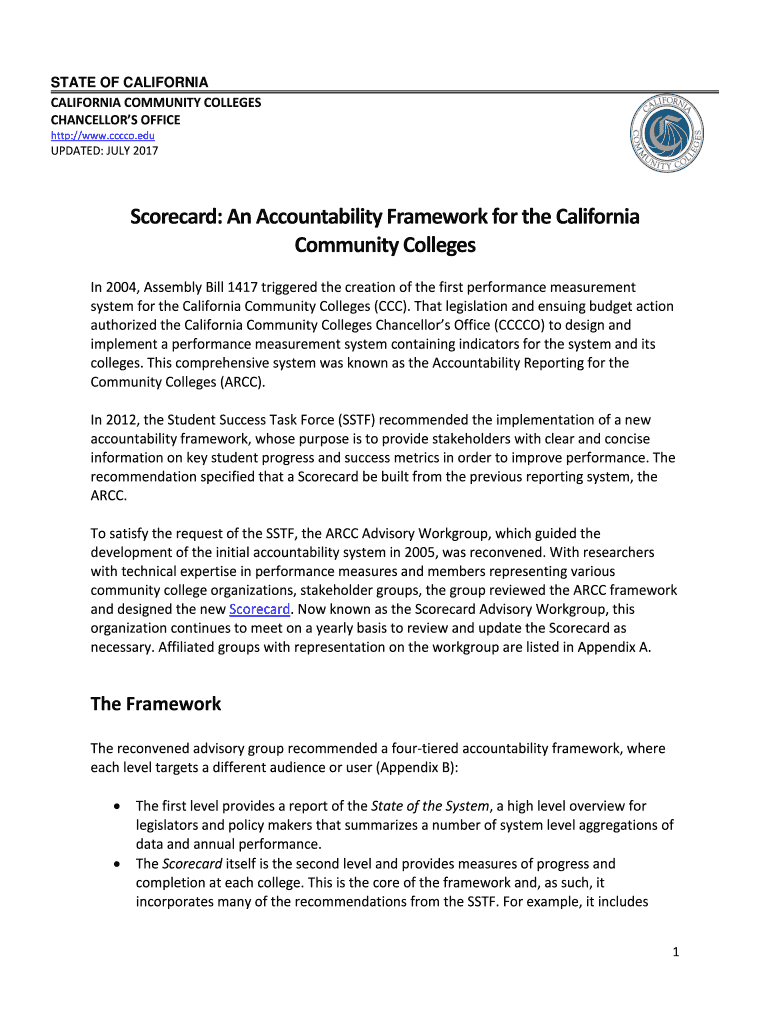







Definition and Meaning of the Scorecard: An Accountability Framework for the California
The Scorecard: An Accountability Framework for the California Community Colleges is a comprehensive system designed to measure and report on student progress and success. Developed in response to Assembly Bill 1417 in 2004 and revised in 2012 following input from the Student Success Task Force, it serves as an essential tool for enhancing transparency and accountability across the state's community colleges. The Scorecard uses a four-tiered performance indicator system, providing a robust framework to assess how well colleges are performing in various key areas critical to educational success.
How to Use the Scorecard for Maximum Impact
Using the Scorecard effectively involves engaging with its multiple components, such as the State of the System report, detailed college metrics, and dynamic online tools like Datamart. Educators and policymakers can utilize the State of the System report to gain a high-level understanding of statewide progress, while college administrators can dive deeper into individual metrics to identify specific strengths and areas for improvement. The Datamart feature allows users to perform detailed analyses by querying specific datasets, thereby supporting data-driven decision-making at the college level.
Steps to Complete the Scorecard Analysis
-
Access the Scorecard Data: Begin by accessing the relevant Scorecard through your institution's data portal or through state education websites.
-
Review the State of the System Report: Obtain a broad understanding of statewide educational trends and benchmarks.
-
Analyze College-Level Metrics: Examine specific data points that relate to your institution to assess areas such as course completion rates and degrees awarded.
-
Utilize the Datamart Tool: Perform custom queries to gain insights into specific aspects of student performance and institutional efficiency.
-
Implement Changes: Use the findings to make informed decisions about improving educational strategies, allocating resources effectively, and setting performance goals.
Key Elements of the Scorecard
The Scorecard consists of several critical elements tailored to evaluate aspects vital to student success:
- Performance Indicators: These include metrics such as graduation rates, transfer rates to four-year institutions, and basic skills improvement.
- State of the System Report: Offers a comprehensive overview of the educational landscape for community colleges statewide.
- College-Level Data: Provides granular insights into the performance of individual colleges, giving administrators the data needed to drive institutional change.
State-Specific Rules for the Scorecard
In California, the Scorecard must align with state educational policies and regulations. Each community college is responsible for accurately reporting data, adhering to both state and federal education directives. Compliance ensures the credibility of data and supports the wider goal of enhancing educational quality and access.
Who Typically Uses the Scorecard
The Scorecard is most commonly utilized by:
- College Administrators: For internal analyses and strategic planning.
- State Policymakers: To guide decisions on educational policy and funding allocations.
- Academic Researchers: To study trends in education performance and policy effectiveness.
- Students and Parents: To evaluate college performance and make informed choices about educational pathways.


Examples of Using the Scorecard Effectively
One example involves a community college using the Scorecard to identify low completion rates in basic skills courses. By leveraging this data, the college developed targeted interventions, such as tutoring programs and enhanced instructional materials, significantly increasing completion rates over time.
Another scenario features policymakers using state-wide Scorecard data to allocate additional resources to colleges with lower transfer rates, thus supporting efforts to improve student outcomes in underperforming regions.
Legal Use and Compliance
Adhering to the legal and compliance standards associated with the Scorecard involves accurate data reporting and privacy protection. The framework must comply with laws governing educational data, such as the Family Educational Rights and Privacy Act (FERPA), ensuring that student information is securely handled and shared only when necessary for educational purposes.
This comprehensive coverage of the "Scorecard: An Accountability Framework for the California" provides a detailed understanding of its significance, usage, and impact on educational accountability.




