






Definition and Meaning of Special Terms and Conditions
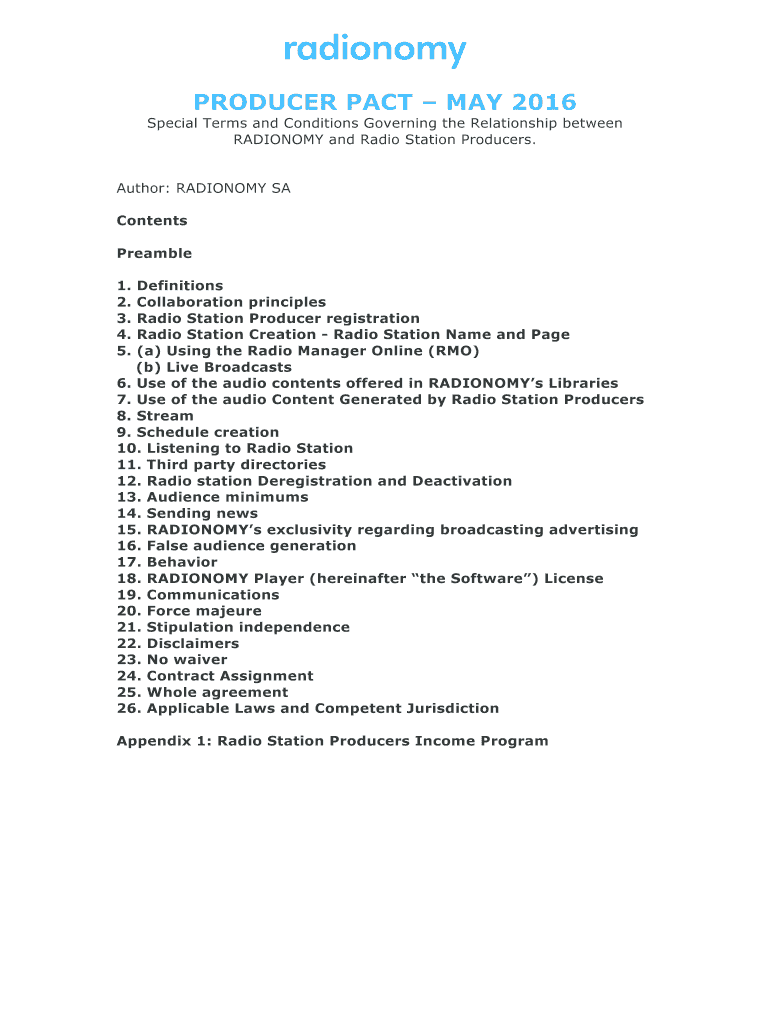
Special terms and conditions governing the relationship between various entities, like those outlined in the "Producer Pact May 2016," refer to custom agreements that establish specific obligations, rights, and operational procedures among the parties involved. These agreements are crafted to address unique circumstances that are not covered by general contracts or standard terms. By defining detailed parameters for collaboration, the special terms help ensure clarity and reduce misunderstandings in professional relationships.
Key Functions
- Customization: Tailors agreements to suit the nature of the business relationship.
- Clarity: Provides a clear framework for operations, roles, and responsibilities.
- Risk Mitigation: Identifies and addresses potential risks and disputes in advance.
Practical Example
A radio station and its producers may have specific collaborative methods that require items like content delivery timelines and intellectual property rights to be explicitly laid out. Special terms would detail these elements meticulously to avoid future conflicts.
How to Use Special Terms
Using special terms involves understanding both the specific needs of the relationship and the broader legal environment. The conditions should reflect the objectives and expectations of the parties involved while being enforceable under applicable laws.
Steps for Effective Use
- Identify Needs: Establish what aspects of the relationship require special conditions.
- Consult Legal Experts: Work with legal professionals to draft clear, enforceable terms.
- Review Regularly: Periodically revisit the agreement to ensure it adapts to any changes in circumstances.
- Communicate Clearly: Ensure all parties understand the terms before finalizing.
Real-World Scenarios
Consider a scenario where a tech company collaborates with a freelance developer. The special terms might include code ownership rights, development milestones, and payment schedules specific to the project.
Steps to Complete the Form
Completing the special terms and conditions form involves a systematic approach to ensure all necessary information is accurately captured and agreed upon by all parties involved.
Step-by-Step Instructions
- Gather Information: Collect details regarding the parties, scope, and purpose of the agreement.
- Draft Initial Terms: Outline the preliminary conditions covering roles, responsibilities, and expectations.
- Negotiate Clauses: Discuss and agree upon key terms, adjusting where necessary to meet mutual objectives.
- Review and Revise: Legal counsel should review the drafted terms for compliance and enforceability.
- Finalize Agreement: Obtain signatures from all parties to signify consent and formalize the conditions.
Example Breakdown
In a publishing contract, terms might include rights to royalties, deadlines for manuscript delivery, and obligations for promotion. Ensuring each party understands and agrees to these terms is crucial.
Key Elements of Special Terms
Understanding the critical components of special terms helps in drafting comprehensive and binding agreements that meet all parties' requirements.
Essential Elements
- Definitions: Clearly define terms to eliminate ambiguity.
- Obligations: Outline duties and responsibilities for each party.
- Compensation: Specify financial arrangements such as payment terms and conditions.
- Termination Clause: Detail conditions under which the agreement may be ended.
Case Study
A manufacturing company and its supplier might include terms on lead time expectations and quality assurance to maintain uninterrupted supply and ensure product quality, respectively.
Legal Use and Compliance
Compliance with legal standards is non-negotiable in the enforcement of special terms. Understanding jurisdiction-specific laws and regulations ensures that terms are legally binding.
Key Compliance Guidelines
- Adhere to Local Laws: Each party should ensure that the agreement complies with the relevant laws of their jurisdiction.
- Documentation: Maintain comprehensive records of the agreement process.
- Dispute Resolution: Establish clear mechanisms for addressing and resolving disputes legally.
Example
A software company might include a dispute resolution term that specifies arbitration in a specific region, in line with local legal standards and practices.
Who Typically Uses These Terms
Special terms are typically employed by businesses and professionals who have unique or complex transaction needs that standard agreements do not address sufficiently.


Common Users
- Businesses and Corporations: For complex commercial relationships involving substantial transactions.
- Freelancers and Contractors: To cover specifics not found in standard employment contracts.
- Partnerships: Between entities in joint ventures needing carefully delineated operational terms.

Industry-Specific Usage
In the entertainment industry, production companies often create special terms with actors and directors to address exclusive rights and performance expectations.
State-Specific Rules for Agreements
Recognizing state-specific variations in governance and contractual obligations is essential for ensuring that the agreement is valid across state lines.
Considerations for Drafting State-Specific Terms
- State Regulations: Laws may differ significantly from one state to another affecting enforceability.
- Tax Implications: Some states have different tax requirements affecting payment terms.
- Labor Laws: Varying labor regulations may necessitate specific employee or contractor terms.
Example
In a state like California with stringent labor laws, special terms may include clauses for worker classification to comply with local labor regulations.
Examples of Using Special Terms
Real-world examples illustrate the diverse applications and benefits of special terms in governing relationships.
Common Applications
- Licensing Agreements: Special terms can cover how intellectual property is used and shared.
- Joint Ventures: Define how profits and responsibilities are shared among partners.
- Consulting Agreements: Detail project-specific goals and consultant obligations.
Scenario Illustration
A retail company entering a joint marketing effort with another business might specify the division of creative responsibilities and profit-sharing through special terms.
Important Terms Related to Special Terms
Understanding relevant terminology is essential for developing comprehensive and effective special terms.
Core Terms
- Force Majeure: Circumstances beyond control that may void contractual obligations.
- Indemnity: Protecting one party against losses due to the actions of another.
- Confidentiality: Ensuring sensitive information shared during the agreement is kept private.
Examples and Importance
Confidentiality clauses can be crucial in technology contracts where trade secrets or proprietary information are shared among partners.
By following these detailed strategies and insights, you can effectively craft and utilize special terms and conditions governing the relationship between diverse parties, thereby ensuring well-defined, legally sound agreements.