






Definition & Meaning
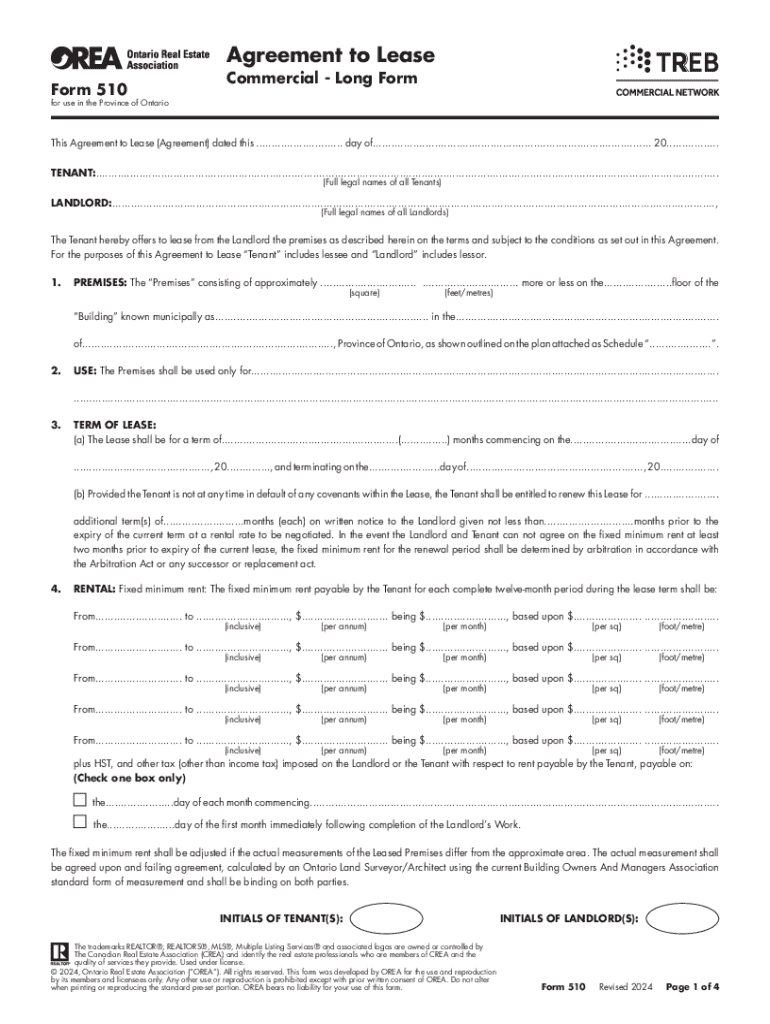
The OREA Form 510: Agreement to Lease Commercial Blank is a legal document used in Ontario to outline the terms of leasing a commercial property. This agreement is critical for establishing the relationship between a landlord and a tenant, clearly defining roles, responsibilities, and expectations. It includes detailed provisions regarding the rental terms, payment responsibilities, and the duration of the lease. By setting clear contractual terms, the form helps prevent potential disputes and misunderstandings between parties, reinforcing a professional and structured approach to commercial leasing.
Who Typically Uses the OREA Form 510
This form is primarily used by landlords, tenants, and real estate professionals involved in the leasing of commercial properties in Ontario. Also, you may find property managers and legal advisors using this document to ensure that lease terms are in compliance with provincial laws. Real estate agents often facilitate the completion of this form to provide clarity and transparency to all contractual parties.


Key Elements of the OREA Form 510
The agreement is comprehensive, including several critical components:
- Premises Description: Identifies the details of the rental property, including physical address and specifics about the space being leased, such as square footage.
- Lease Term: Outlines the duration of the lease, including start and end dates, renewal options, and any provisions for early termination.
- Rent and Deposit: Specifies the rental amount, due dates, the security deposit required, and any other applicable financial obligations.
- Maintenance and Utilities: Clarifies responsibilities for property maintenance and utility payments, providing accountability for both landlord and tenant.
- Alterations and Approvals: Includes stipulations regarding any alterations a tenant may want to make, often requiring landlord approval.
- Insurance Requirements: Details the insurance coverage needed to protect both the landlord’s and tenant’s interests.
- Renewal and Assignment Conditions: Describes the conditions under which a lease can be renewed or reassigned to another tenant.
How to Obtain the OREA Form 510
Accessing the OREA Form 510 typically involves a few straightforward steps. Real estate professionals, particularly those affiliated with the Ontario Real Estate Association (OREA), can directly access this form through their association. For tenants and landlords not directly part of a professional network, the form might be available through real estate offices or can be requested from a professional handling the lease.
Steps to Complete the OREA Form 510
- Acquire the Form: Obtain the latest version of the OREA Form 510, ensuring compliance with current provincial regulations.
- Fill in the Parties’ Information: Enter the full names, addresses, and contact details of both the landlord and the tenant.
- Describe the Premises: Precisely detail the property being leased, identifying its location, size, and any specific features.
- Lease Duration: Define clear start and end dates, including any options for renewal or extensions.
- Financial Terms: Outline rental amounts, payment terms, and required deposits, ensuring all financial responsibilities are specified.
- Detail Responsibilities: Specify which party is responsible for maintenance, repairs, and utilities.
- Sign and Date: Both parties should thoroughly review, sign, and date the document to enact the agreement legally.
Legal Use of the OREA Form 510
The OREA Form 510 serves as a legally binding contract once signed by both parties. It is subject to Ontario real estate and commerce laws, making it essential that all provisions are consistent with provincial statutes. Legal advisors often review these agreements to ensure compliance and fairness, providing advice to either party as necessary. Misuse or incorrect completion of the form could lead to legal disputes or void the agreement.
Important Terms Related to OREA Form 510
- Leasehold Improvements: Refers to modifications or improvements made by the tenant to the leased space, which are typically the tenant's responsibility unless otherwise agreed.
- Force Majeure: A clause that frees both parties from liabilities or obligations when an extraordinary event or circumstance beyond their control prevents them from fulfilling contractual duties.
- Subletting Provisions: Conditions under which a tenant may be allowed to sublease the rented property to another party.
Examples of Using the OREA Form 510
For example, a new start-up renting its first office space might use the OREA Form 510 to ensure that all aspects of rent, maintenance, and building use are well-documented before moving in. Similarly, a larger corporation expanding its operations might use this form when leasing additional commercial premises, tailoring specific terms to fit their operational needs.
Versions or Alternatives to the OREA Form 510
While OREA Form 510 is widely recognized for commercial leases in Ontario, alternative formats may exist, typically used by specific real estate firms or legal advisors. These alternatives may feature customized clauses to address unique leasing scenarios. Despite the availability of alternatives, OREA Form 510 remains a standard due to its comprehensive and standardized nature, making legal and procedural adherence straightforward.