TEXAS NOTARY ACKNOWLEDGMENT 2026

Get Form
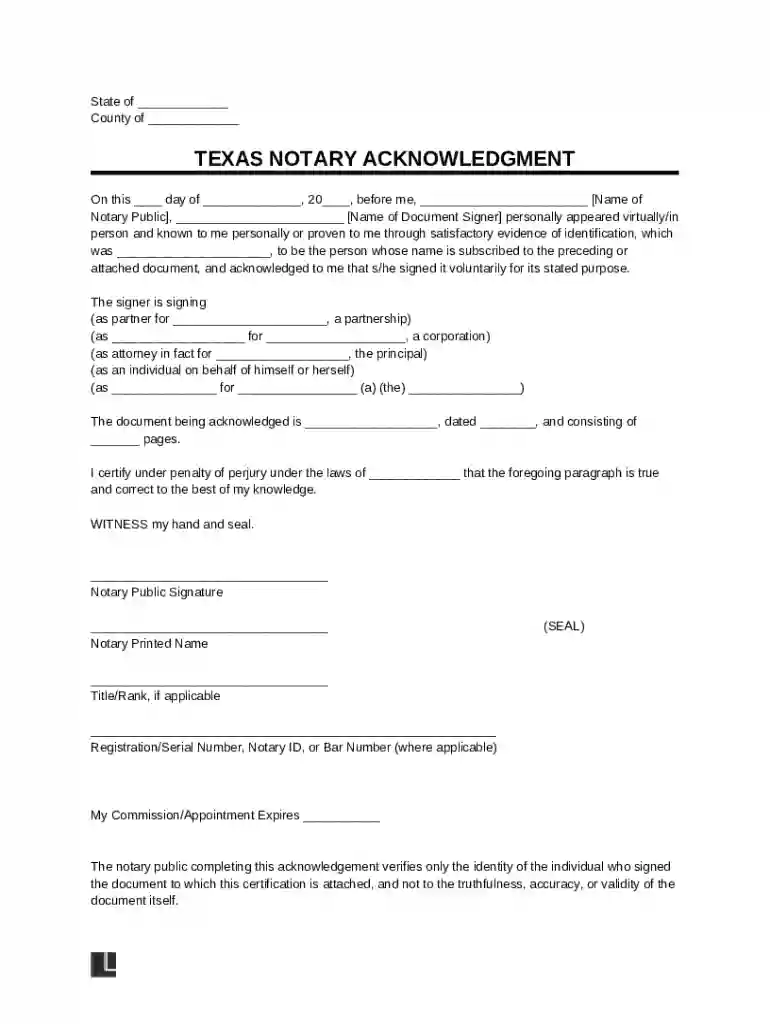
TEXAS NOTARY ACKNOWLEDGMENT Preview on Page 1

Here's how it works

01. Edit your form online
Type text, add images, blackout confidential details, add comments, highlights and more.

02. Sign it in a few clicks
Draw your signature, type it, upload its image, or use your mobile device as a signature pad.

03. Share your form with others
Send it via email, link, or fax. You can also download it, export it or print it out.

Definition & Meaning

A Texas Notary Acknowledgment is a legal form used to confirm that a notary public has verified the identity of a signer who voluntarily acknowledges signing a document. This process ensures the authenticity of the signature and involves recording specific details such as the date, the names of the parties involved, and the type of signing—whether for an individual, partnership, corporation, or other entity types. In this context, the notary public’s role is strictly to verify identities and not to validate the document's content.

How to Use the Texas Notary Acknowledgment

Utilizing the Texas Notary Acknowledgment involves a clear process to ensure legal compliance. Typically used for documents requiring notarization, this form functions as a safeguard for authenticity and intent. Here are the common steps to use it effectively:

  1. Prepare the Document: Ensure the document requiring notarization is complete, leaving space for notary acknowledgment.
  2. Verify Identity: Present an official identification such as a driver’s license or passport to the notary public before signing the document.
  3. Sign in Presence: The individual must sign the document in the presence of the notary, confirming their identity and intention to sign.
  4. Notary's Role: The notary fills out the acknowledgment section, which includes their signature, date, and notarial seal.

Obtaining the Texas Notary Acknowledgment

Acquiring a Texas Notary Acknowledgment is straightforward. The form itself is typically part of a document that requires notarization. Here are ways to obtain it:

  • Visit a Notary Public: Find a licensed notary public. Often found at banks, law offices, or dedicated notary services.
  • Online Platforms: Utilize online notarization services that allow remote notarization and acknowledgment through video conferencing.

No matter the method, ensure that the notary is certified and active under Texas law to perform the acknowledgment.

Steps to Complete the Texas Notary Acknowledgment

Completing the Texas Notary Acknowledgment requires precision and adherence to legal requirements:

  1. Prepare Required Information:
    • Gather all necessary information, such as the signer's full name and date of the document.
  2. Notary Verification:
    • Present legally valid identification to the notary.
  3. In-Person Signing:
    • Execute the document in front of the notary.
  4. Notarial Entry:
    • The notary completes the acknowledgment section, affixing their seal, signature, and relevant notary details.
  5. Record Keeping:
    • The notary may record the transaction in their notary logbook as required by Texas state law.

Importance of the Texas Notary Acknowledgment

The Texas Notary Acknowledgment is crucial for legal assurances and document validation. It guarantees:

  • Identity Verification: Provides a verified means of confirming the signer's identity.
  • Voluntary Consent: Ensures the document was signed willingly and under no duress.
  • Legal Binding: Offers legally binding acknowledgment, often required for real estate, legal agreements, or official filings.

Key Elements of the Texas Notary Acknowledgment

Understanding the components of the Texas Notary Acknowledgment is vital. These include:

  • Name of Signer: The individual whose signature is being acknowledged.
  • Document Title: Identifying the document or agreement being notarized.
  • Date of Acknowledgment: The day the acknowledgment is formally confirmed.
  • Notary Seal and Signature: A legally-required validation of the notarial act.

Each element serves a specific purpose in ensuring the document's validity.

State-Specific Rules for the Texas Notary Acknowledgment

Texas state laws govern notarial acts, requiring adherence to specific rules during acknowledgment:

  • Identification Requirements: Valid government-issued ID must be presented.
  • Notary Restrictions: A notary may not notarize documents where they have a direct interest.
  • Record Maintenance: Notaries need to maintain a journal of all notarial acts, capturing essential details.

Examples of Using the Texas Notary Acknowledgment

Practical examples where the Texas Notary Acknowledgment is commonly used include:

  • Real Estate Transactions: Deeds, property transfers, and mortgage documents often require notarization.
  • Legal Affidavits: Legal affidavits require acknowledgment to attest to the truthfulness of statements.
  • Corporate Filings: Ensuring legitimacy of authorization documents, such as for mergers or acquisitions.

The acknowledgment serves as a critical step in formalizing and legally recognizing these transactions.

be ready to get more

Complete this form in 5 minutes or less

Get form

Security and compliance

At DocHub, your data security is our priority. We follow HIPAA, SOC2, GDPR, and other standards, so you can work on your documents with confidence.

Learn more
ccpa2
pci-dss
gdpr-compliance
hipaa
soc-compliance
be ready to get more

Complete this form in 5 minutes or less

Get form