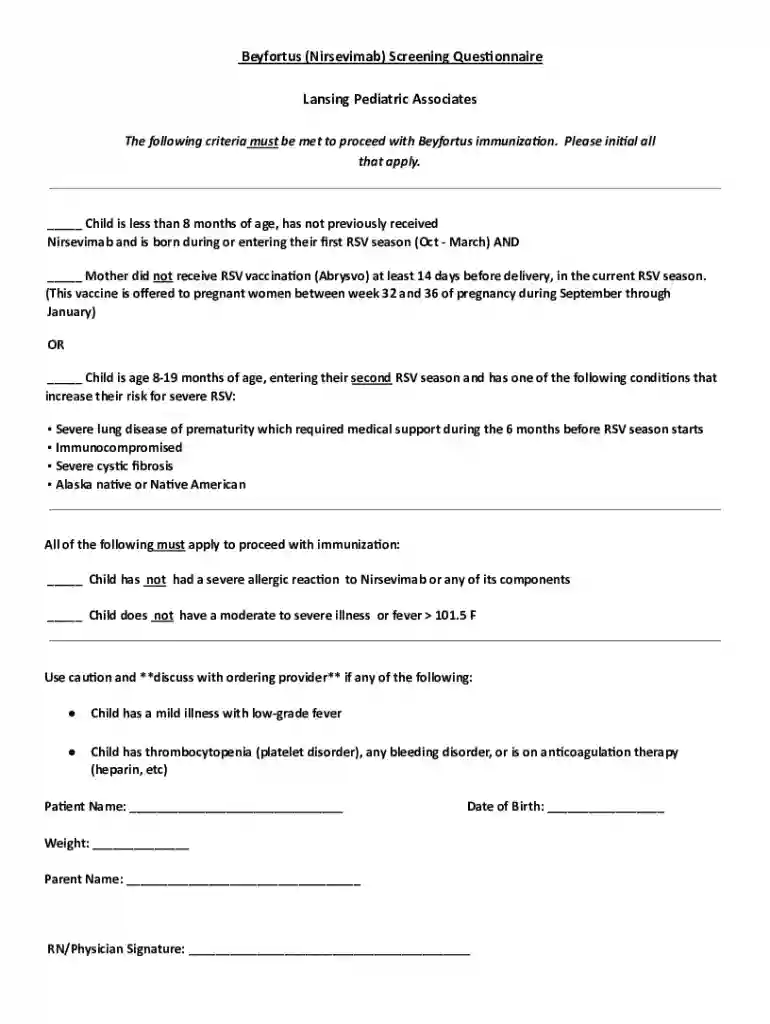
Beyfortus Screening Questionnaire 2026

Get Form
Beyfortus Screening Questionnaire Preview on Page 1

Here's how it works

01. Edit your form online
Type text, add images, blackout confidential details, add comments, highlights and more.

02. Sign it in a few clicks
Draw your signature, type it, upload its image, or use your mobile device as a signature pad.

03. Share your form with others
Send it via email, link, or fax. You can also download it, export it or print it out.

Definition and Meaning of the Beyfortus Screening Questionnaire

The Beyfortus Screening Questionnaire is an essential tool developed to assess patient eligibility for the Beyfortus (Nirsevimab) immunization. This form plays a critical role in determining whether a child qualifies for the vaccine, which is designed to protect against respiratory syncytial virus (RSV). By identifying specific factors such as age, previous vaccination history, and health conditions, the form helps medical professionals make informed decisions regarding vaccine administration. Understanding the criteria listed in the questionnaire is vital for ensuring that only eligible patients receive the immunization, thereby maximizing its effectiveness and safety.

Who Typically Uses the Beyfortus Screening Questionnaire

The primary users of the Beyfortus Screening Questionnaire are healthcare providers, specifically pediatricians and family doctors who administer vaccines. These professionals rely on the form to evaluate the suitability of Beyfortus for each patient. In addition to practitioners, administrative medical staff may also use the questionnaire to gather necessary information before a child's visit. Furthermore, parents and guardians of children eligible for the RSV immunization often engage with the questionnaire as part of the preparatory documentation prior to their healthcare appointments. This collaborative approach ensures that all relevant parties are informed and prepared for the vaccination process.


decoration image ratings of Dochub

Key Elements of the Beyfortus Screening Questionnaire

The Beyfortus Screening Questionnaire comprises several integral elements designed to capture comprehensive details about a patient's health status. Key components include:

  • Patient Information: Captures basic details such as name, date of birth, and contact information.
  • Medical History: Enquires about previous vaccinations, allergies, and ongoing medical conditions.
  • Current Health Status: Assesses the child’s current health, including recent illnesses or symptoms.
  • Age Verification: Ensures the child falls within the age range specified for the Beyfortus vaccine.
  • Exclusion Criteria: Identifies contraindications or circumstances under which the vaccine should not be administered.

Each section is crafted to collate important data that aids healthcare providers in making accurate vaccination decisions.

Steps to Complete the Beyfortus Screening Questionnaire

Completing the Beyfortus Screening Questionnaire involves a straightforward process, usually guided by a healthcare provider:

  1. Collect Initial Information: Gather the child's personal details and any relevant medical information.
  2. Review Medical History: Discuss previous vaccinations and any known allergies or chronic conditions.
  3. Assess Current Health: Note any recent illnesses or health changes.
  4. Verify Eligibility: Check that the child falls within the specified age range and meets other criteria.
  5. Confirm Exclusion Factors: Ensure no contraindications are present that would hinder safe vaccine administration.

Following these steps rigorously ensures thorough and consistent completion of the form.

Eligibility Criteria for the Beyfortus Screening Questionnaire

The eligibility criteria outlined in the Beyfortus Screening Questionnaire are critical to ensure that the immunization is administered safely and effectively. Criteria include:

  • Age Requirement: Specific age limits that determine vaccine suitability.
  • Health Status: Criteria regarding the absence of acute infections or severe allergies at the time of vaccination.
  • Medical Conditions: Consideration of pre-existing conditions that might contraindicate vaccine use.
  • Vaccination History: Review of prior RSV vaccinations to avoid unnecessary duplication.

Understanding and adhering to these criteria are essential to maximize vaccine efficacy and patient safety.

decoration image

How to Use the Beyfortus Screening Questionnaire

Healthcare providers can implement the Beyfortus Screening Questionnaire to guide decision-making and ensure safety in vaccine delivery. The form is typically used as follows:

  • Pre-appointment Review: Completed by parents or guardians, providing essential background information.
  • Provider Consultation: Discussed during the appointment to address any concerns or inconsistencies.
  • Final Assessment: Used by the healthcare provider to verify patient eligibility before administering the vaccine.

The questionnaire serves as both an informational and decision-making tool within the clinical process.

Important Terms Related to Beyfortus Screening Questionnaire

Understanding specific terms used within the Beyfortus Screening Questionnaire can enhance comprehension and accuracy:

  • Nirsevimab: The active ingredient in Beyfortus, targeting RSV.
  • RSV (Respiratory Syncytial Virus): A common respiratory virus that the vaccine aims to protect against.
  • Contraindications: Medical conditions or factors that increase the risk of adverse reactions if the vaccine is given.
  • Immunization Schedule: The timeline for administering vaccinations, including Beyfortus.

Recognizing these terms allows for a clear interpretation of the questionnaire requirements and outcomes.

Legal Use of the Beyfortus Screening Questionnaire

The Beyfortus Screening Questionnaire aligns with legal frameworks governing vaccine administration in the United States. It ensures compliance with healthcare regulations by:

  • Documenting Informed Consent: Collecting consent from parents or guardians before administering the vaccine.
  • Ensuring Privacy: Safeguarding patient information consistent with HIPAA regulations, ensuring that data confidentiality is maintained.
  • Medical Record Keeping: Serving as an official record that can be consulted for future reference or in the case of legal inquiries.

Proper understanding and application of this legal context are crucial for healthcare providers and institutions using the questionnaire.

be ready to get more

Complete this form in 5 minutes or less

Get form

Got questions?

We have answers to the most popular questions from our customers. If you can't find an answer to your question, please contact us.
Contact us
The RSV vaccine helps protect against infection with RSV, a common virus that can make babies and older adults seriously ill. Its offered on the NHS if youre pregnant, aged 75 to 79, or turned 80 after 1 September 2024.
CDC recommends an RSV vaccine for all adults ages 75 years and older and for adults ages 5074 years who are at increased risk of severe RSV. Risk factors that increase your risk for severe illness include: Chronic heart or lung disease. Weakened immune system.
Does Beyfortus cause long-term side effects? Its not likely. No long-term side effects have been reported in clinical trials of the drug. If you have concerns about long-term side effects from Beyfortus, talk with your childs doctor.
The CDC recommends that all adults ages 75 and older and those ages 60 to 74 who have risk factors for severe RSV disease, such as chronic heart or lung disease, a weakened immune system, other medical conditions such as diabetes, and/or live in a nursing home, get one of the three RSV vaccines.
Get the vaccine If you are age 70 years or older (or an Indigenous person age 60 years or older) and do not live in a continuing care or supportive living facility, you can book an appointment for RSV vaccine free of charge: Book online at a community pharmacy through the Alberta Vaccine Booking System.

Security and compliance

At DocHub, your data security is our priority. We follow HIPAA, SOC2, GDPR, and other standards, so you can work on your documents with confidence.

Learn more
ccpa2
pci-dss
gdpr-compliance
hipaa
soc-compliance

People also ask

For infants born April through September, and for young children who are at increased risk for severe RSV disease and entering their second RSV season, the best time to give nirsevimab is shortly before the RSV season begins. In most of the continental US, that season is October through November.

Related links