
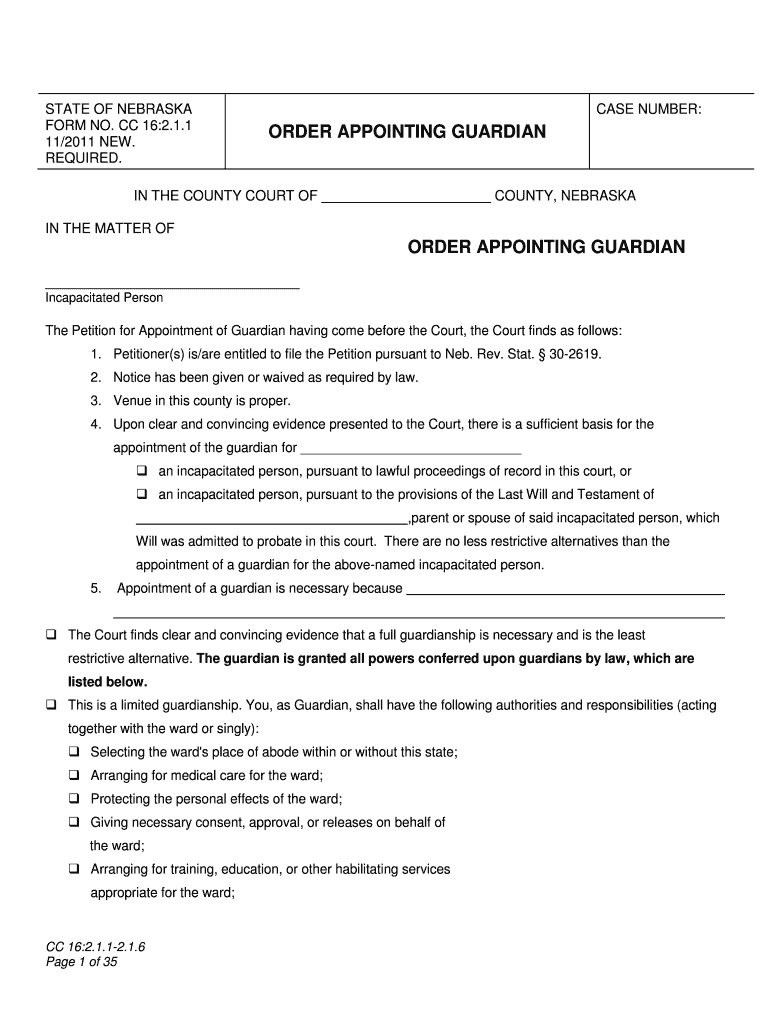







Definition and Meaning of CC 16:2 1 1
The CC 16:2 1 1 is a legal form used in Nebraska for appointing guardians or conservators for both incapacitated persons and minors. This form is essential in complying with the legal requirements of the state to ensure proper care and management of the individual's personal and financial responsibilities. It establishes the legal framework for identifying who is fit to handle these duties and outlines the necessary steps to achieve lawful guardianship or conservatorship.
Detailed Purpose
- Establishes Legal Guardianship: This form is crucial in determining who will legally manage the personal, medical, and financial decisions for individuals unable to do so themselves.
- Specifies Responsibilities: It outlines the specific duties of the guardian or conservator, such as managing finances, property, and personal care.
- Ensures Compliance: The form requires adherence to Nebraska laws, ensuring the appointed guardian or conservator meets legal standards.
Steps to Complete the CC 16:2 1 1
Filling out the CC 16:2 1 1 form involves several detailed steps to ensure all legal requirements are met. Each section of the form must be completed with precision to avoid delays or rejections.
- Personal Information: Provide detailed information about both the petitioner and the person needing guardianship. This includes full names, addresses, and relationships.
- Reason for Guardianship: Clearly specify the reasons why the individual cannot manage their affairs, supported by medical or psychological evaluations when necessary.
- Proposed Guardian Details: Include information about the proposed guardian, including their qualifications, willingness to serve, and their relationship to the individual.
Key Components
- Capability Assessment: Detailed assessment of the individual's inability to manage their affairs due to incapacity.
- Consent: Documenting consent from involved parties, where possible, is necessary.
- Financial Responsibility Statement: Outline financial stewardship plans, if applicable.
Legal Use of the CC 16:2 1 1
The legal use of the CC 16:2 1 1 form mandates compliance with Nebraska's guardianship and conservatorship laws. Understanding these legalities ensures the form supports the ethical and responsible appointment of guardians.
Key Legal Boundaries
- Statutory Requirements: Adherence to the statutes outlined by Nebraska law for appointing guardians or conservators.
- Court Validation: The form must be validated and approved by a court, making the appointment legal and enforceable.
- Ethical Responsibility: The guardian must prioritize the health, safety, and financial security of the individual.
State-Specific Rules
Nebraska sets specific regulations regarding guardianship and conservatorship, adding nuanced steps to the completion process of the CC 16:2 1 1 form.
- Residency Requirements: The petitioner typically needs to be a resident or demonstrate a significant connection to Nebraska.
- Legal Compliance: Precise adherence to state rules regarding capacity and related decision-making authorities.
- Court Hearings: Often required for final approval, a hearing provides a platform to contest appointments or suggest alternatives.
Important Terms Related to CC 16:2 1 1
Familiarity with terminology associated with CC 16:2 1 1 is essential for correctly filling out the form. Understanding these terms helps clarify roles and responsibilities.
Glossary
- Petitioner: The individual who files the form to request guardianship or conservatorship.
- Ward: The person for whom guardianship is requested.
- Guardian/Conservator: An individual appointed by the court to manage affairs for someone incapacitated.
Key Elements of the CC 16:2 1 1
Every section of the CC 16:2 1 1 has vital elements that need attention to ensure legality and accuracy.
- Identifying Information: Accurate representation of personal and contact details of all parties.
- Authority Scope: Clear boundaries of the guardian or conservator's decision-making power.
- Financial Details: Comprehensive inclusion of the ward's financial assets and liabilities if relevant.
Penalties for Non-Compliance
Adhering to the regulations surrounding the CC 16:2 1 1 is integral to the guardianship or conservatorship's legality. Failing in compliance can have serious legal consequences.
Possible Consequences
- Legal Penalties: Non-compliance might result in fines or nullified guardianship appointments.
- Loss of Rights: The appointed guardian might lose the right to manage the individual's affairs.
- Court Actions: Repeated non-compliance might lead to judicial interventions or alternate appointments.
Examples of Using the CC 16:2 1 1
Using real-world scenarios helps in understanding the practical application of the CC 16:2 1 1.
Case Scenarios
- Elderly Care: Assigning a close family member as a guardian to an elderly relative with advanced dementia.
- Minor Guardianship: Assigning guardianship to a relative for a minor child whose parents are deceased or unable to care for them.
These comprehensive sections aim to provide a nuanced understanding of the CC 16:2 1 1, catering to all legal and practical facets of its use.




