




01. Edit your form online
Type text, add images, blackout confidential details, add comments, highlights and more.

Type text, add images, blackout confidential details, add comments, highlights and more.

Draw your signature, type it, upload its image, or use your mobile device as a signature pad.

Send it via email, link, or fax. You can also download it, export it or print it out.
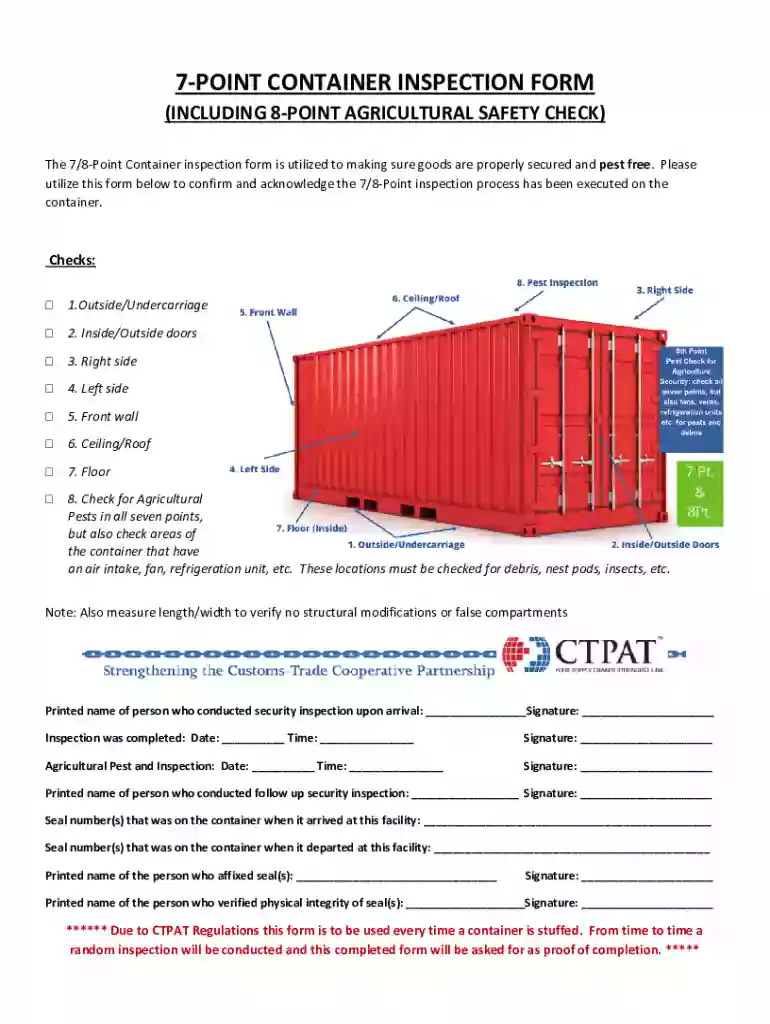
The 7-Point Container Inspection Checklist is an essential tool designed to ensure the security and cleanliness of goods transported in ocean containers. This checklist is a comprehensive guide for conducting thorough inspections on containers, focusing on crucial areas such as the container's exterior, doors, and interior surfaces. Its primary aim is to detect agricultural pests and other potential risks before the containers are loaded for transport, thereby maintaining compliance with Customs-Trade Partnership Against Terrorism (CTPAT) regulations.
Using the 7-Point Container Inspection Checklist involves following a systematic process to examine each designated point on the container. Inspectors must:
This checklist is primarily used by logistics managers, shipping coordinators, and quality assurance personnel within the supply chain industry. It is especially critical for companies engaged in international shipping, where compliance with CTPAT and other regulatory bodies is required. Inspectors trained in cargo security protocols are often tasked with conducting these inspections to ensure global shipping standards are met.


The checklist adheres to the legal requirements set forth by CTPAT, a U.S. Customs and Border Protection (CBP) initiative. It is mandatory in many shipping contexts to ensure security against tampering and contamination. Failure to adhere to these legal standards can result in penalties, shipment delays, or revocation of shipping privileges.
Case Study in Agricultural Shipping: A company exporting agricultural products regularly uses the checklist to ensure pest-free conditions, reducing the risk of quarantine issues at the destination port.
Manufactured Goods Shipment: Inspections using this checklist have prevented spoilage and loss by identifying temperature control failures within refrigerated containers.
Retail Supply Chain: Large retail conglomerates implement the checklist as a part of their routine quality assurance processes, mitigating security risks and enhancing efficiency.
While the checklist can be used manually, it is also compatible with digital logistics software, such as TurboTax or QuickBooks, which can integrate inspection data into broader supply chain management systems. This compatibility improves efficiency by reducing manual entry errors and providing real-time data sharing across platforms.
At DocHub, your data security is our priority. We follow HIPAA, SOC2, GDPR, and other standards, so you can work on your documents with confidence.


Printed name of person who conducted security inspection upon arrival: Signature: Inspection was completed: Date: Time: Printed name of person who conducted
Each container should be checked using the 7-point inspection process listed below upon arrival and prior to stuffing.
This chapter gives an overview about the troubleshooting and diagnostic features and the different user interfaces. 7 Hardware Information. This chapter


