






Definition and Purpose of the Complete Zip Code Demographics Packet - Spanish Fork
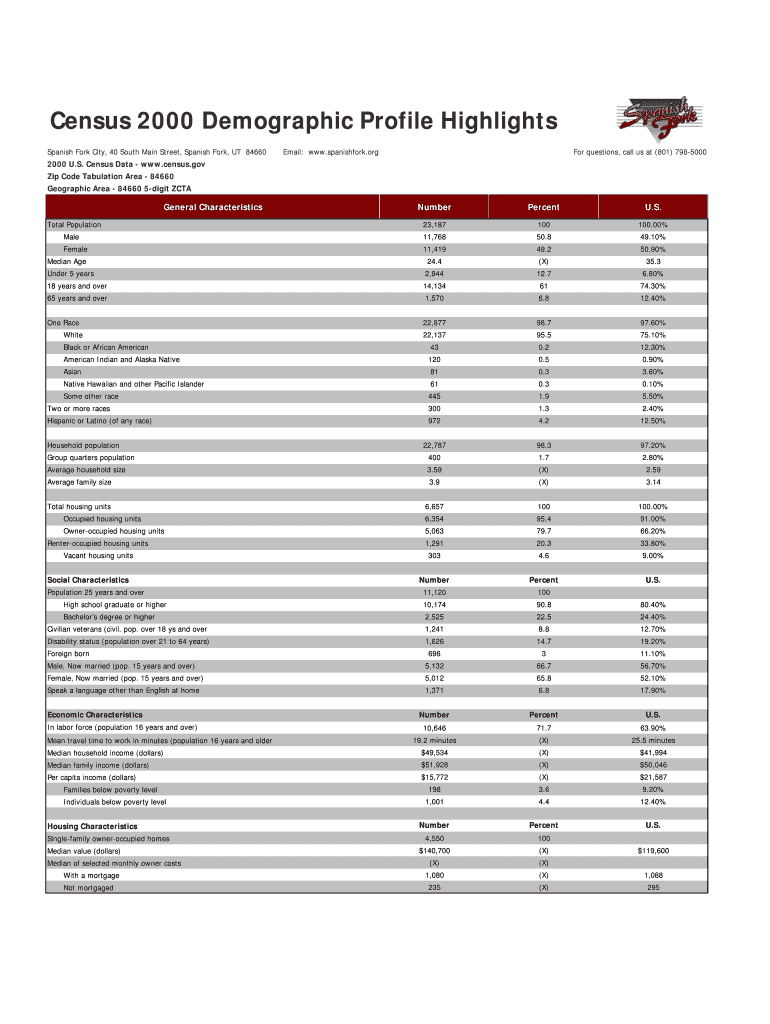
The Complete Zip Code Demographics Packet for Spanish Fork provides a comprehensive insight into the demographic characteristics of Spanish Fork City, utilizing data from the 2000 U.S. Census. This packet includes detailed information on various aspects such as population gender, age distribution, and racial composition. It also covers household and family structures, educational attainment, employment status, income levels, and housing characteristics. The purpose of this packet is to offer a detailed demographic profile that helps businesses, researchers, and local authorities understand the community better. By analyzing these characteristics, stakeholders can make informed decisions regarding resource allocation, community planning, and development initiatives.
How to Use the Demographics Packet Effectively
Using the Complete Zip Code Demographics Packet efficiently involves understanding the data provided and applying it to your specific needs. Users can start by identifying key sections relevant to their research or business objectives:
- Compare age distribution data to tailor services and products for different age groups.
- Analyze educational attainment levels to develop targeted educational programs or employment opportunities.
- Review household income levels to assess market potential and consumer purchasing power in Spanish Fork.
These insights can guide strategic decisions, from marketing campaigns to public policy planning, ensuring that initiatives are well-aligned with the community's needs.
Steps to Obtain the Complete Zip Code Demographics Packet - Spanish Fork
Acquiring the Complete Zip Code Demographics Packet for Spanish Fork is a straightforward process, typically involving:
- Visit the appropriate local government or municipal website: Local authorities or census bureaus often provide access to such demographic reports online.
- Request through email or phone: Contacting the local city office or statistical department may allow you to request the packet via email or mail.
- Access through libraries or research institutions: Some libraries or educational institutions may have archived demographic packets available for public use.
- Check online repositories: Platforms specializing in demographic data often list reports, which can be downloaded after a brief registration.
Once obtained, users should verify the currency of the data, considering it is based on the 2000 U.S. Census, to fully understand any present applicability.
Steps to Complete a Comprehensive Analysis
Completing an analysis using the demographics packet involves several key steps:
- Define Objectives: Clearly outline your research questions or objectives.
- Data Examination: Go through the packet to identify relevant statistics.
- Data Interpretation: Analyze the statistics in context — consider factors such as trends and projections.
- Comparison with Current Data: If possible, align the packet’s information with current demographic trends to understand changes over time.
By following these steps, researchers can derive actionable insights that accurately reflect societal shifts and changes within Spanish Fork.
Key Elements Covered in the Packet
The Complete Zip Code Demographics Packet contains several crucial elements:
- Population Characteristics: Detailed breakdown of population by age, gender, and race.
- Household and Family Structures: Information on family sizes, compositions, and living arrangements.
- Educational Attainment: Statistics on the highest level of education completed by residents.
- Employment Status and Industry: Data on employment rates, predominant industries, and occupational fields.
- Income Distribution: Insights into income brackets and economic well-being.
- Housing Characteristics: Details on home ownership, rental patterns, and occupancy rates.
These elements form the backbone of any demographic analysis as they provide essential insights into the community's fabric.
Legal and Confidential Use of Demographic Data
When using demographic data, it is important to comply with all legal stipulations regarding data privacy and confidentiality. Users must:
- Respect privacy agreements: Ensure that any use of the data aligns with privacy laws and agreements.
- Use data ethically: Avoid discriminatory practices by using demographic data ethically.
- Acknowledge the source: Properly cite any data utilized from the demographic packet in reports or publications.
These considerations help maintain integrity and trustworthiness when utilizing demographics data in research or business planning.
Variations and Historical Context of the Demographics Packet
Though the discussed demographic packet is specifically from the 2000 U.S. Census, there may exist other versions or updates from subsequent census data. Comparing these variations can help:
- Understand historical shifts: Analyze how demographic trends have evolved over the decades.
- Recognize emerging patterns: Identify and prepare for new demographic patterns and trends.
Users should ensure they are referencing the most relevant version for their specific need, considering both historical context and future implications.