
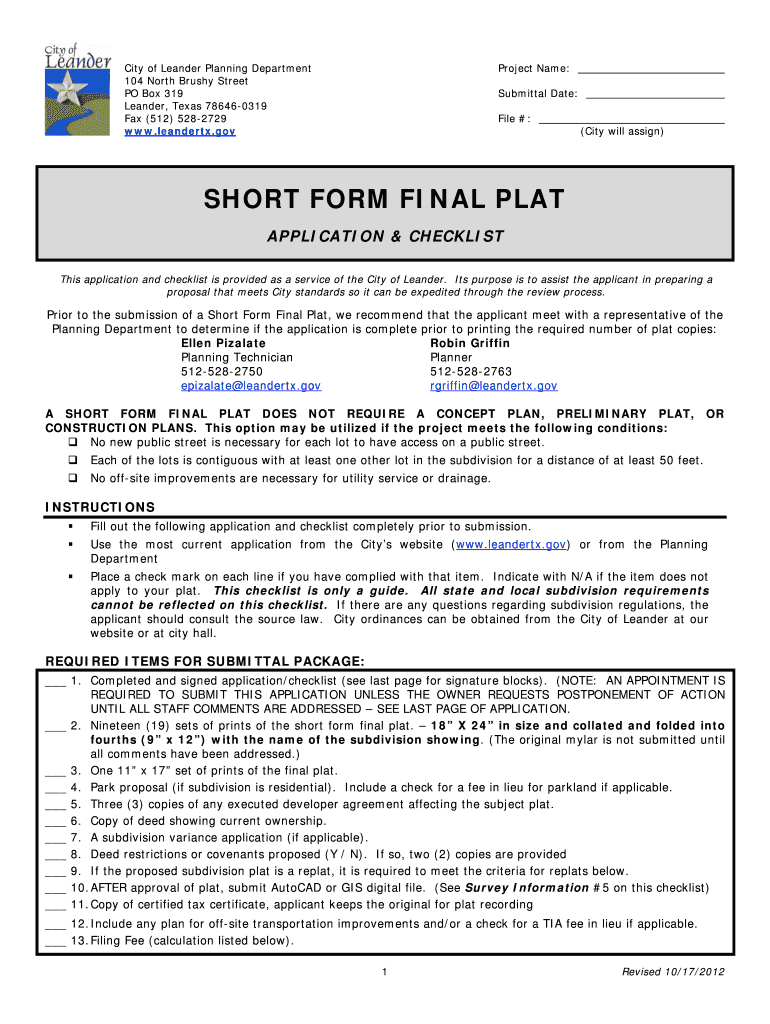







Definition and Purpose of the Short Form Final Plat Application and Checklist
The Short Form Final Plat Application and Checklist serves as a streamlined process for the approval of subdivision plats under specific conditions. This form is typically used in the context of municipal planning and development, offering an expedited review process to applicants. It reduces the need for extensive preliminary documentation, like concept plans or preliminary plats. The main goal of the form is to simplify and speed up the approval process for developers while ensuring compliance with local zoning and land use regulations. By adhering to this checklist, applicants can assure that critical elements and standards are met, thereby facilitating quicker administrative approval from the city planning department.
Obtaining the Short Form Final Plat Application and Checklist
The Short Form Final Plat Application and Checklist is usually provided by city planning departments. For instance, in Leander, Texas, this form can be downloaded directly from the city's official website or obtained in person from the planning department office. Applicants are encouraged to contact the department to ensure they have the most recent version of the document. Additionally, some jurisdictions may provide an online platform for accessing and submitting the form, making the process more accessible and efficient for users. Ensuring that all required attachments and fees accompany the form is critical to avoid delays in processing.
Steps to Complete the Short Form Final Plat Application
-
Gather Necessary Information:
- Collect detailed legal descriptions of the properties involved.
- Include the names and contact information of the property owners.
-
Review Checklist Requirements:
- Ensure that all checklist items are thoroughly addressed.
- Check for replat criteria or additional city-specific requirements.
-
Prepare Required Documents:
- Attach surveyor's plat maps and other mandatory documentation.
- Include proof of fee payment and any landowner agreements.
-
Consult with Planning Representatives:
- Engage with city planners for a preliminary review to correct any deficiencies early.
- Seek guidance on complex issues or uncertainties in the application process.
-
Submit the Form:
- File the completed application and checklist with the city’s planning department.
- Pay careful attention to designated submission methods, which may include online portals, mail, or in-person deliveries.
Key Elements of the Checklist
The checklist within the Short Form Final Plat Application includes the following key elements ensuring adherence to city standards:
- Land Descriptions and Borders: Detailed boundaries and measurements to define properties accurately.
- Parcel Information: Legal information, including parcel numbers and subdivision identifiers.
- Infrastructure Details: Information on existing or required public utilities like water, sewage, and electricity connections.
- Compliance Indicators: Certifications or statements of compliance with local zoning laws and ordinances.
- Approval Signatures: Necessary fields for endorsements by registered land surveyors and applicable municipal authorities.
Legal Use and Compliance
Using the Short Form Final Plat Application legally requires adherence to all relevant federal, state, and local laws. Compliance ensures that the subdivision and platting process does not contravene any development regulations. Ensuring appropriate legal use of the form involves:
- Adhering to Local Zoning Laws: Ensuring that proposed divisions conform to zoning specifications.
- Meeting Survey Standards: Filing plats that align with the acceptable surveying practices.
- Securing Necessary Approvals: Including utilities and access rights from public works departments.
Non-compliance can result in penalties, including rejected applications, delays, or legal actions.
Important Terms to Understand
- Subdivision Plat: A drawing or map that defines the division of a parcel of land into lots, tracks, and associated infrastructure.
- Replat: The act of re-dividing land that is already platted into different configurations or sizes.
- Zoning Compliance: Adherence to municipal regulations that dictate the usage of land areas within the city's jurisdiction.
State-Specific Rules
State-specific variations may exist in the procedures and requirements for the Short Form Final Plat Application. For example, Texas might have unique aspects such as:
- Land Recording Laws: Specific rules regarding how and when land divisions must be recorded in public records.
- Approval Processes: Different timelines and specific assessment phases determined by local government protocols.
Understanding these variances ensures that applicants anticipate and meet all legal requirements pertinent to their jurisdiction.
Examples and Scenarios of Use
Real-world applications of the Short Form Final Plat Application may include:
- Residential Developers: Seeking faster processing to expedite housing projects.
- Municipal Improvements: Public projects aiming to reassess existing land divisions for city development purposes.
- Commercial Ventures: Business expansions needing swift subdivision approvals to commence building swiftly.
Each scenario is tailored to streamline development efforts within regulatory frameworks, emphasizing the broad utility of this form.
By addressing the above elements in the Short Form Final Plat Application and Checklist, users can confidently navigate the process of land platting and subdivision, thereby facilitating efficient compliance with applicable regulatory demands.




