
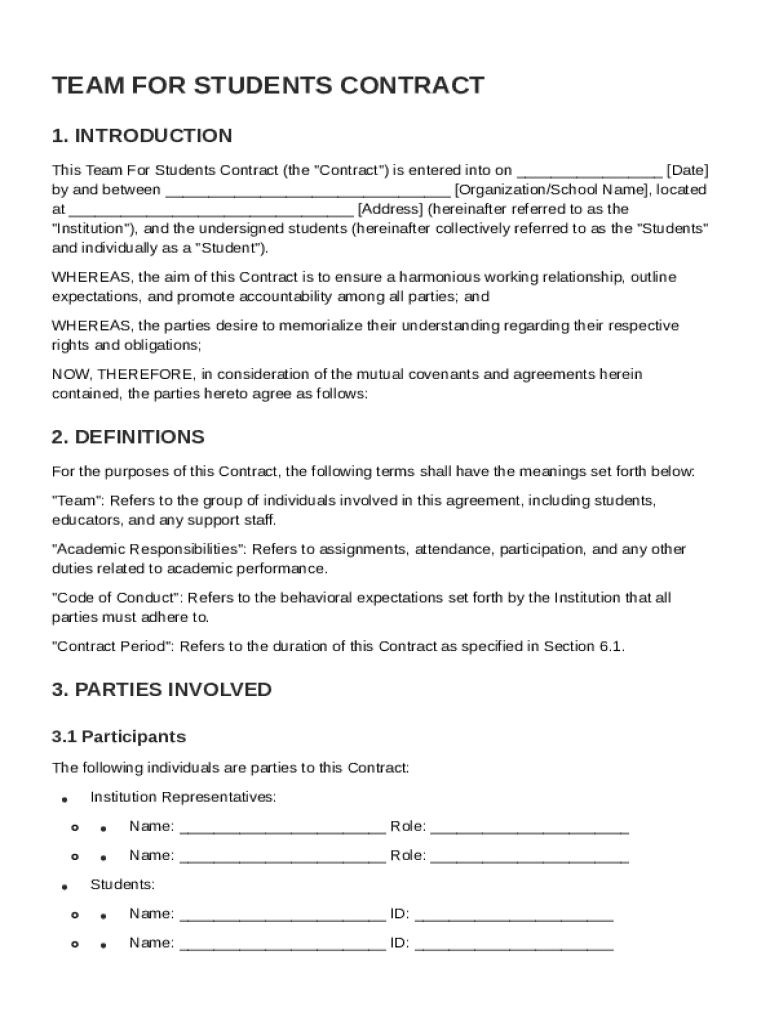







Definition and Purpose of the Team For Students Contract Template
The "Team For Students Contract Template" is a formal agreement utilized within educational settings to promote a collaborative environment among students and educators. This template facilitates clear communication by outlining roles, responsibilities, and expectations of both parties. Primarily, it serves educational institutions and aims to enhance accountability and mutual understanding. The contract typically includes sections on communication protocols, performance review schedules, and procedures for conflict resolution. By establishing a concrete framework, the template helps maintain effective partnership and ensures that all participants understand their obligations.
How to Use the Team For Students Contract Template
Using the Team For Students Contract Template involves several key steps that ensure its effective implementation. First, review the entire document to understand its content and requirements. Personalize the template to address specific needs, including the insertion of relevant educational goals and responsibilities for both students and educators. Next, gather input from all stakeholders, incorporating their feedback to align expectations. Implementation often involves organizing a meeting or workshop to discuss the terms and clarify any ambiguities. Once finalized, all parties should read and agree to the terms before signing, making the contract legally binding within the context of the institution.
Key Elements of the Team For Students Contract Template
The template incorporates several critical elements that define its structure and function:
-
Roles and Responsibilities: Clearly articulated duties for students and educators help prevent misunderstandings.
-
Communication Guidelines: Outlines how information will be exchanged and who holds accountability for updates.
-
Objectives and Goals: Shared educational aims that guide the contractual relationship.
-
Conflict Resolution Protocols: Procedures to handle disagreements, ensuring they are resolved constructively.
-
Amendments and Termination Clauses: Specifies how modifications can be made and under what circumstances the contract may be terminated.
These core components create a robust framework, promoting productive educational interactions.
Who Typically Uses the Team For Students Contract Template
The primary users of the Team For Students Contract Template are educational institutions, including schools, colleges, and universities. Administrators and educators often employ this document to clearly define educational partnerships. Students, particularly in collaborative programs or projects, use it to better understand their roles and expectations. This template may also be favored by extracurricular program directors or organizations tied to educational development, as it helps provide a structured environment that aligns with educational objectives.

Legal Use and Compliance of the Team For Students Contract Template
Legally, the Team For Students Contract Template is designed to foster transparency and accountability within educational environments. While not a legally binding contract in the conventional sense, adherence to the terms can prevent misunderstandings and disputes. Within the United States, it’s imperative to ensure the template complies with educational law and privacy regulations, such as FERPA. Institutions should review the document with legal counsel to confirm compliance and make sure it aligns with local, state, and federal laws.
Important Terms Related to the Team For Students Contract Template
Understanding specialized terminology is essential for effectively utilizing the Team For Students Contract Template:
-
Accountability: Expectation for parties to uphold their commitments and responsibilities.
-
Review Period: Designated times for evaluating student and educator performance.
-
Termination Clause: Terms under which the contract can be ended by either party.
-
Performance Metrics: Standards used to assess success within the educational context.
Familiarity with these terms ensures all parties can engage with the document effectively.
State-Specific Rules for the Team For Students Contract Template
While the template provides a general framework, there are often state-specific considerations that must be observed. Each state may have unique educational mandates and legal stipulations affecting how such agreements are constructed and enforced. For instance, some states could require additional provisions regarding student rights or educator responsibilities. Institutions must tailor the template to conform with their state’s education department guidelines and legal requirements, consulting local legal resources as necessary to ensure compliance.
Examples of Using the Team For Students Contract Template
The use of this contract template can vary widely depending on context. A college might adapt it to set goals and responsibilities for a student group project. In another scenario, a high school could utilize it during teacher-parent-student conferences to agree on performance and behavioral expectations. Extracurricular programs similarly benefit from this template by establishing clear guidelines for student participation and conduct. Each example tests the adaptability of the template to suit differing educational environments and objectives.
Steps to Complete the Team For Students Contract Template
-
Review and Customize: Tailor the template to align with specific program or course needs.
-
Input Collection: Gather insights from educators, students, and administrators to refine content.
-
Draft Finalization: Incorporate feedback and adjust the document as necessary.
-
Discussion and Clarification: Facilitate a meeting to discuss terms.
-
Signature Collection: Obtain signatures from all parties once a consensus is reached.
-
Implementation: Distribute copies to relevant stakeholders and integrate the contract into the educational workflows.
Following these steps ensures that the template supports its intended purpose effectively within educational settings.




