
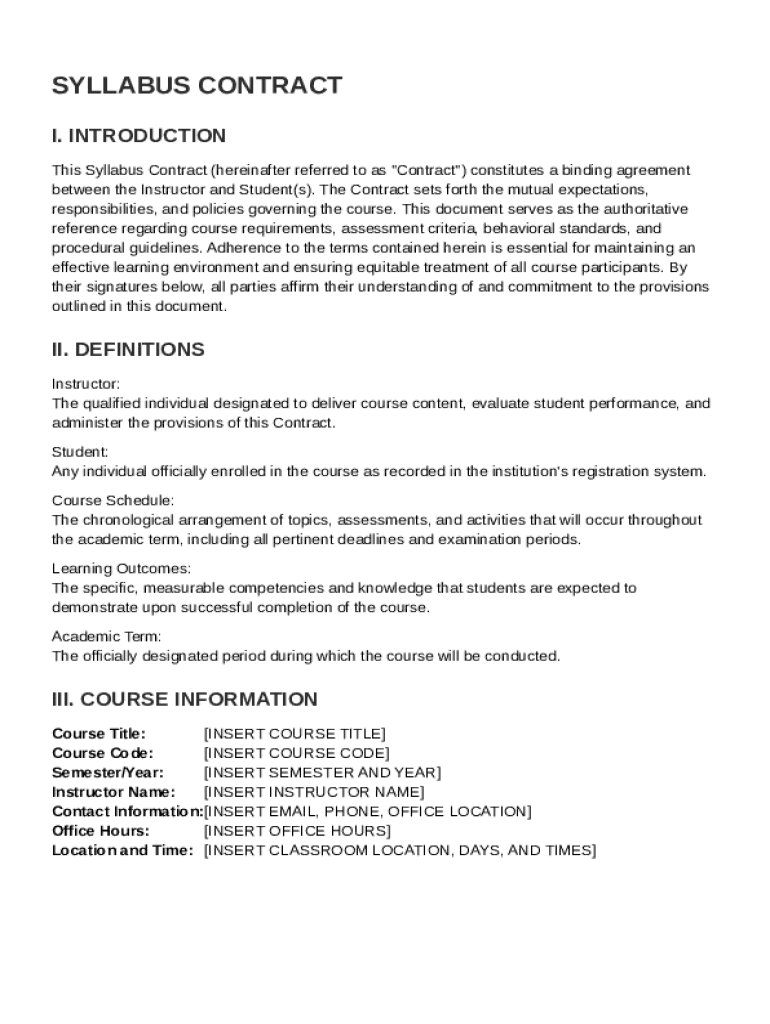







Definition and Meaning
A Syllabus Contract Template establishes a formal agreement between instructors and students that delineates the expectations and responsibilities in a course setting. This document covers comprehensive course guidelines, including the course schedule, assessment criteria, grading policies, and academic integrity. It clarifies roles and obligations to foster a conducive learning environment, serving as both a reference and a tool for accountability throughout the semester. The template serves to standardize these elements to ensure clarity and uniformity across different sections and courses.
Key Elements of the Syllabus Contract Template
A well-crafted Syllabus Contract Template comprises several critical components:
- Course Information: Clearly states the course title, code, meeting times, and instructor contact details.
- Learning Objectives: Outlines the goals that students are expected to achieve by the end of the course.
- Assessment Criteria: Details the methods and weightage of assignments, exams, and participation towards the final grade.
- Grading Policies: Provides a breakdown of the grading scale, including the criteria for merits and distinctions.
- Attendance Requirements: Specifies the importance of attendance and participation, including policies on absences.
- Academic Integrity: Reinforces the importance of honesty and integrity, detailing the consequences of plagiarism or cheating.
- Support Services: Lists resources available to students, such as tutoring or counseling services.
Steps to Complete the Syllabus Contract Template
Completing the Syllabus Contract Template involves several sequential steps:
- Input Basic Information: Begin by entering the course title, number, and instructor's name and contact information.
- Define Learning Outcomes: Clearly articulate what students are expected to learn and achieve.
- Outline the Course Schedule: Provide a weekly breakdown of topics, reading assignments, and key deadlines.
- Describe Assessment Methods: List the types of assessments and their respective contributions to the overall grade.
- Set Grading Policies: Specify the grading scale and criteria for passing.
- Clarify Attendance Policy: State the expectations for student attendance and participation.
- Highlight Academic Integrity: Ensure students understand the importance of academic honesty.
- Add Support Services Information: Include contact details and descriptions of available student services.
How to Use the Syllabus Contract Template
To effectively use the Syllabus Contract Template, instructors should:
- Customize the Template: Adapt the pre-formatted structure to fit the specific needs of the course, making sure all sections are relevant and concise.
- Engage Students: Discuss the syllabus in the first class to ensure students understand its contents and significance.
- Maintain Accessibility: Distribute both digital and printed copies to students, and ensure it is accessible on the course's online learning platform.
- Periodically Review and Update: Revisit the syllabus during the course to address any changes, ensuring it remains a living document that reflects the course's progression.
Examples of Using the Syllabus Contract Template
The Syllabus Contract Template can be applied in various educational settings:
- Traditional University Courses: Used to establish guidelines and academic expectations in undergraduate and graduate programs.
- Online Learning Environments: Adopted in virtual platforms to provide structure and clarity for remote learners.
- Professional Development Workshops: Used by corporate trainers to define the scope and objectives of training sessions and workshops.
Important Terms Related to Syllabus Contract Template
Several terms are essential when discussing a Syllabus Contract Template:
- Course Syllabus: The overarching document that forms the backbone of the template.
- Learning Outcomes: Specific goals that students are expected to achieve through the course.
- Assessment: The variety of methods used to evaluate student performance.
- Grading Scale: The system used to measure and report academic achievement.
- Academic Policy: Institutional rules governing student conduct and course management.
Who Typically Uses the Syllabus Contract Template
The Syllabus Contract Template is utilized by:
- Instructors: Teachers and professors who aim to communicate course requirements clearly and consistently.
- University Administrators: Academic staff who ensure syllabus compliance with institutional policies.
- Students: Individuals who use the syllabus as a guide to understand the course structure, objectives, and evaluation methods.


Legal Use of the Syllabus Contract Template
Using the Syllabus Contract Template entails legal considerations:
- Compliance with Institutional Policies: All syllabi must align with the university's academic regulations and policies.
- Acceptance of Terms: By enrolling in the course, students implicitly agree to abide by the syllabus's guidelines.
- Intellectual Property: Instructors must ensure all course content respects copyright laws and properly cite sourced materials.
State-Specific Rules for the Syllabus Contract Template
While the content of a Syllabus Contract Template largely follows national academic standards, certain state-specific regulations may apply:
- Compliance with State Education Standards: Ensure the syllabus aligns with any additional state-mandated educational requirements.
- Disability Accommodation Policies: Adhere to state laws regarding accommodations for students with disabilities in the syllabus content.




