
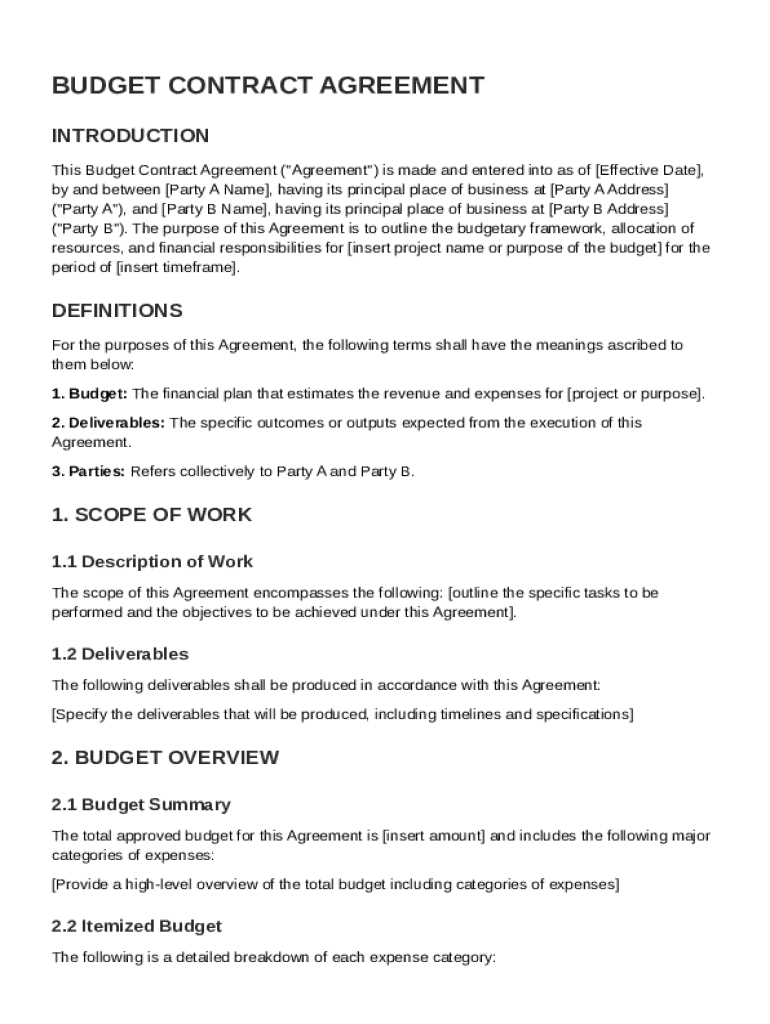







Definition & Purpose of the Budget Contract Template
The Budget Contract Template serves as a detailed framework outlining the financial expectations and obligations between two parties, often designated as Party A and Party B, involved in a project. It encompasses various aspects necessary for establishing a clear understanding of budget allocation, including definitions, scope of work, detailed expense categories, payment terms, duration, and more. By delineating these elements, it preempts misunderstandings and crystalizes mutual consent regarding project deliverables and financial provisions.
Key Elements of the Budget Contract Template
Critical to the effectiveness of the Budget Contract Template are its defining components:
- Scope of Work: Clearly outlines the objectives and responsibilities to be undertaken, setting the stage for precise deliverable expectations.
- Budget Overview: Offers a detailed breakdown of anticipated expenses, categorized into sections such as materials, labor, overhead, and contingency funds.
- Payment Terms: Specifies the schedule, method, and conditions under which payments will be made, including any upfront payments or milestone-triggered releases.
- Duration and Amendments: Details the project's timeline and outlines procedures for modifying contractual terms as necessary.
Steps to Complete the Budget Contract Template
- Identify Parties Involved: Enter the names and contact information for all parties involved.
- Define Scope: Clearly articulate the scope to ensure both parties have a unified understanding of expectations.
- Detail Budget: Provide a comprehensive list of expenses, ensuring all potential costs are accounted for.
- Set Payment Terms: Outline a payment schedule with preferred methods and necessary conditions.
- Specify Duration: Define project timelines and parameters for extensions or amendments.
- Include Signatures: Both parties should sign to acknowledge agreement on terms.
Common Users of the Budget Contract Template
The Budget Contract Template is extensively used by various entities, including:
- Small Businesses: These entities often use the template to precisely manage project expenses and timelines.
- Freelancers and Consultants: Professionals use it to formalize client agreements, ensuring clarity on payment and deliverable expectations.
- Nonprofits and NGOs: These organizations rely on structured budget outlines to satisfy grant funding requirements and enhance project accountability.

Legal Use and Implications
The Budget Contract Template establishes a legally binding agreement under U.S. law once signed by all parties. Each element, including confidentiality clauses and dispute resolution processes, adheres to legal standards designed to safeguard each party's interests. In the case of a breach, the template serves as evidence in legal proceedings, emphasizing the importance of precise and truthful completion.
Form Variants and Alternatives
While the Budget Contract Template is versatile, alternative templates may be used for specific industries or projects, such as grant-specific budget forms or interim project budget outlines. Older versions might exist, but updates typically reflect the latest legal and industry standards, underscoring the importance of using the most current template.
Importance of Using a Budget Contract Template
Utilizing a Budget Contract Template brings structured certainty to financial arrangements, reducing ambiguities and aiding in smoother project execution. Its predetermined format acts as a checklist ensuring no critical details are overlooked, fostering professional trust and minimizing the risk of financial disputes.
Understanding Important Terms
Familiarity with key terms within the Budget Contract Template is crucial:
- Contingency Fund: An allocated reserve for unforeseen expenses, enhancing financial resilience.
- Amendment Clause: A provision detailing how contractual changes can be made, vital for adapting to evolving project needs.
- Parties Involved: All entities partaking in the contract, whose clear identification prevents conflicts regarding accountability.
Practical Examples of the Budget Contract Template
A digital marketing agency might use the template to partition a project's budget, detailing allocations for staff, software, and advertising spend. Similarly, a contractor can outline expenses for labor, materials, and subcontractors when bidding for a construction project, ensuring comprehensive financial visibility for clients.




