





Definition and Meaning of the Ct Home Improvement Contract Template
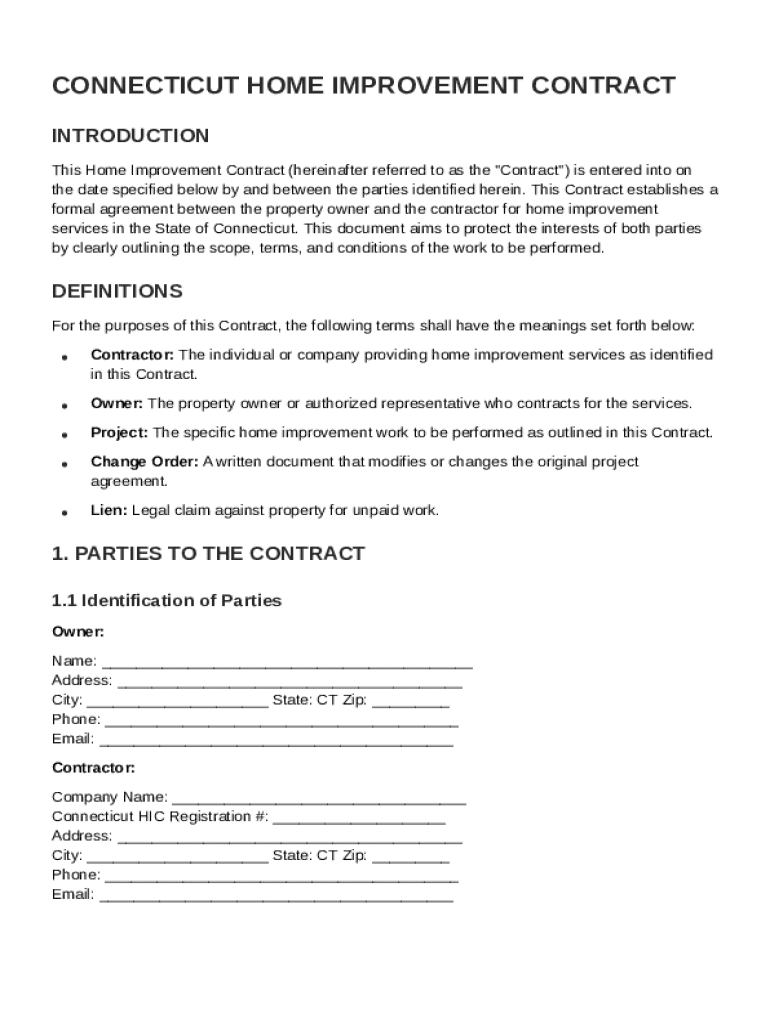
The Connecticut Home Improvement Contract Template is a formal agreement utilized between property owners and contractors for home improvement services. It delineates the specific tasks to be completed, along with payment terms, change order procedures, warranties, and responsibilities for permits. The contract serves the dual purpose of protecting the interests of both parties and ensuring compliance with state laws. Additionally, it includes provisions for termination conditions, dispute resolution methods, and the owner's rights to cancel the agreement within three business days. This document is crucial for legally safeguarding both parties during home improvement transactions.
How to Use the Ct Home Improvement Contract Template
Using the Connecticut Home Improvement Contract Template involves several steps to ensure that all essential elements are covered and both parties are satisfied with the terms:
-
Review the Form: Begin by thoroughly reading the template to understand its sections and required information.
-
Customize the Details: Tailor the contract to the specific project by adding details such as the scope of work, start and completion dates, total cost, and payment schedules.
-
Incorporate Legal Requirements: Ensure that all state-specific legal requirements are included, such as licensing information and insurance proof.
-
Outline Specific Responsibilities: Clearly define the duties of each party, including who provides materials and handles permits and inspections.
-
Review and Sign: Both parties should review the completed contract together, make necessary revisions, and then sign to agree on the outlined terms.
-
Distribute Copies: Each party should retain a copy of the signed contract for their records.
Key Elements of the Ct Home Improvement Contract Template
The Ct Home Improvement Contract Template contains several crucial components, each of which serves to protect the interests of the involved parties:
-
Scope of Work: A detailed description of the project, including tasks to be performed, materials to be used, and the timeline for completion.
-
Payment Terms: Information on the total project cost, deposit amount, and installment payments, if applicable.
-
Change Orders: A process for any modifications or changes to the original contract terms, including how costs and timelines will be adjusted.
-
Warranties and Permits: Documentation of any warranties on workmanship or materials and a statement on the responsibility for procuring necessary permits.
-
Dispute Resolution: Methods for addressing disputes, which may include mediation or arbitration clauses.
State-Specific Rules for the Ct Home Improvement Contract Template
The Connecticut Home Improvement Contract Template must adhere to Connecticut’s specific rules and regulations:
-
Compliance with the Home Improvement Act: Ensures contractors are licensed and follow regulations that protect consumers.
-
Three-Day Cancellation Right: Allows homeowners the right to cancel the contract within three business days of signing without penalty.
-
Licensure and Insurance: Contractors must provide proof of licensure and insurance to execute home improvement work legally in Connecticut.
By including these state-specific requirements, the contract offers additional legal protection and compliance assurance.
Steps to Complete the Ct Home Improvement Contract Template
Completing the Connecticut Home Improvement Contract Template requires careful attention to detail:
-
Gather Information: Collect necessary information, including contractor details, project description, and payment terms.
-
Fill in the Template: Enter the collected data into the corresponding sections of the template.
-
Verify Details: Double-check all entries for accuracy, ensuring that all legal and financial terms are clear and complete.
-
Consult an Attorney: If needed, seek legal advice to confirm that the contract aligns with all state laws and regulations.
-
Finalize the Contract: Once all parties are agreed on the terms, sign and date the document.
-
Keep a Record: Store a copy of the signed contract for future reference or in case disputes arise.
Legal Use of the Ct Home Improvement Contract Template
The legal use of the Connecticut Home Improvement Contract Template encompasses ensuring all areas of the contract comply with state and federal laws. This includes:
-
Adherence to the ESIGN Act: If electronic signatures are used, they must comply with the Electronic Signatures in Global and National Commerce Act to be legally binding.
-
Licensing Verification: Contractors must provide valid state-issued licenses, ensuring they are authorized to undertake home improvement work.
-
Contractor Registration: Contractors must be registered with the state under the Home Improvement Act, offering an additional layer of consumer protection.
Adhering to these legal protocols when using the contract template helps safeguard both the homeowner and contractor from potential legal challenges.
Important Terms Related to the Ct Home Improvement Contract Template
Understanding critical terms related to the Connecticut Home Improvement Contract Template aids in comprehension and execution:
-
Contractor: The professional or company engaged to perform home improvement tasks.
-
Owner: The property owner engaging the contractor's services.
-
Workmanship Warranty: A guarantee of quality and durability for the work performed.
-
Arbitration Clause: A provision that mandates arbitration in the event of a contract dispute, avoiding traditional court litigation.
-
Permit Responsibility: The party responsible for obtaining necessary permits for the project.
Grasping these terms fosters informed contract creation and utilization.
Examples of Using the Ct Home Improvement Contract Template
Examples showcase varied contexts where the Connecticut Home Improvement Contract Template is used effectively:
-
Kitchen Renovation: A homeowner hiring a contractor to modernize a kitchen space by installing new cabinets, countertops, and appliances can use the contract to define the project's scope and payment terms.
-
Roof Replacement: For a roofing project, the contract can specify materials, estimated completion time, and contingency plans for weather-related delays.
-
Bathroom Remodel: In a bathroom upgrade, this contract outlines tasks such as plumbing adjustments, tile installation, and fixture updates, ensuring clarity and accountability.
Such examples highlight the contract's adaptability to different home improvement contexts.
Who Typically Uses the Ct Home Improvement Contract Template
The template is typically utilized by two main groups:
-
Homeowners: Individuals or families seeking to enhance their living spaces through professional services rely on the contract for legal protection and project clarity.
-
Contractors: Licensed professionals offering construction and renovation services use the template to formalize their agreements with clients, ensuring all aspects of the transaction are clear and enforceable.
This dual usage underscores the contract's role in facilitating smooth interactions between service providers and clients.