
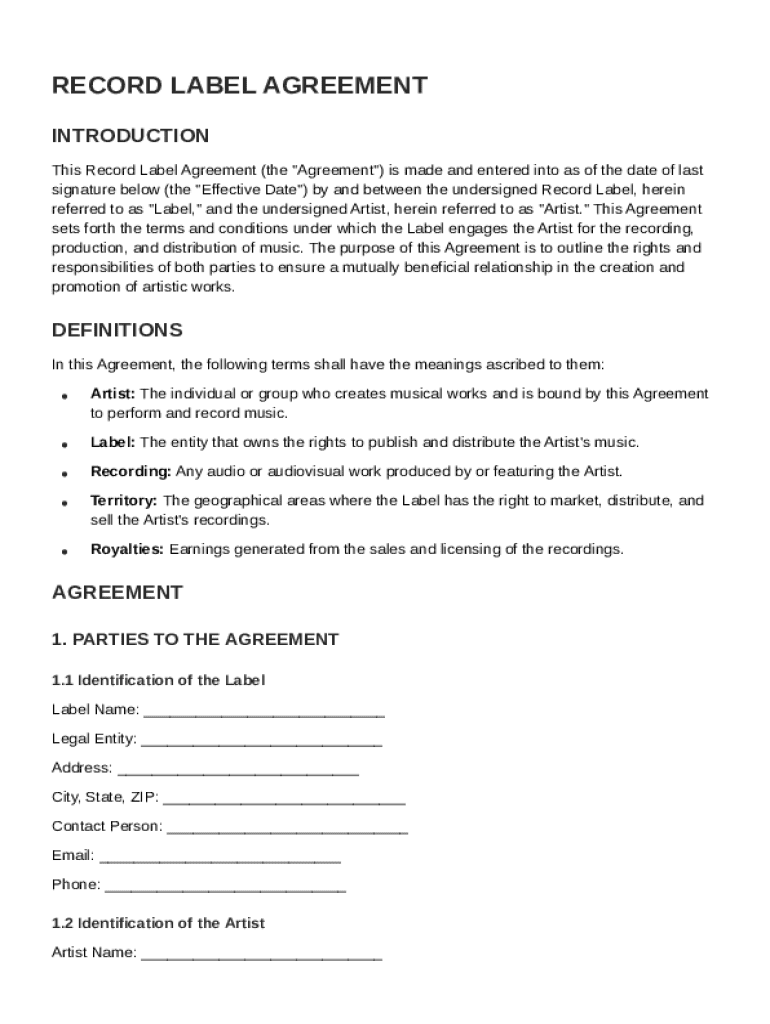







Definition and Purpose of the Record Label Contract Template
The Record Label Contract Template serves as a formal agreement between a record label and an artist, outlining the terms for recording, production, and distribution of music. It defines essential roles, rights, and responsibilities, providing a comprehensive framework that governs the professional relationship. Key components include exclusivity clauses, which ensure the artist's commitment to the label, and compensation structures, which detail how advances and royalties are calculated and paid.
Key Aspects of Record Label Contract
- Exclusivity Clauses: Specify if the artist is bound to work exclusively with the label.
- Compensation: Includes details of advances, royalty schemes, and payment terms.
- Marketing Obligations: Outlines the label's role in promoting the artist's work.
- Ownership of Recordings: Defines who retains the rights to produced materials.
- Termination Conditions: Specifies the circumstances under which the contract can be ended.
How to Use the Record Label Contract Template
This template can be employed by both record labels and artists to establish a formal agreement without crafting a document from scratch. To utilize the template effectively, follow these steps:
- Review: Carefully read through each section to understand its implications.
- Customize: Edit the template to include specific terms relevant to both parties.
- Consult Legal Advice: Seek legal counsel to ensure compliance with applicable laws.
- Finalize and Sign: Once all terms are agreed upon, both parties should sign the document to formalize the agreement.
Customization Tips
- Adjust Terms: Modify clauses related to payments and obligations to match realities.
- Insert Specifics: Add details like recording timelines and delivery expectations.
Steps to Complete the Record Label Contract Template
Completing the Record Label Contract Template involves more than just filling out standard sections. Here's a structured procedure:
- Identify Parties: Specify the artist and the record label's full legal names.
- Define Project Scope: Clearly state the intended projects, albums, or records.
- Negotiate Terms: Discuss and agree on financial terms and responsibilities.
- Draft Terms: Write precise terms, including timelines and milestones.
- Seek Approvals: Present the draft to legal advisors for refinement.
- Final Review: Both parties should verify that all details are accurate before signing.
Important Considerations
- Timelines: Ensuring that project deadlines are realistic and agreed upon.
- Confidentiality: Include clauses to safeguard sensitive information.
Who Typically Uses the Record Label Contract Template
This template is used extensively by various stakeholders in the music industry. Understanding who benefits from this template can clarify its critical significance:
- Record Labels: Establish control over artist agreements to streamline managing portfolios.
- Musicians/Artists: Protect personal rights while proactively managing career advancements.
- Managers: Oversee and ensure adherence to contractual obligations on behalf of their clients.
- Legal Advisors: Provide expert guidance on the enforceability of terms included.


Scenario Examples
- Emerging Artists: Use agreements to ensure fair compensation during initial career phases.
- Established Labels: Maintain consistent agreement standards across multiple artists.
Important Terms Related to Record Label Contract Template
The success and effectiveness of utilizing the template heavily rely on understanding key terminologies:
Common Terms
- Advance: Upfront payment given to an artist that is recoupable from future royalties.
- Royalty: Earnings that the artist receives from the sale of music.
- Master Recording: The original recording of a song or album.
- Recoupment: Process where the label is reimbursed for advances through future artist earnings.
Legal Use of the Record Label Contract Template
While using this template, it's crucial to ensure legal admissibility across different jurisdictions in the United States. Here's how:
- Compliance: Align contract terms with U.S. federal and state music contract laws.
- Enforceability: Draft terms in a manner that can withstand legal scrutiny.
- Dispute Resolution: Include procedures for resolving disputes amicably.
Legal Considerations
- State Laws: Some states have specific regulations regarding artist contracts.
- Legal Representation: Encouraged for clarification and drafting contracts that stand robustly under legal examination.
Key Elements of the Record Label Contract Template
For a contract to be deemed comprehensive and effective, it must contain several key elements. These ensure both parties are clear on their rights and obligations:
- Parties Involved: Exact names of the record label and the artist(s).
- Term Duration: Contract length and conditions for renewal or extension.
- Intellectual Property Rights: Details regarding who retains the rights to materials produced.
- Financial Obligations: Specifics on how payments, advances, and royalties are calculated.
- Termination Clause: Conditions that will justify the legal conclusion of the contract.
Ensuring Comprehensive Coverage
- Clear Terminology: Use precise legal language to avoid potential misinterpretations.
- Flexible Terms: Allow room for renegotiation or amendments if circumstances change.
Digital vs. Paper Version of the Record Label Contract
Deciding between digital and paper versions of this contract impacts its accessibility and ease of management. Each format has distinct advantages:
Digital Version
- Advantages: Easily editable, facilitates online signatures, and can be shared instantaneously across multiple platforms.
- Environmental Impact: Reduces paper use, promoting an eco-friendly approach.
Paper Version
- Advantages: Tangible, some stakeholders prefer physical records for archives.
- Security: Not subject to digital malicious attacks.
In conclusion, the Record Label Contract Template is a dynamic tool designed to cater to the diverse needs in the music industry. By following structured approaches, utilizing legal insights, and adapting to modern technological advancements, the contract remains a pivotal element for establishing professional relations between artists and labels.




