
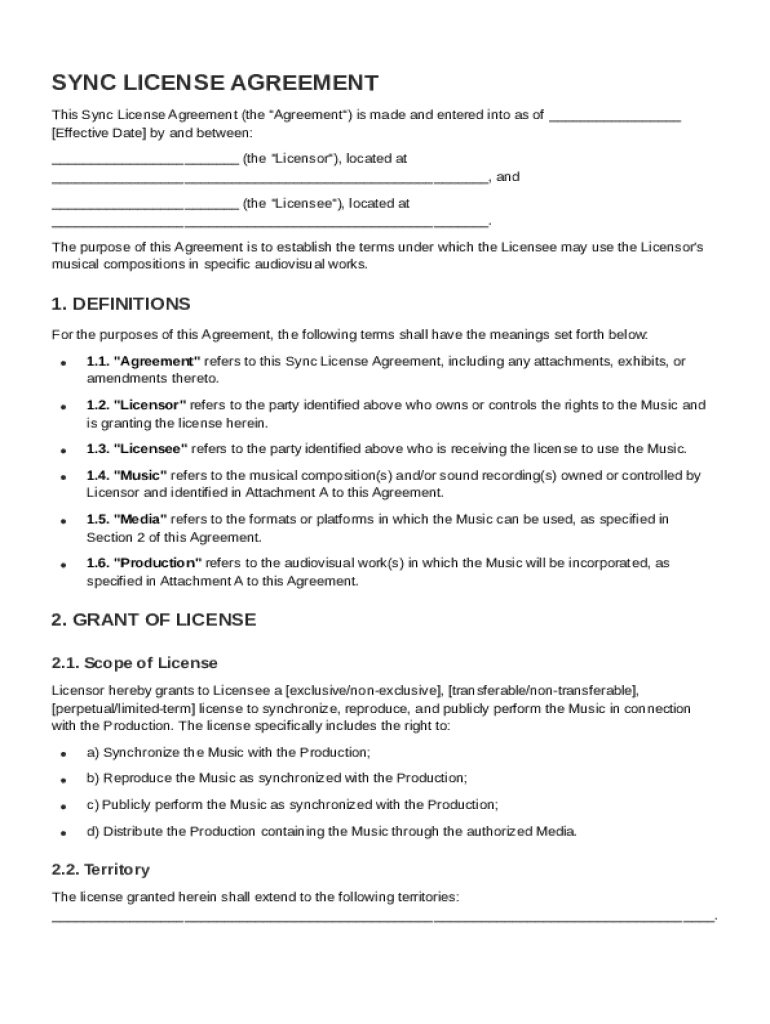







Definition and Meaning
A Sync License Agreement defines the terms under which a licensee may use a licensor's musical compositions in audiovisual works, such as films or advertisements. By understanding its meaning, users can effectively manage the synchronization of music with visual media. This type of agreement is essential for ensuring the legal use of music within a range of visual content and works as a protective tool for both parties involved. It outlines specific rights, usage restrictions, and payment obligations, which are essential for maintaining clarity and avoiding disputes.
Key Components
- Rights Grant: Specifies the exact rights the licensee has to use the music, such as the geographic area and media types.
- Payment Terms: Outlines financial commitments, including upfront fees and royalty arrangements.
- Usage Restrictions: Describes how the music can be used, ensuring it aligns with the creator's vision and legal requirements.
- Termination Conditions: Identifies scenarios in which the agreement may be dissolved, providing an escape route in case of breaches.
Key Elements of the Sync License Agreement Template
The template comprises critical elements that standardize the licensing process, ensuring all necessary legal components are included. Each element plays a vital role in protecting the interests of both the licensor and licensee.
Legal Provisions
- Warranties and Indemnities: Promises made by both parties to cover representations and responsibilities, including claims of ownership.
- Dispute Resolution: Preferred methods for resolving conflicts, such as mediation or arbitration, as well as the governing law.
- Amendments: Conditions under which changes to the agreement might be made, allowing for flexibility and updates as needed.
Practical Examples
Consider a scenario where a filmmaker wants to use a piece of music in a documentary. The Sync License Agreement would define the film's distribution territories and mediums, ensuring all legal requirements are met and financial terms are agreed upon.
How to Use the Sync License Agreement Template
Using a Sync License Agreement Template involves careful customization to fit the specific needs of the parties involved. Each section must be tailored to reflect accurate details that apply to the particular circumstances.
Customization Steps
- Identify Both Parties: Start by accurately naming the licensor and licensee, ensuring there are no confusions or misrepresentations.
- Detail Music Composition and Use: Clearly outline the music composition involved and describe how it will be synchronized with visual content.
- Specify Financial Arrangements: Agree on one-time fees or ongoing royalties and detail the payment schedule and method.
Steps to Complete the Sync License Agreement Template
Completing a Sync License Agreement Template requires thorough attention to ensure all key aspects are addressed and understood by both parties.
Step-by-Step Process
- Gather Required Information: Collect all essential details about the music piece, usage plans, and associated parties.
- Initial Draft: Use the template to draft an initial version, filling in known details and leaving placeholders for areas needing further negotiation.
- Review and Refinement: Both parties review the draft, making necessary adjustments to terms concerning rights, payments, and restrictions.
- Finalization and Signing: Once agreed, finalize the document and proceed with authorized signatures from both parties.
Important Terms Related to the Sync License Agreement Template
Understanding the terminology used within the Sync License Agreement Template is crucial for its effective application.
Common Terms and Their Meanings
- Synchronization: The process of aligning and integrating music within a visual medium.
- Licensor vs. Licensee: Clarifies roles, with the licensor owning the rights to the music and the licensee seeking those rights for use.
- Exclusive vs. Non-Exclusive License: An exclusive license prohibits others from using the music, while a non-exclusive license allows multiple agreements.
Legal Use of the Sync License Agreement Template
To ensure legal protection, both parties need to be informed about the legal obligations and rights stated in the template. It helps preemptively resolve potential legal issues that could arise from improper music use.
Compliance and Legal Guidance
- Adherence to ESIGN Act: Electronic signatures on these agreements hold the same legal standing as traditional ink signatures.
- State-Specific Regulations: While the U.S. broadly recognizes these templates, state laws may impose specific requirements or nuances.
Who Typically Uses the Sync License Agreement Template
Various professionals and businesses utilize this template to legally obtain music for visual projects.


Typical Users
- Filmmakers and Producers: Secure rights to incorporate music into movies or television shows.
- Advertising Agencies: Use music tracks in commercials or promotional videos.
- Content Creators: Individuals or entities planning to integrate music into digital media like YouTube videos or podcasts.
Examples of Using the Sync License Agreement Template
Explores real-world scenarios where the agreement template has been applied effectively, demonstrating its versatility and necessity.
Practical Use Cases
- Film Industry: A director secures a sync license for a classic song to be used in a pivotal scene, enhancing audience emotional engagement.
- Marketing Campaigns: An agency creates an ad jingle and secures its usage rights to ensure continuity across different marketing platforms.
- Educational Videos: An educational provider uses a piece of music to add depth to an online learning module, acquiring rights that protect against future claims.




