Supplier Agreement Template 2026

Get Form
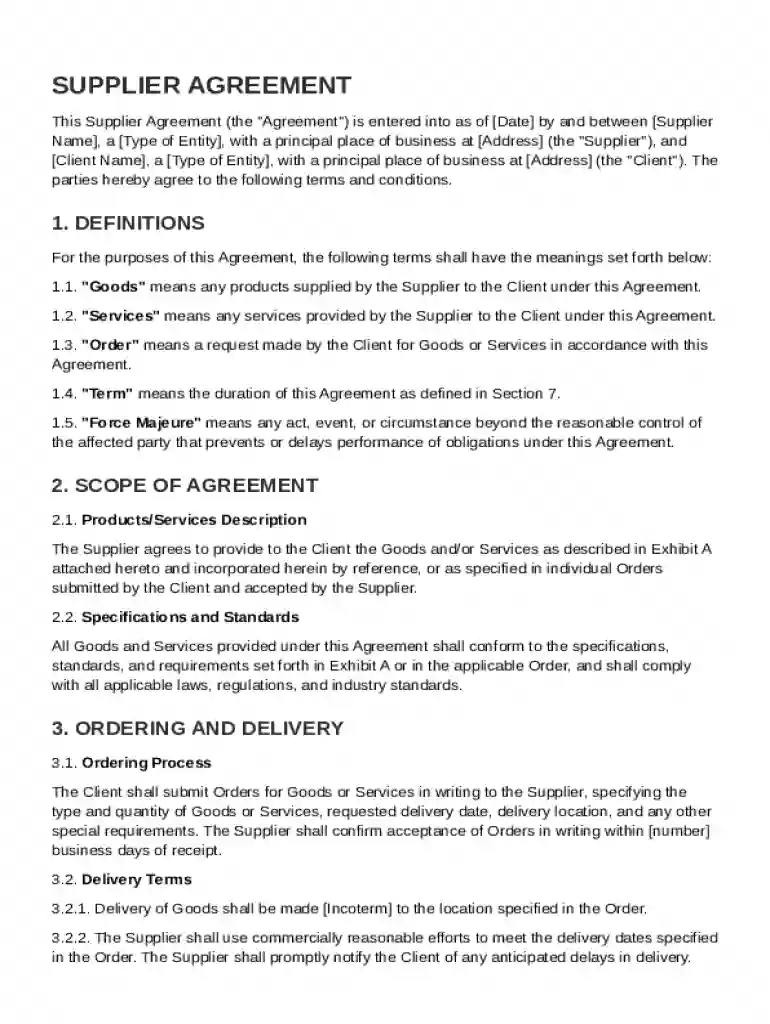
Supplier Agreement Template Preview on Page 1

Here's how it works

01. Edit your form online
Type text, add images, blackout confidential details, add comments, highlights and more.

02. Sign it in a few clicks
Draw your signature, type it, upload its image, or use your mobile device as a signature pad.

03. Share your form with others
Send it via email, link, or fax. You can also download it, export it or print it out.

Definition and Meaning

A Supplier Agreement Template is a pre-designed document that outlines the essential terms and responsibilities between a supplier and a client for the provision of goods and services. This template serves as a foundational guide for creating a formal contract, ensuring that all necessary clauses are included to protect the interests of both parties. It covers key aspects such as scope of work, pricing structures, delivery schedules, and termination conditions. By utilizing this template, both suppliers and clients can avoid potential misunderstandings and disputes by establishing a clear and mutual understanding of expectations from the outset.

How to Use the Supplier Agreement Template

Utilizing a Supplier Agreement Template involves several key steps to ensure the document is tailored correctly for the specific business transaction. Start by reviewing the template's predefined sections to understand the standard content addressed. Next, customize aspects such as pricing terms, delivery schedules, and specific responsibilities to reflect the unique requirements of your arrangement. Engage all relevant stakeholders, ensuring that legal advisors review the agreement for compliance and adequacy. Once finalized, both parties should review and understand the agreed terms, ensuring consensus before signing.

Key Elements of the Supplier Agreement Template

The Supplier Agreement Template includes multiple essential components vital for a comprehensive arrangement. These elements typically include:

  • Scope of Work: Detailed description of goods or services to be provided.
  • Pricing and Payment Terms: Clear guidelines on pricing structures, invoice schedules, and payment conditions.
  • Delivery and Performance Standards: Timelines and standards for delivery and performance, including penalties for delays.
  • Warranties and Representations: Expectations around the quality of the goods or services, and any guarantees offered.
  • Confidentiality: Clauses to protect proprietary and sensitive information shared during the agreement.
  • Termination Conditions: Processes and conditions under which the agreement can be terminated by either party.
  • Dispute Resolution: Methods for resolving conflicts, such as mediation or arbitration.

Steps to Complete the Supplier Agreement Template

Completing the Supplier Agreement Template involves a structured approach:

  1. Review Initial Template: Familiarize yourself with the standard clauses included in the template.
  2. Customize Details: Modify sections to reflect the specific roles, responsibilities, and expectations of both parties.
  3. Consult Legal Advisors: Seek advice to ensure that the agreement complies with all relevant laws and regulations.
  4. Discuss with Counterparty: Engage in negotiations with the other party to finalize terms and address any concerns.
  5. Finalize Agreement: Once all parties agree, finalize the document and prepare for signatures.

Who Typically Uses the Supplier Agreement Template

This template is typically utilized by businesses engaged in supplier-client relationships where goods and services are exchanged. Common users include:


  • Manufacturers and Distributors: To formalize agreements with retailers or wholesalers.
  • Service Providers: Engaging with clients for service-based projects.
  • Retail Businesses: Creating agreements with suppliers of goods.
  • Logistics Companies: Establishing terms with clients requiring transportation or delivery services.
decoration image ratings of Dochub

Legal Use of the Supplier Agreement Template

The legal utility of the Supplier Agreement Template lies in its role as a contract that binds both parties to their agreed obligations under U.S. law. It must incorporate pertinent state-specific laws to be enforceable. Furthermore, having a written agreement helps in mitigating risks by providing a documented reference point during disputes or legal challenges. Parties should ensure that all legal formalities, such as valid signatures and witness endorsements, are adhered to for the agreement to be legally valid.

State-Specific Rules for the Supplier Agreement Template

While the Supplier Agreement Template serves as a broad framework, it must be adapted to incorporate specific state regulations and industry standards to be fully compliant. For instance, certain states may have unique statutes regarding payment schedules, confidentiality agreements, or dispute resolution that necessitate inclusion or customization. Consulting with a local legal expert is crucial to ascertain that the agreement adheres to applicable state legislation and avoids potential legal pitfalls.

Examples of Using the Supplier Agreement Template

Real-world applications of the Supplier Agreement Template vary across industries:

  • In Technology: A software company uses the template to outline the provision of software as a service (SaaS) to its clients, detailing service levels and support.
  • In Manufacturing: Manufacturers draft agreements with raw material suppliers specifying delivery times, quality standards, and pricing models.
  • In Retail: Retail chains employ the template to formalize their procurement arrangements with preferred suppliers, detailing product specifications and bulk order agreements.

Each use case demonstrates the flexibility of the template to accommodate diverse business needs while maintaining a clear legal framework.

be ready to get more

Complete this form in 5 minutes or less

Get form

Got questions?

We have answers to the most popular questions from our customers. If you can't find an answer to your question, please contact us.
Contact us
Your supplier agreement template should outline the suppliers obligations regarding delivery, including the delivery schedule, delivery method, location, and who bears the risk during transit. Any penalties for late delivery should also be noted.
How to draft a contract in 13 simple steps Start with a contract template. Understand the purpose and requirements. Identify all parties involved. Outline key terms and conditions. Define deliverables and milestones. Establish payment terms. Add termination conditions. Incorporate dispute resolution.
Vendor relationships are often more long-term and may involve ongoing services or regular product deliveries. Supplier relationships can be more transactional and may be shorter-term, though long-term supplier relationships also exist.
A supplier contract is a formal agreement between a company and an external party that provides goods or services. It defines the scope of supply, delivery timelines, pricing, and the responsibilities of each party, including how issues such as delays or defects will be handled.
Summary. A supplier agreement should include essential terms such as payment terms, delivery obligations, liability clauses and warranties. Management contracts and services schedules provide structure to ensure duties and expectations are met for successful business relationships.

Security and compliance

At DocHub, your data security is our priority. We follow HIPAA, SOC2, GDPR, and other standards, so you can work on your documents with confidence.
Learn more
ccpa2
pci-dss
gdpr-compliance
hipaa
soc-compliance
be ready to get more

Complete this form in 5 minutes or less

Get form

People also ask

A vendor contract should include the following: Contact information for both parties. Detailed description of the goods or services. Length of the contract and/or expected product delivery time. Price and payment method. Terms for ending the contract. Consequences of contract bdocHub.
Checklist for Preparing a Vendor Agreement Identify all parties (with their legal names) involved in the agreement. The date from which the agreement comes into effect. The purpose of the agreement. Details on work or services or goods to be delivered. Place of work or delivery of goods/ services.
The following points should be included in a supplier agreement: Type of materials and products sourced. Quantity, and quality of the goods/service. Price and payment terms. Confidentiality clauses. Delivery time frame. Procurement terms and conditions.

Related links