




Definition & Meaning
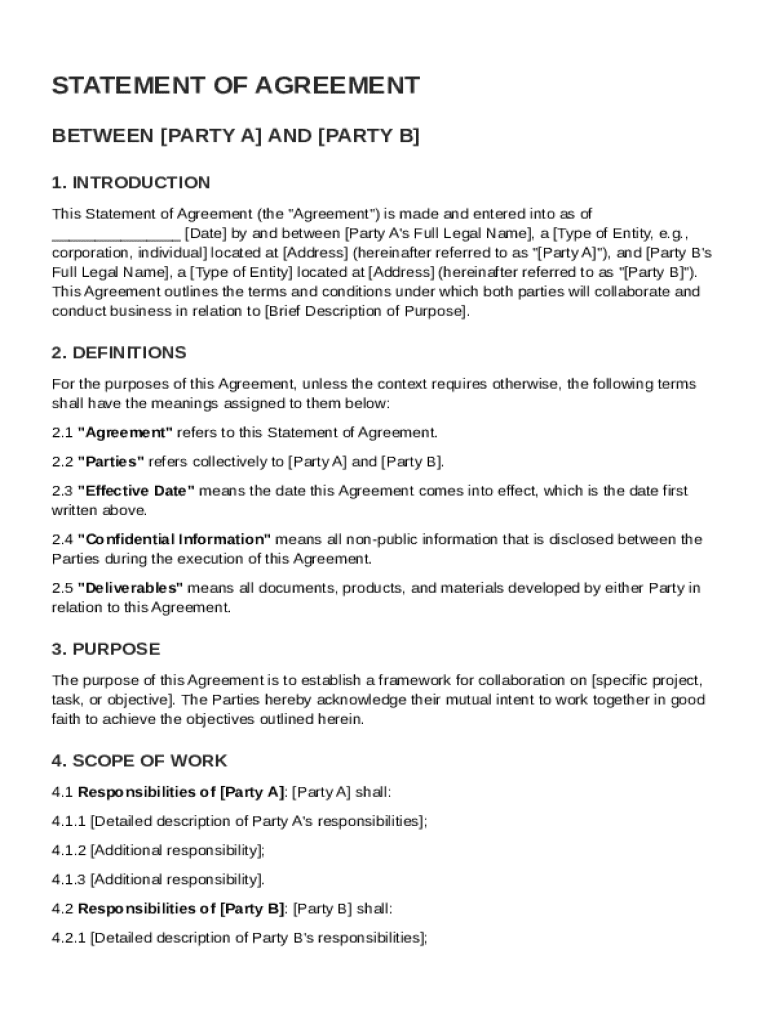
A Statement Agreement Template is a formal document that outlines the collaboration terms between two parties. It serves to establish clarity by stipulating key elements such as objectives, responsibilities, and obligations of each party involved. The document often includes sections covering confidentiality clauses, payment terms, and dispute resolution mechanisms. Its purpose is to provide a structured framework that governs the interaction and expectations of the cooperating entities, ensuring mutual understanding and adherence to agreed-upon terms.
Key Elements of the Statement Agreement Template
The Statement Agreement Template typically comprises several essential components:
- Definitions Section: Clarifies the terms and phrases used within the agreement to avoid misinterpretation.
- Responsibilities: Details the specific duties and obligations of each party, which are crucial for collaborative efforts.
- Payment Terms: Specifies the amount, method, and schedule of payments, providing financial clarity to the involved parties.
- Confidentiality Obligations: Outlines the requirements for confidentiality, protecting sensitive information from unauthorized disclosure.
- Dispute Resolution Procedures: Describes the steps and methods available for resolving disagreements, such as mediation or arbitration.
- Termination Clauses: Provides the conditions under which the agreement can be terminated by either party.
Each element is instrumental in establishing a comprehensive and transparent agreement that facilitates effective collaboration while safeguarding the interests of both parties.
Steps to Complete the Statement Agreement Template
Completing a Statement Agreement Template involves several systematic steps:
- Review Pre-existing Agreements: Examine any prior arrangements to ensure consistency and continuity.
- Identify Parties Involved: Clearly determine the entities or individuals entering the agreement.
- Define Objectives and Scope: Articulate the main goals and the scope of the collaboration.
- Detail Responsibilities and Duties: Allocate specific tasks and obligations, respectively.
- Specify Payment and Financial Terms: Include detailed payment plans and accepted payment methods.
- Include Confidentiality and Security Clauses: Address protection of sensitive information.
- Outline Dispute Resolution Processes: Clearly define how potential conflicts will be handled.
- Set Termination and Amendment Conditions: State the terms under which the agreement can be modified or terminated.
Completing these steps ensures that the agreement is thorough, legally sound, and unambiguous.
Important Terms Related to Statement Agreement Template
Understanding the terminology is crucial for interpreting the Statement Agreement Template:
- Confidentiality: The obligation to safeguard sensitive information exchanged between parties.
- Obligations: The duties each party is legally required to perform as per the agreement.
- Mediation: A method for resolving conflicts through a neutral third party.
- Indemnity: Security against legal responsibility for one's actions within the agreement.
- Arbitration: A binding procedure in which a dispute is resolved by an impartial adjudicator.
- Force Majeure: A clause that frees both parties from liability in case of unforeseen events like natural disasters.
These terms and their meanings provide a foundation for understanding and implementing the agreement effectively.
Legal Use of the Statement Agreement Template
A Statement Agreement Template, once properly filled and signed, holds significant legal weight. It serves as:
- A Binding Contract: Legally enforces the terms and conditions set within it.
- Protection for Parties: Safeguards the interests of both parties by clearly stating each party's rights and obligations.
- Resolution Framework: Offers a structured method for handling any disputes or breaches that might arise.
However, it is important to ensure that the template complies with applicable federal and state laws, which may require consultation with a legal professional.
Who Typically Uses the Statement Agreement Template
The Statement of Agreement template is widely used across different sectors, including:
- Business Partnerships: To clarify roles, responsibilities, and profit-sharing.
- Freelancers and Contractors: When outlining the terms of a project with clients.
- Joint Ventures: To establish the framework for cooperation between companies.
- Educational Institutions: For collaborations between schools or departments.
- Non-Profit Organizations: When entering partnerships or collaborations with other entities.
The template is versatile, accommodating a range of professional and organizational needs for structured agreements.

How to Use the Statement Agreement Template
Utilizing the Statement Agreement Template involves several key considerations:
- Customization: Tailor the template to meet the specific needs and circumstances of the agreement.
- Thorough Review: Ensure all sections are correctly completed and accurately reflect the intentions of the parties involved.
- Legal Verification: Have the final document reviewed by a legal professional to ensure compliance and validity.
- Signature Collection: Obtain signatures from all parties to make the agreement legally binding.
- Regular Updates: Revisit and modify the agreement as necessary to reflect changes in the relationship or obligations.
By following these steps, users can ensure that they effectively employ the template to create a robust, legally enforceable agreement.
Examples of Using the Statement Agreement Template
Practical scenarios illustrate the diverse applications of the Statement Agreement Template:
- Tech Startups and Investors: Outlining terms of investment, equity distribution, and operational control.
- Creative Projects: Detailing roles and revenue share in a film production between producers, directors, and actors.
- Construction Contracts: Clearly defining responsibilities, payment schedules, and milestones in a builder-client relationship.
- Consultancy Work: Establishing terms of service, deliverables, and confidentiality in consultancy engagements.
These examples highlight how the template can be adapted to various industries to ensure clear and equitable agreements.