






Definition and Meaning
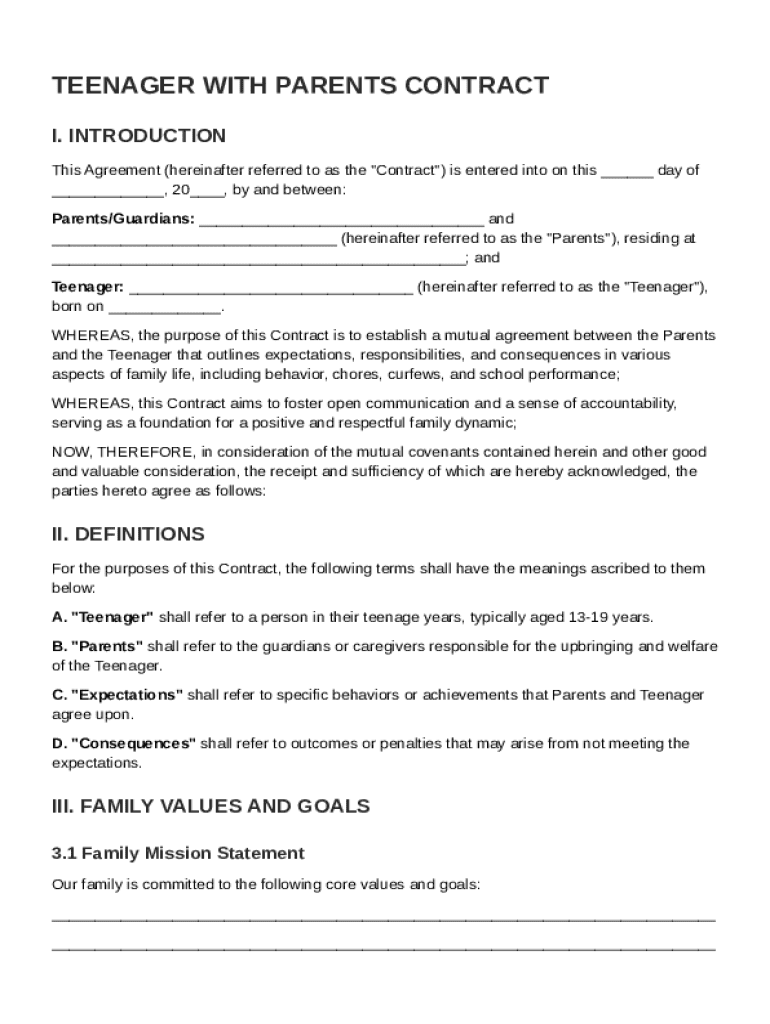
A "Teenager With Parents Contract Template" is a structured agreement designed to establish clear expectations and responsibilities between teenagers and their parents. This form functions as a guideline to promote mutual understanding, helping both parties navigate areas such as behavior, chores, curfews, and academic performance. It fosters open communication and accountability, aiming to create a positive family dynamic by setting defined rules that both sides agree to uphold.
Relevant Scenarios
- Behavioral Guidelines: Specify expected conduct, including respect towards family members and adherence to house rules.
- Chores and Responsibilities: Outline daily and weekly tasks, ensuring the teenager actively contributes to household maintenance.
- Curfews and Free Time: Establish appropriate curfew times and standards for managing free hours to balance personal time with family duties.
- Academic Performance: Detail expectations regarding school activities, homework, and acceptable grades.
Steps to Complete the Teenager With Parents Contract Template
Initial Discussion
- Open Dialogue: Begin with a discussion involving both the parents and the teenager, ensuring that all parties can voice their expectations and concerns.
- Define Objectives: Clearly outline the goals of the contract, such as improved behavior or academic performance, to align expectations.
Drafting the Contract
- Customize Terms: Tailor the template to fit the family’s specific needs by specifying rules and responsibilities.
- Assign Consequences and Rewards: Determine appropriate consequences for rule violations and rewards for compliance.
- Set Timeframes: Define start and end dates for the contract, allowing for periodic review and adjustment based on the teenager’s progress.
Finalization
- Review and Agree: Go over the final draft with all parties, making sure everyone understands and agrees to the terms.
- Sign the Document: Have both parents and the teenager sign the contract to signify acceptance and commitment.
Key Elements of the Teenager With Parents Contract Template
Fundamental Components
- Expectations: Clearly articulated guidelines regarding acceptable and unacceptable behaviors.
- Responsibilities: Detailed description of duties, including household chores and homework.
- Communication Strategy: Mechanisms for ongoing dialogue to address issues as they arise.
- Evaluation Points: Specific metrics for assessing compliance and effectiveness of the contract.
Practical Examples
- Chores List: A schedule that outlines specific tasks the teenager is responsible for each day and week.
- Academic Expectations: Required GPA or grade benchmarks that need to be met each semester.
Important Terms Related to the Teenager With Parents Contract Template
Key Terminology
- Mutual Respect: Understanding and valuing each individual's role within the agreement.
- Accountability: Holding the teenager and parents responsible for fulfilling their respective obligations.
- Negotiation: Dialogue process for reaching consensus on contract terms to ensure buy-in from both parties.
Contextual Use
- Responsibility: The teenager agrees to complete assigned chores and homework.
- Consequences: Define specific penalties for not adhering to the agreed tasks or expectations.
How to Use the Teenager With Parents Contract Template
Practical Application
- Personalization: Modify the template to reflect family values, expectations, and the unique circumstances of the teenager.
- Regular Updates: Revisit and revise the contract periodically to ensure it remains relevant and effective as the teenager matures.
Usage Insights
- Conflict Resolution: Employ the contract as a reference point during disputes to foster fair and equitable solutions.
- Goal Setting: Use the contract as a tool to set and achieve developmental goals, both academic and personal.
Who Typically Uses the Teenager With Parents Contract Template


General Users
- Families: Parents seeking to improve communication and set clear boundaries with their teenagers.
- Counselors and Educators: Professionals who might recommend or facilitate the use of such templates to address behavioral or academic issues.
Use Cases
- Therapeutic Contexts: Family therapists may utilize the template to guide discussions and enforce boundaries in a counseling setting.
- Educational Frameworks: Schools might adopt a similar approach to manage student behavior and performance expectations.
Legal Use of the Teenager With Parents Contract Template
Compliance and Enforcement
- Contract Binding Nature: Although not legally enforceable in the traditional sense, the template is a powerful tool for setting expectations and follow-through within the family.
- Conflict Avoidance: Provides a formalized method to prevent disputes by clearly outlining roles, responsibilities, and consequences.
Limitations
- Legal Recognition: Understand that while the template brings structure and accountability, it is not recognized as a legally binding document in court.
Examples of Using the Teenager With Parents Contract Template
Case Study Insights
- Case Study A: A family experiencing frequent arguments about missed curfews used the contract to agree on a reasonable time for the teenager to return home, resulting in improved trust.
- Case Study B: A teenager struggling with school performance found motivation through the contract’s rewards clause for meeting grade goals, leading to improved academic success.
Real-World Applications
- Curfew Adjustments: A family uses the contract to periodically adjust curfew times based on the teenager’s academic responsibilities and social activities.
- Incentive Programs: Parents develop a system of rewards tied to school performance, household contributions, and adherence to agreed-upon rules.
This comprehensive exploration of the "Teenager With Parents Contract Template" offers detailed insights into its purpose, structure, and application. By understanding these aspects, families can better utilize the template to enhance communication and accountability within the home.