




01. Edit your form online
Type text, add images, blackout confidential details, add comments, highlights and more.

Type text, add images, blackout confidential details, add comments, highlights and more.

Draw your signature, type it, upload its image, or use your mobile device as a signature pad.

Send it via email, link, or fax. You can also download it, export it or print it out.
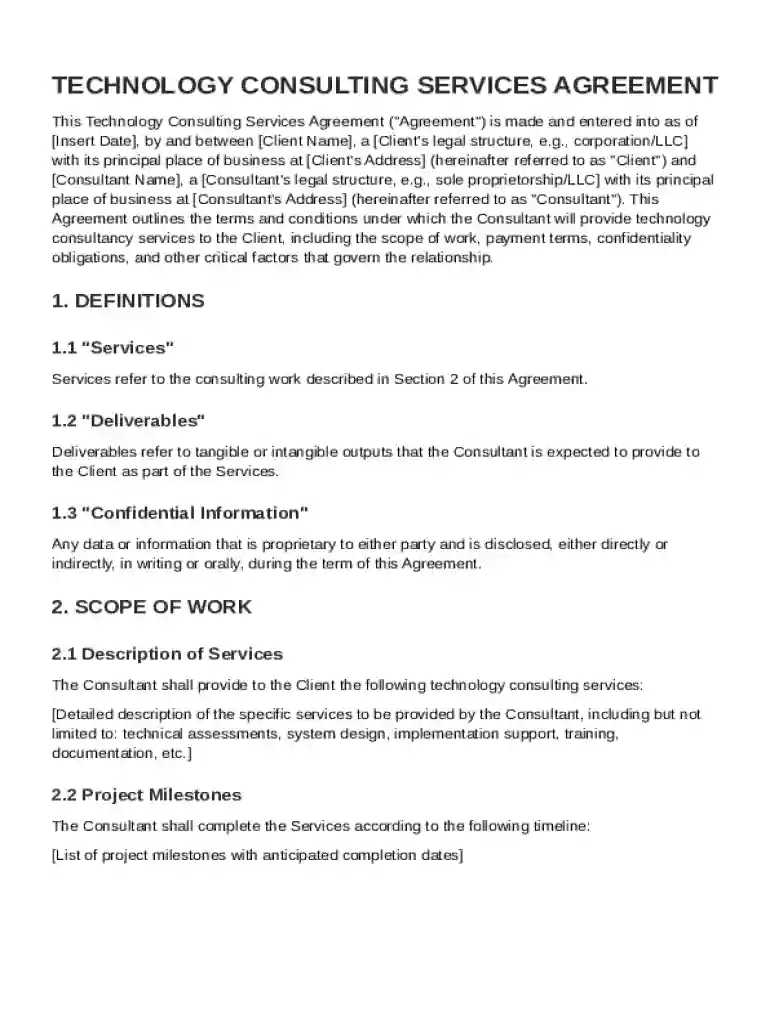
The Technology Consult Contract Template serves as a blueprint for defining the professional relationship between a consultant and a client in the realm of technology services. It is essential to understand the vital components embedded within this template:
Scope of Work: This section delineates the specific tasks and deliverables the consultant is expected to complete. It’s crucial to have a precise description to avoid misunderstandings and define the project's boundaries.
Compensation Details: Here, the payment terms are explicitly stated. This includes the consultant's fee structure, payment schedule, and any potential bonuses or penalties tied to performance metrics.
Confidentiality Obligations: Given the sensitive nature of technology consulting, the agreement must outline the consultant’s duty to safeguard proprietary and confidential information shared during the course of the project.
Liability Limitations: This element limits the consultant's responsibility for damages or losses incurred by the client. Typically, it includes clauses that specify the maximum liability amount.
Termination Conditions: Both parties need clear guidelines on how and under what circumstances the agreement can be terminated. This section covers notice periods and any conditions that could lead to early termination.
Ownership of Deliverables: It’s essential to clarify who holds the rights to the work produced during the consulting engagement. This component is pivotal in avoiding future disputes over intellectual property.
Governing Law: This clause states the jurisdiction's laws that will govern the contract. It is vital to agree on which state or country’s legal framework will apply to the agreement.
The Technology Consulting Services Agreement, commonly known as a Technology Consult Contract, is a legally binding document that formalizes the relationship between a technology consultant and their client. This agreement serves as a roadmap for both parties, outlining the terms and conditions under which consulting services will be provided. Through this template, both the consultant and client can align on expectations, deliverables, and responsibilities, significantly reducing the risk of disagreements.
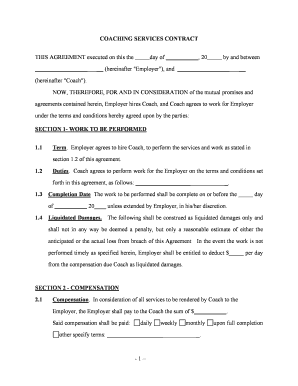
Filling out the Technology Consult Contract Template involves several key steps designed to ensure completeness and accuracy:
Identify Parties: Clearly state the legal names of the consultant and client involved in the agreement. This identification must be precise to avoid any potential legal questions.
Define Scope and Objectives: Elaborate on the specific services that will be provided, including details such as timelines, project milestones, and deliverable descriptions.
Detail Financial Arrangements: Outline the payment terms including the amounts, schedule, and payment methods. Be sure to specify any conditions that could alter payment, such as performance-based incentives or penalties.
Specify Confidentiality Terms: Establish the levels of confidentiality required for the project. Define what constitutes confidential information and the obligations of both parties to protect it.
Include Termination Clauses: Provide the conditions under which either party can terminate the contract, including specific notice periods and any applicable penalties.
Confirm Intellectual Property Rights: Clearly state who will own the intellectual property developed during the project and any rights the client may have to use it.
Add Governing Law Clauses: Indicate which jurisdiction's laws will govern the contract to preemptively address any legal jurisdictional issues.
Understanding specific terminology associated with the Technology Consult Contract Template is pivotal for both parties:
Deliverables: Tangible or intangible outcomes that the consultant is expected to provide upon project completion.
Indemnification: A clause where one party agrees to compensate another for any harm or loss arising out of the contract.
Force Majeure: Refers to unforeseeable circumstances that prevent one or both parties from fulfilling their contractual obligations.
Non-compete Clause: A section preventing the consultant from engaging in business that competes with the client during and after the engagement.
Retainer Fee: An upfront cost paid to secure the consultant's services, often applied as a credit towards the total fees incurred.
The Technology Consult Contract Template is instrumental for various stakeholders within the technology sector:
Freelance Consultants: Independent experts offering specialized IT services who need to formalize their working relationships with clients.
Technology Firms: Companies providing technology services that require precise agreements to define projects for their clients.
Startups: Emerging companies leveraging external expertise in technology to fortify their operations or develop new products.
Tech-driven Enterprises: Organizations that frequently engage with consultants to maintain competitiveness through innovative technology solutions.


The practical application of a Technology Consult Contract Template varies widely across different scenarios:
Developing a New Software Solution: A tech startup might employ a consultant to help design software, necessitating a contract that clarifies IP ownership and project phases.
Performing IT System Audits: Corporations often hire specialists to audit systems, emphasizing confidentiality agreements in the contract to protect sensitive data.
Outsourcing IT Support: Businesses may engage third-party consultants for tech support. The contract will typically include detailed service level agreements (SLAs) within the scope of work.
Implementing Cybersecurity Protocols: A financial institution might use this contract to bring in a consultant to enhance cybersecurity measures, defining responsibilities around data protection.
The Technology Consult Contract Template must comply with specific legal stipulations to be enforceable:
ESIGN Act Compliance: If the contract is to be signed electronically, it must comply with regulations under the Electronic Signatures in Global and National Commerce Act, ensuring that electronic signatures hold the same weight as physical signatures.
UCC (Uniform Commercial Code) Provisions: For contracts involving the sale of goods/services, alignment with UCC standards is necessary to ensure legality across states.
Data Protection Regulations: Particularly relevant in contracts involving data handling, compliance with regulations like the California Consumer Privacy Act (CCPA) is mandatory.
ADA (Americans with Disabilities Act) Compliance: Ensures accessibility in contracts when engaging with parties that require accommodation for disabilities.
In the current technological landscape, the choice between digital and paper versions of a Technology Consult Contract comes with its own implications:
Digital Advantages: Offers convenience and efficiency with capabilities such as electronic signatures, easy sharing, and storage. Digital contracts are environmentally friendly and allow for instantaneous updates.
Paper Advantages: Some parties may prefer paper due to its tangible nature, requiring physical signatures and offering a traditional form of security that some clients trust more.
Considerations for Choice: Depending on the client's technological readiness and preference, one method may be favored. Some organizations enforce strict documentation processes that necessitate paper copies for archival purposes.
At DocHub, your data security is our priority. We follow HIPAA, SOC2, GDPR, and other standards, so you can work on your documents with confidence.



The consultant will provide technical assistance for home energy audits, review audit reports, and provide feedback, attending audits and reviewing reports.
Mar 24, 2022 Discover the essential components of a robust consulting agreement. Learn how to create a solid contract with these 12 key elements.


