Sound Production Contract Template 2026

Get Form
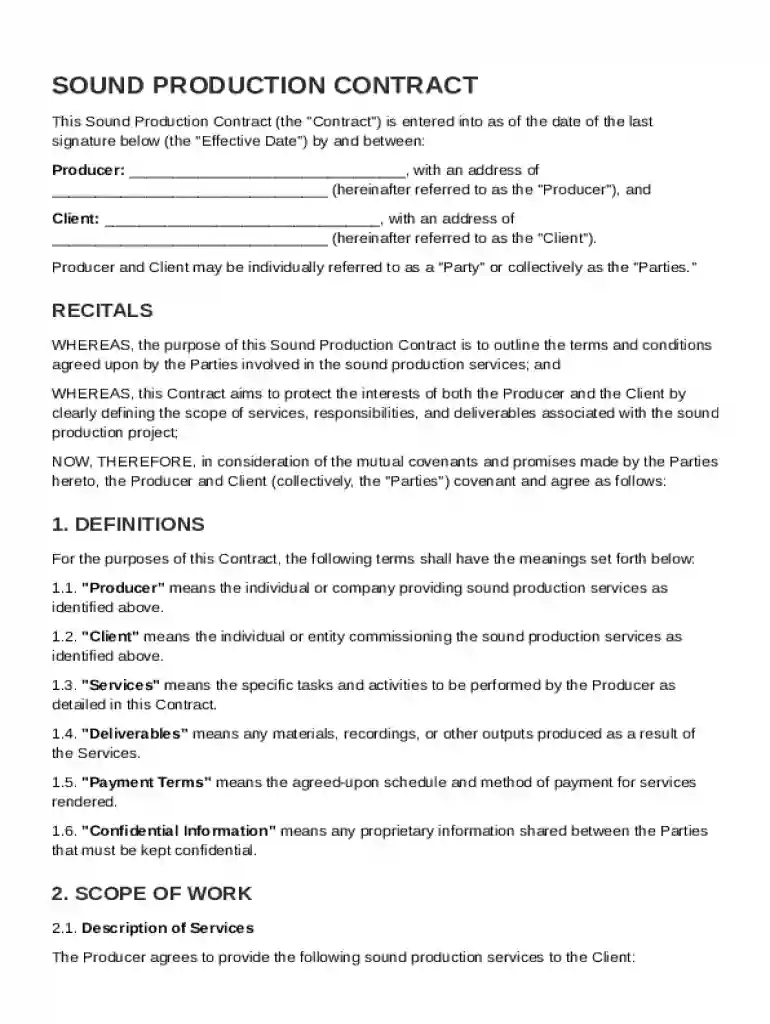
Sound Production Contract Template Preview on Page 1

Here's how it works

01. Edit your form online
Type text, add images, blackout confidential details, add comments, highlights and more.

02. Sign it in a few clicks
Draw your signature, type it, upload its image, or use your mobile device as a signature pad.

03. Share your form with others
Send it via email, link, or fax. You can also download it, export it or print it out.

Definition & Meaning

A Sound Production Contract Template is a structured legal document that formalizes the agreement between a Producer and a Client for sound-related services. It delineates the roles, responsibilities, and expectations of both parties in a sound production project. This template serves to protect both parties' rights and interests by laying out the agreement's specifics, including payment terms, deliverable ownership, and confidentiality requirements. By utilizing such a template, both Producers and Clients can ensure that project terms are clear, reducing the likelihood of misunderstandings and disputes.

Key Elements of the Sound Production Contract Template

Roles and Responsibilities

  • Producer Responsibilities: Outline tasks related to creating, editing, and delivering sound content. The document should clearly specify what will be provided, how, and when.
  • Client Responsibilities: Typically include providing access to necessary resources and adhering to payment timelines.

Payment Terms

  • Fee Structure: Set expectations for the pricing model, such as a flat fee, hourly rate, or milestone payments.
  • Payment Schedule: Detail when and how payments will be made to the Producer, including any deposits or final balances due upon project completion.

Ownership and Intellectual Property Rights

  • Deliverables: Define what constitutes deliverables and who will own the final productions.
  • Rights Retention: Specify what rights the Producer may retain, such as the right to use work samples for promotional purposes.

Confidentiality Obligations

  • Non-Disclosure Agreement: Include clauses that prevent the sharing of sensitive project information with unauthorized parties.
  • Duration: Clarify how long confidentiality obligations last beyond the project's end.

Termination Clauses

  • Grounds for Termination: Detail conditions under which the contract can be terminated by either party, including breaches of contract or failure to meet obligations.
  • Notice Requirements: State the required notice period for terminating the contract and any compensations or remedies due.

Liability Limitations

  • Liability Caps: Establish limits on the extent of liability for both parties, typically related to the value of the contract.
  • Exclusions: Specify any circumstances under which liability might not apply, such as force majeure events.

Steps to Complete the Sound Production Contract Template

  1. Gather Information: Collect all necessary details from both parties, including names, addresses, and contact information.
  2. Define Scope of Work: Clearly articulate the services to be provided, milestones, and deliverables.
  3. Fill in Financial Details: Complete sections on payment terms, including fees and schedules.
  4. Clarify Rights and Obligations: Detail ownership rights, confidentiality terms, and responsibilities of each party.
  5. Set Contract Terms: Finalize termination conditions, liability limitations, and any dispute resolution terms.
  6. Review and Sign: Both parties should review the completed template, make any necessary adjustments, and provide signatures in agreement.

Legal Use of the Sound Production Contract Template

Using a Sound Production Contract Template legally protects both parties involved in a sound production project. The document should comply with relevant laws and regulations, and it is advisable to consult a legal expert to ensure completeness and legality. Properly executed, the contract acts as a legally binding agreement that supports claims and defenses in case of disputes.

State-Specific Rules for the Sound Production Contract Template

Sound Production Contract Templates may need adjustments to align with state-specific legal requirements. Each state in the United States may have different regulations regarding contract enforcement, intellectual property rights, and dispute resolution procedures. It is important to tailor the template to comply with local laws, and engaging with a local legal advisor is recommended for this purpose. Some states might have unique tax implications or require additional disclosures in contracts related to sound production services.

Why Should You Use a Sound Production Contract Template

Protecting Interests

  • Ensures that the rights and expectations of both parties are clearly documented.
  • Reduces the risk of conflicts by setting out all the terms of the agreement upfront.

Streamlining Negotiations

  • By having a structured document, discussions can focus on filling and adjusting predefined sections, saving time.
  • Provides a standardized starting point that can be easily customized to suit specific project needs.

Examples of Using the Sound Production Contract Template

Example 1: Studio Production

A music producer enters into a contract with an artist to produce a new album. The template helps outline details such as the number of tracks, payment schedule, and rights to master recordings.

Example 2: Podcast Series

A content creator hires a sound engineer to provide editing services for a podcast. The contract specifies the number of episodes, delivery timelines, and payment terms, and includes a confidentiality agreement for unreleased content.

Digital vs. Paper Version of the Sound Production Contract

Choosing between a digital or paper version of the Sound Production Contract Template may depend on the parties' preferences and procedural requirements.

  • Digital Version: Offers easy distribution and editing capabilities, often integrating with electronic signature platforms like DocHub for secure signing and storage.

  • Paper Version: Might be required where physical signatures are a preference or legal necessity, though it can be less efficient for amendments and sharing.

Regardless of format, ensuring a copy is accessible to both parties is crucial for future reference.

be ready to get more

Complete this form in 5 minutes or less

Get form

Security and compliance

At DocHub, your data security is our priority. We follow HIPAA, SOC2, GDPR, and other standards, so you can work on your documents with confidence.
Learn more
ccpa2
pci-dss
gdpr-compliance
hipaa
soc-compliance
be ready to get more

Complete this form in 5 minutes or less

Get form