




01. Edit your form online
Type text, add images, blackout confidential details, add comments, highlights and more.

Type text, add images, blackout confidential details, add comments, highlights and more.

Draw your signature, type it, upload its image, or use your mobile device as a signature pad.

Send it via email, link, or fax. You can also download it, export it or print it out.
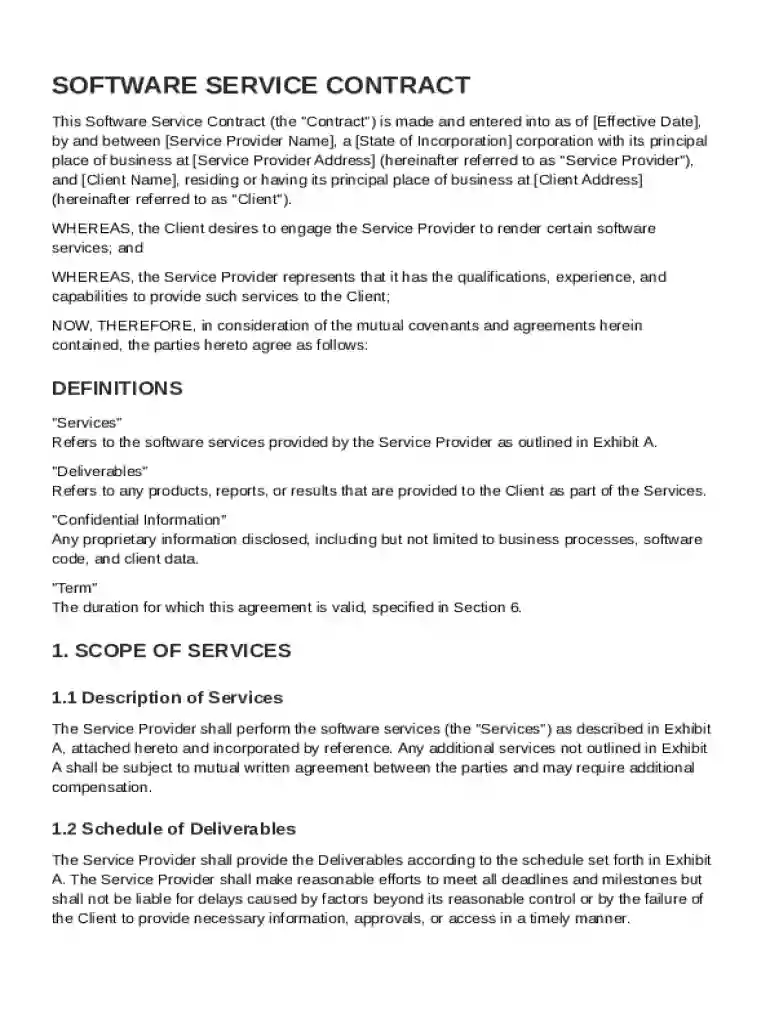
A Software Service Contract Template defines the formal agreement between a service provider and a client regarding the provision of software services. This template serves as a blueprint to outline the terms and conditions under which the services are delivered. It generally includes sections detailing service descriptions, scope, and terms of compensation. The template also specifies the responsibilities of both parties and addresses confidentiality and intellectual property rights. Additionally, it covers the duration of the contract, termination conditions, warranties, and dispute resolution processes. By using such a template, both parties set clear expectations and establish a legal framework that ensures protection throughout the engagement.
When you decide to use a Software Service Contract Template, the first step is to carefully customize it to meet the specific needs of your arrangement. Service providers should start by entering detailed descriptions of the services being offered, including all deliverables, timelines, and any pertinent milestones. Clients will need to verify that these details align with their expectations and project requirements. It is also important to fill in information regarding payment terms, including rates, payment schedules, and methods of payment. Before finalizing the contract, both parties should review the responsibilities and rights outlined to ensure mutual understanding and agreement, making necessary adjustments to reflect any negotiations that have taken place.
Identify Parties Involved: Start by clearly identifying the service provider and the client within the contract, including contact information and relevant business details.
Define Scope of Services: Detail the specific software services being provided. Include an exhaustive list of tasks, deliverables, and project deadlines.
Set Compensation Terms: Specify the compensation details such as price, payment schedule, and mode of payment. Ensure this section aligns with negotiations and comprehensively covers the financial aspects.
Outline Responsibilities: Clearly define the responsibilities for both the provider and the client to avoid misunderstandings.
Establish Terms of Confidentiality: Outline any confidentiality obligations to protect sensitive information exchanged during the contract period.
Address Intellectual Property Rights: Clarify ownership of any intellectual property created under the contract to prevent disputes later.
Include Contract Duration and Termination Conditions: State the duration of the contract and conditions that allow for its termination.
Review and Sign: Both parties should thoroughly review the contract for any errors or misalignments. Once everything is in order, sign the document to make it legally binding.
This template is primarily used by software development companies, IT service providers, and freelance software developers who enter into agreements with clients to provide various software-related services. It is also leveraged by business clients, such as corporations and startups, seeking to hire software services for internal or customer-facing applications. Such templates are essential for companies and individuals operating within tech industries to ensure all service engagements are carried out in a structured, legal manner, providing clarity and protection for both service providers and recipients.


The Software Service Contract Template ensures that all parties involved in the software service agreement are protected by law. It defines the legal obligations and rights, making it a binding document in case of disputes. For enforceability, it must comply with federal and state laws, and any deviations or addendums should be mutually agreed upon and documented. Legal professionals often review the finalized template to ascertain compliance and correctness, recommending adjustments to prevent ambiguities that could lead to potential legal challenges.
Each U.S. state may have variations in laws affecting software service contracts. Important considerations, such as consumer protection laws, data privacy legislation, and intellectual property statutes, can vary between states. It is crucial to determine the governing law clause within the template to specify which state's laws apply, particularly when the contracting parties are located in different states. When drafting or finalizing contracts, consulting with legal experts familiar with state-specific requirements proves beneficial in ensuring that the template complies with the necessary regional standards.
At DocHub, your data security is our priority. We follow HIPAA, SOC2, GDPR, and other standards, so you can work on your documents with confidence.



Aug 1, 2016 The terms and conditions of those license agreements are available below, as well as in the header files and documentation file accompanying
General Purpose. The general purpose of this Agreement is to engage the services of Consultant to perform the services and provide the deliverables


