




Key Elements of the Responsibility Agreement Template
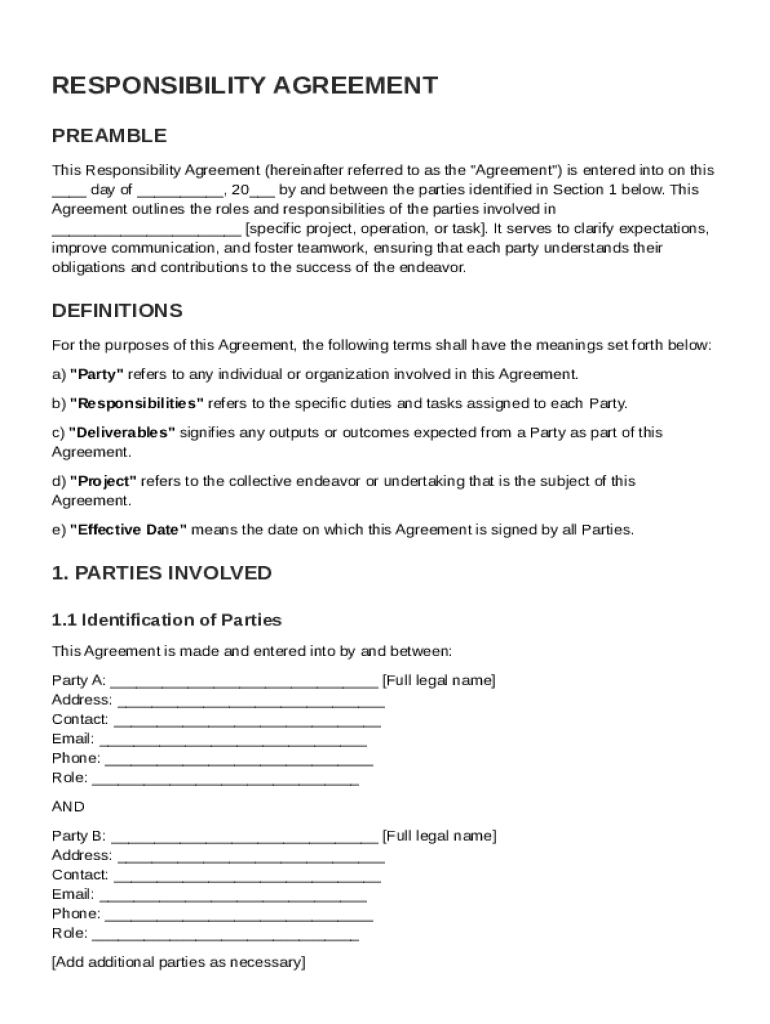
A Responsibility Agreement Template is a crucial document designed to clearly outline the roles and responsibilities of parties involved in a project. This ensures that expectations are aligned, communication is effective, and teamwork is facilitated. The template typically includes several key elements:
-
Identification of Parties Involved: It is essential to clearly identify each party participating in the project. This often includes individuals or entities responsible for various tasks and deliverables.
-
Delineation of Responsibilities: Each party's specific duties and deliverables should be outlined in detail to avoid confusion and ensure accountability.
-
Project Timeline: The template should include a timeline that specifies when tasks need to be completed. This helps in monitoring progress and ensuring that the project stays on schedule.
-
Communication Protocols: Established methods for communication should be defined to ensure that information is exchanged effectively between parties. This includes regular meetings, updates, or communication channels.
-
Acknowledgment and Acceptance: There should be a section where all parties acknowledge their understanding and acceptance of the outlined responsibilities. This usually involves signing and dating the document.
Steps to Complete the Responsibility Agreement Template
Completing a Responsibility Agreement Template involves several structured steps to ensure comprehensive and clear documentation:
-
Gather Necessary Information: Collect all relevant details about the project, including the parties involved, goals, timelines, and specific tasks.
-
Identify and Assign Roles: Clearly define the roles of each participant. Ensure that each party understands their specific responsibilities and how they contribute to the project's success.
-
Establish Timeframes: Set deadlines for each task. This helps maintain project momentum and ensures accountability.
-
Define Communication Plans: Decide on how communication will be conducted throughout the project. This might involve regular meetings, email updates, or the use of collaboration tools.
-
Draft the Agreement: Use the Responsibility Agreement Template to draft the document, integrating all the above elements.
-
Review and Revise: Allow all parties to review the draft. Make necessary revisions based on their feedback to ensure clarity and mutual agreement.
-
Sign and Acknowledge: Once finalized, all parties should sign the document. This formalizes their commitment to the responsibilities and terms outlined.
How to Use the Responsibility Agreement Template
Utilizing a Responsibility Agreement Template effectively requires a clear understanding of its purpose and components. Here’s how it can be used:
-
Project Planning: At the project's beginning, use the template to map out responsibilities and timelines, which will serve as a project roadmap.
-
Task Allocation: During the project, refer back to the document to ensure that tasks are being performed as assigned and that all parties are meeting their obligations.
-
Conflict Resolution: If disputes arise, the template serves as a reference to resolve issues related to task responsibilities and deadlines.
-
Project Evaluation: Post-project, review the template to assess performance against the outlined responsibilities and timelines. This can help identify areas for improvement in future projects.
Important Terms Related to the Responsibility Agreement Template
Understanding specific terminology associated with a Responsibility Agreement Template helps in accurately interpreting its contents. Some key terms include:
-
Deliverables: These are the tangible or intangible outputs that parties must produce as part of their responsibilities.
-
Milestones: Significant points or events in the project timeline used to gauge progress.
-
Stakeholders: Individuals or groups with an interest or investment in the project's outcome.
-
Scope of Work: The specific tasks and objectives that the parties have agreed to undertake.
-
Amendments: Modifications made to the agreement after its initial signing, usually documented formally in writing.
Legal Use of the Responsibility Agreement Template
Responsibility Agreements must comply with applicable legal standards to ensure their enforceability. Important legal considerations include:
-
Binding Nature: Once signed, the agreement becomes legally binding, meaning that parties are obliged to adhere to their outlined responsibilities.
-
Amendment Provisions: The document should allow for amendments to be made in writing, ensuring that all changes are formally recognized and agreed upon by all parties.
-
Termination Conditions: Conditions under which the agreement can be terminated should be clearly outlined to protect all parties involved.
-
Confidentiality Clauses: Often included to protect sensitive information involved in the project.
Examples of Using the Responsibility Agreement Template
Using practical examples can illustrate how a Responsibility Agreement Template functions in various scenarios:
-
Construction Projects: In construction, such agreements assign specific duties to architects, contractors, and subcontractors, ensuring clarity throughout the building process.
-
Software Development: In a software development team, responsibilities might be divided among developers, testers, and project managers, with deadlines and deliverables clearly specified.
-
Marketing Campaigns: For marketing campaigns, the agreement can delineate tasks among creative teams, media buyers, and account managers, facilitating synchronized efforts.
Variants or Alternatives to the Responsibility Agreement Template
Different situations may require adaptations or alternatives to the standard Responsibility Agreement Template:
-
Memorandum of Understanding (MOU): Used when parties need a non-binding agreement to outline intentions and roles at a high level.
-
Service Level Agreement (SLA): Ideal when focusing on the performance aspects of service provision, particularly in IT and telecommunication sectors.
-
Project Charter: Used primarily in project management to formally authorize a project or phase and document initial requirements.
Digital vs. Paper Version
Choosing between a digital and paper version of the Responsibility Agreement Template may depend on several factors:
-
Accessibility: Digital versions offer easy sharing and editing capabilities, improving access and collaboration, especially for remote teams.
-
Security: Digital forms can include encryption and password protection, adding an extra layer of security.
-
Environmental Impact: Digital templates reduce paper usage, supporting environmentally friendly practices.
-
Legal Validity: Both digital and paper versions are often equally valid legally, provided that electronic signatures meet security and compliance standards.