




01. Edit your form online
Type text, add images, blackout confidential details, add comments, highlights and more.

Type text, add images, blackout confidential details, add comments, highlights and more.

Draw your signature, type it, upload its image, or use your mobile device as a signature pad.

Send it via email, link, or fax. You can also download it, export it or print it out.
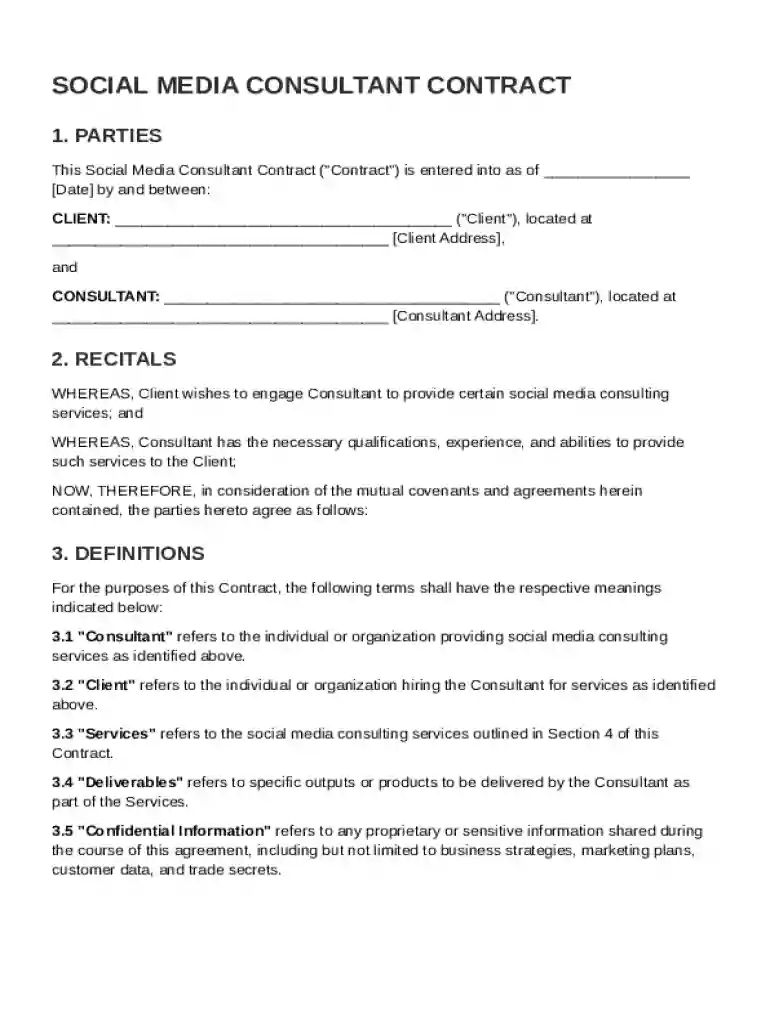
A Social Media Consultant Contract Template is a standardized document used to formalize the agreement between a client and a social media consultant. This template serves as a framework for detailing the roles and responsibilities of both parties, encompassing key aspects such as deliverables, timelines, and compensation. The purpose of using such a template is to ensure clarity and mutual understanding, reducing the likelihood of disputes and misunderstandings. It typically includes important sections on confidentiality, intellectual property rights, and termination conditions, all of which are vital for protecting the interests of both the client and consultant.
The contract template includes several essential components designed to clearly outline the scope of services and expectations.
These sections are crucial for legal clarity and operational efficiency within the agreement framework.
Completing the Social Media Consultant Contract Template involves several critical steps to ensure accuracy and comprehensiveness.
Each step should include meticulous attention to detail to ensure that all contractual obligations are adequately captured.
Understanding the terminology in the contract is crucial for both parties. Here are some key terms to be familiar with:
A proper grasp of these terms is essential for a thorough understanding of the contract’s legal implications.
This template is widely used by various entities, including:
Understanding who uses these contracts enables better tailoring of the template to meet specific needs.


Contracts in the United States are often subject to state-specific regulations that may affect their enforceability or content.
Recognizing these state-specific rules helps ensure that the contract is compliant with local legal requirements.
Using this contract template legally involves adhering to certain standards and practices.
Being aware of these legal considerations ensures that the contract is valid and enforceable.
The following are practical scenarios illustrating the application of this contract template:
Each example highlights the utility of the template in ensuring clear expectations and responsibilities for all involved parties.
At DocHub, your data security is our priority. We follow HIPAA, SOC2, GDPR, and other standards, so you can work on your documents with confidence.

The Town hereby engages Consultant, as an independent contractor, who will be primarily responsible to act as the lead for a number of communications activities.
Consultant is an independent contractor, and fully and solely responsible for (a) the performance and supervision of the Services; (b) Consultant Personnel (
by T Akatsuka 2019 Cited by 1 To address this issue, Fujitsu proposes the use of a consulting method to develop a customer-oriented cul- ture on the basis of a customers viewpoints. This


