




01. Edit your form online
Type text, add images, blackout confidential details, add comments, highlights and more.

Type text, add images, blackout confidential details, add comments, highlights and more.

Draw your signature, type it, upload its image, or use your mobile device as a signature pad.

Send it via email, link, or fax. You can also download it, export it or print it out.
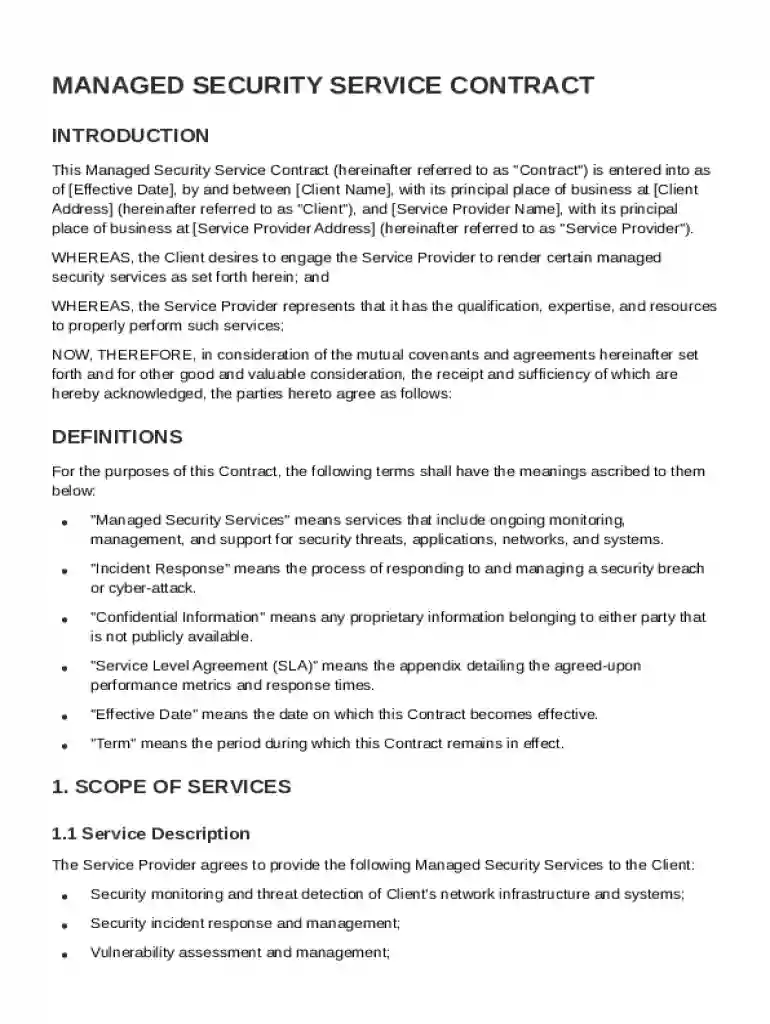
The Managed Security Service Contract Template is a structured document that formalizes the agreement between a client and a service provider for the delivery of managed security services. This template serves as a reference for creating a comprehensive, legally-binding contract specifying the managed services scope, client and provider responsibilities, payment terms, and compliance obligations. It ensures both parties are on the same page about expectations and safeguards confidential information through detailed confidentiality clauses.
A comprehensive Managed Security Service Contract Template is composed of several critical sections:
When utilizing this template, it's important to tailor each section to reflect the particular needs and expectations of both parties. Begin by reviewing the scope of services and ensuring it aligns with the client's security requirements. Adjust the SLA terms to include specific performance indicators and thresholds. Use relevant payment terms that account for your organization's cash flow preferences. Ensure that confidentiality clauses adhere to current data protection regulations applicable to your industry.
Filling out the Managed Security Service Contract Template involves a series of methodical steps:
The Managed Security Service Contract Template is legally enforceable once signed by both parties. Legal use involves:
Businesses of various sizes that require enhanced security services due to the sensitivity of their operations are the primary users of this template. Organizations in industries such as finance, healthcare, and technology, where data protection is paramount, find this template particularly beneficial. It ensures they can effectively outsource security operations while maintaining strict control over data confidentiality.


While the template provides a foundational structure, state-specific regulations must be considered. This includes:
Legal counsel should review the template considering state-specific requirements to ensure complete compliance.
Examples include:
Each organization customizes the template according to its unique security needs, industry regulations, and business processes.
At DocHub, your data security is our priority. We follow HIPAA, SOC2, GDPR, and other standards, so you can work on your documents with confidence.

PDF Icon. download. Download Free PDF. Download Free PDF. Contract for Security Service Arrangement Contract for Security Service Arrangement Year 20 This
Dell Technologies Services is pleased to provide Endpoint security implementation service for software (the. Service(s)) in accordance with this Service


