






Definition and Meaning
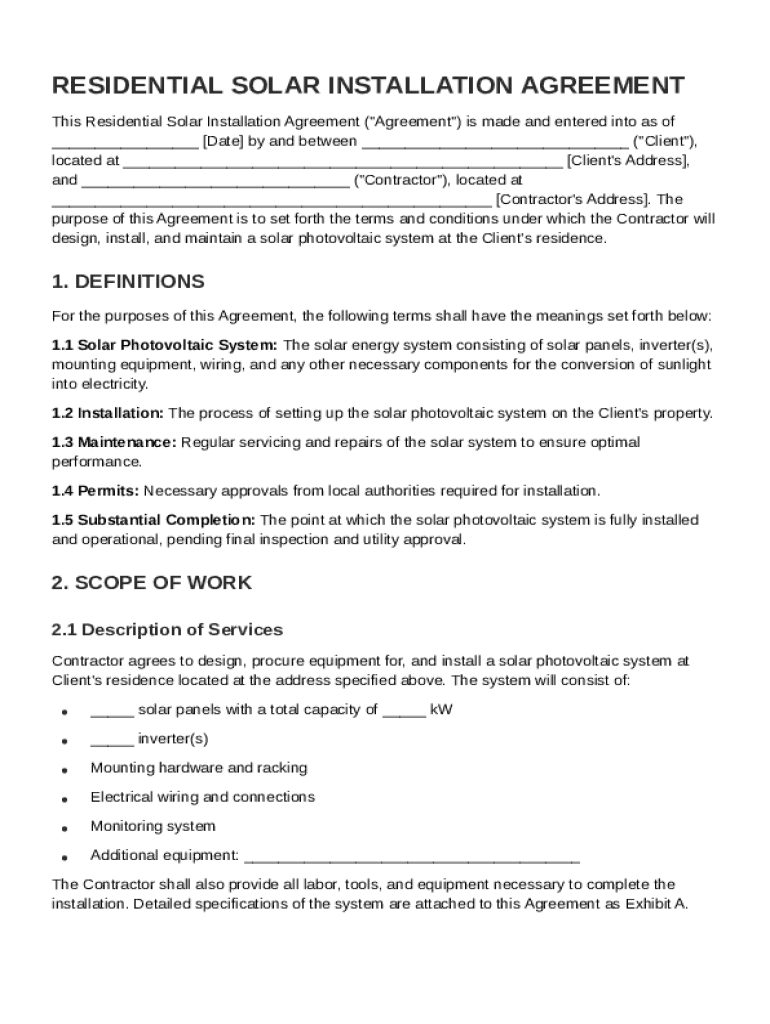
The Residential Solar Contract Template serves as a formal agreement outlining the terms and conditions between a client and a contractor for the design, installation, and maintenance of a solar photovoltaic system at a client's residence. This document ensures that both parties have a mutual understanding of the expectations and responsibilities involved in the solar installation project. It typically includes legal stipulations, scope of work, payment terms, and warranties, providing a clear framework for the completion of the solar installation.
Key Components
- Scope of Work: Details the specific tasks and responsibilities of the contractor regarding the solar installation.
- Payment Terms: Explains the financial arrangements, including down payments, installment schedules, and penalties for late payments.
- Warranty Information: Provides information on the warranties covering both the installation work and the solar equipment itself.
- Client Responsibilities: Outlines any preparatory steps the client must undertake, such as obtaining necessary easements or ensuring accessibility to the premises.
Key Elements of the Residential Solar Contract Template
The effectiveness of a Residential Solar Contract Template hinges on several essential components that must be included to avoid potential disputes and ensure smooth operations.
Important Clauses
- Permits and Approvals: Clarifies who is responsible for obtaining the necessary permits and approvals from local or state authorities before starting the installation.
- Termination Conditions: Lists the conditions under which either party can terminate the agreement, such as failure to perform or unexpected regulations.
- Liability Limitations: Defines the extent to which each party is liable for damages or deficiencies arising during the project.
Additional Considerations
- Timeline and Project Milestones: Establishes a timeline for key project phases and completion dates to set expectations for the project's duration.
- Dispute Resolution: Provides a mechanism for resolving conflicts, whether through arbitration, mediation, or legal action.
Legal Use of the Residential Solar Contract Template
Understanding the legal context of the Residential Solar Contract Template is crucial for ensuring compliance and protecting both parties' interests.
Compliance and Legal Validity
- Adherence to ESIGN Act: Ensures that electronic signatures used in the contract are legally binding, providing the same authenticity as traditional signed documents.
- State Regulations: Acknowledges variations in state laws that may affect the legality or contents of the contract, such as specific requirements for renewable energy projects.
Steps to Complete the Residential Solar Contract Template
Successfully filling out the Residential Solar Contract Template requires close attention to detail to ensure all necessary information is accurately provided.
Completion Process
- Fill Out Personal and Project Information: Enter the client's and contractor's contact details, along with a precise description of the project site.
- Detail the Scope of Work: Clearly specify the type of solar system to be installed and any customization requested by the client.
- Define Payment Terms and Conditions: Outline the cost of the project, payment schedule, and any financing options if applicable.
- Review and Obtain Necessary Permits: Verify that all necessary permits and licenses have been secured before work commences.
- Confirm Signatures and Complete Document: Obtain all required signatures electronically or on paper to finalize the contract legally.
State-Specific Rules for the Residential Solar Contract Template
Due to varying state regulations, it is essential to tailor the Residential Solar Contract Template to comply with local laws where the project will occur.
Regional Variations
- California: Requires additional disclosures in contracts due to its stringent energy policies, focusing on consumer protection and efficiency standards.
- New York: Incorporates specific language regarding net metering and energy buy-back agreements.
Why You Should Use the Residential Solar Contract Template
Choosing to use a Residential Solar Contract Template provides several advantages that reduce risks and enhance project outcomes.
Benefits
- Clarity and Transparency: Ensures that both parties understand their responsibilities, reducing misunderstandings and potential conflicts.
- Legal Protection: Provides a legally binding document that protects both parties in case of discrepancies.
- Efficiency in Setup: Facilitates a streamlined process for initiating and executing solar installation projects, saving time and resources.
Examples of Using the Residential Solar Contract Template
Real-world applications can provide insight into how the Residential Solar Contract Template can be effectively utilized.
Practical Applications
- Home Renovations: Utilized as part of larger home improvement projects to incorporate renewable energy solutions.
- New Residential Developments: Employed by developers offering pre-installed solar systems in new housing projects.
- Municipal Initiatives: Used by local governments promoting community-based solar initiatives through agreements with contractors.
Important Terms Related to the Residential Solar Contract Template
Familiarity with essential terms within the contract is crucial for ensuring a clear understanding of the document.
Glossary of Key Terms
- Photovoltaic System: A solar power system that converts sunlight into electricity using semiconductor cells.
- Net Metering: A billing mechanism that credits solar energy system owners for the electricity they add to the grid.
- Renewable Energy Credits (RECs): Certificates representing the environmental benefits of generating one megawatt-hour of renewable energy.
By focusing on these blocks, the content thoroughly covers the key aspects of the Residential Solar Contract Template, providing comprehensive insights and guidance on its effective use and understanding.