






Definition and Meaning
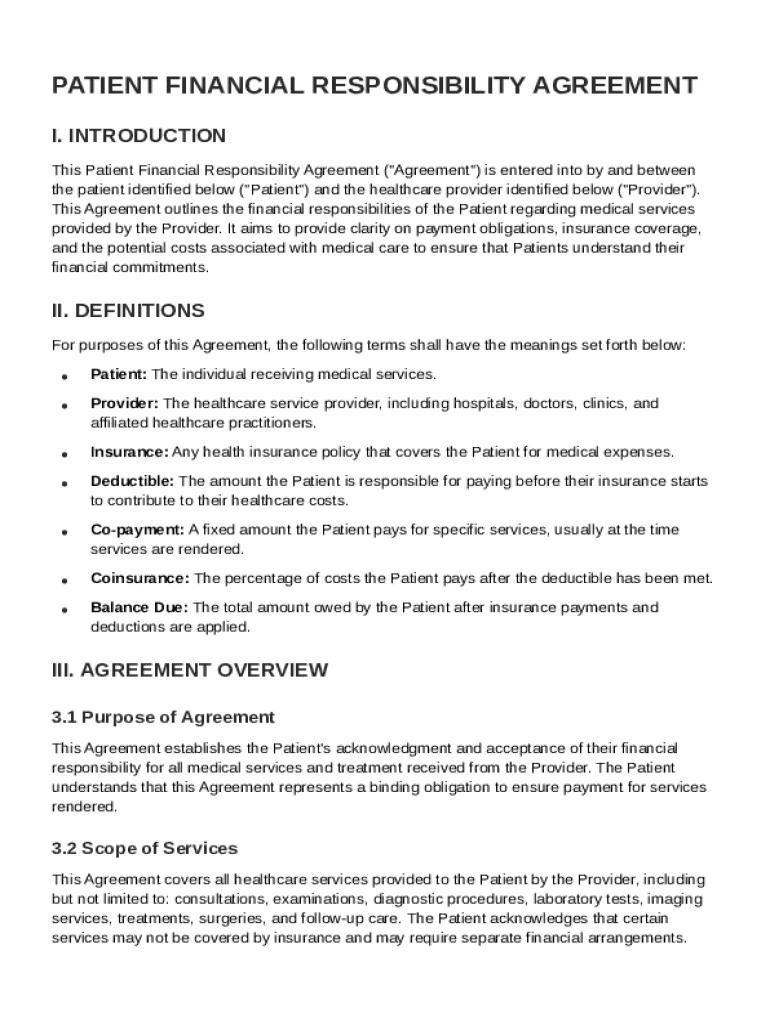
The Patient Financial Responsibility Agreement Template is a formal document used by healthcare providers to outline the financial responsibilities of patients receiving medical services. It establishes clear guidelines regarding the payment requirements for services rendered, including details on deductibles, co-payments, and coinsurance. This agreement serves as a crucial communication tool between healthcare providers and patients, ensuring both parties understand the financial obligations that accompany medical care.
Key Components
- Payment Obligations: Outlines the patient's responsibility to cover costs not paid by insurance.
- Insurance Coverage: Clarifies the necessity for patients to understand their insurance coverage, including what is and isn’t included.
- Billing Process: Describes the procedure for how bills will be issued and what payment methods are acceptable.
- Assistance Programs: Details any available financial assistance options for qualifying patients.
Steps to Complete the Patient Financial Responsibility Agreement Template
Completing the Patient Financial Responsibility Agreement Template involves several critical steps to ensure accuracy and compliance with legal requirements. This guide breaks down the process into manageable phases, making it straightforward for both providers and patients.
Step-by-Step Instructions
- Personal Information: Enter the patient's full name, contact details, and insurance information accurately.
- Service Details: Specify the healthcare services being provided and their associated costs.
- Insurance Details: Document the insurance policy number and coverage specifics.
- Payment Terms: Define the payment schedule and methods, including any options for installment payments.
- Signature Section: Both the healthcare provider and the patient must sign the document to validate the agreement.
Key Elements of the Patient Financial Responsibility Agreement Template
The template includes essential elements that ensure it serves its purpose effectively. Each section is designed to capture vital information that protects both the provider and the patient.
Critical Sections
- Patient Consent: Acknowledgment that the patient understands and agrees to the terms laid out.
- Provider Information: Details of the healthcare facility, ensuring transparency and contactability.
- Terms and Conditions: The legal framework that governs the payment and service provision.
- Amendment Clause: Allows for updates or changes to the agreement, subject to mutual consent.
Important Terms Related to the Patient Financial Responsibility Agreement Template
Understanding the terminology used within the agreement template is essential for both healthcare providers and patients. These terms often carry specific meanings in the context of medical billing and obligations.
Common Terms
- Deductible: The amount a patient must pay out-of-pocket before insurance coverage starts.
- Co-Payment: A fixed fee paid by the patient for specific services at the time of receiving care.
- Coinsurance: The percentage of costs a patient is responsible for after the deductible has been met.
- Authorization: A formal document that grants the provider permission to perform services or procedures.
Legal Use of the Patient Financial Responsibility Agreement Template
The legal framework surrounding the Patient Financial Responsibility Agreement Template ensures it fulfills its role in the healthcare industry. By adhering to established laws, the agreement protects both parties involved.
Compliance and Regulations
- ESIGN Act Compliance: Ensures that electronic signatures are legally binding.
- State-Specific Health Laws: Aligns with state regulations that may affect payment terms and patient rights.
- Data Security: Implements measures such as encryption to protect sensitive patient information.
State-Specific Rules for the Patient Financial Responsibility Agreement Template
Different states may have specific guidelines that impact the application and enforcement of the responsibility agreement. Understanding these variances ensures the agreement is compliant with regional laws.
Examples
- California: Requires additional notices regarding patient rights and billing transparency.
- New York: Mandates specific language related to financial assistance programs.
- Texas: Has rules on how payment plans must be structured for uninsured patients.
Who Typically Uses the Patient Financial Responsibility Agreement Template
The template is primarily used by various stakeholders within the healthcare system to ensure clear communication and understanding of financial responsibilities.


Common Users
- Healthcare Providers: Hospitals, clinics, and private practices who need to formalize payment agreements.
- Patients: Individuals receiving care who need to understand their financial commitments.
- Insurance Companies: As a reference for verifying patient responsibilities and coverage limits.

Versions or Alternatives to the Patient Financial Responsibility Agreement Template
While the Patient Financial Responsibility Agreement Template is widely used, there may be variations or alternative forms that fulfill similar roles in different contexts.
Alternatives
- Custom Agreements: Some providers may tailor their agreement forms to better meet specific needs.
- Electronic Portals: Platforms offering digital agreements and signature capabilities for ease of use.
- Mobile Applications: Apps that allow patients to review and sign agreements on their devices.
Examples of Using the Patient Financial Responsibility Agreement Template
Case studies and examples provide insight into how the template is applied in real-world scenarios, emphasizing its practical benefits.
Real-World Scenarios
- Case Study 1: A hospital successfully implemented the template, reducing payment disputes by 30%.
- Case Study 2: A private practice customized the template to include a section for military veterans, improving patient compliance.
- Scenario 3: A clinic used the template to clarify billing for out-of-network services, resulting in clearer patient communication and fewer complaints.