



Definition and Meaning of Patent License Agreement
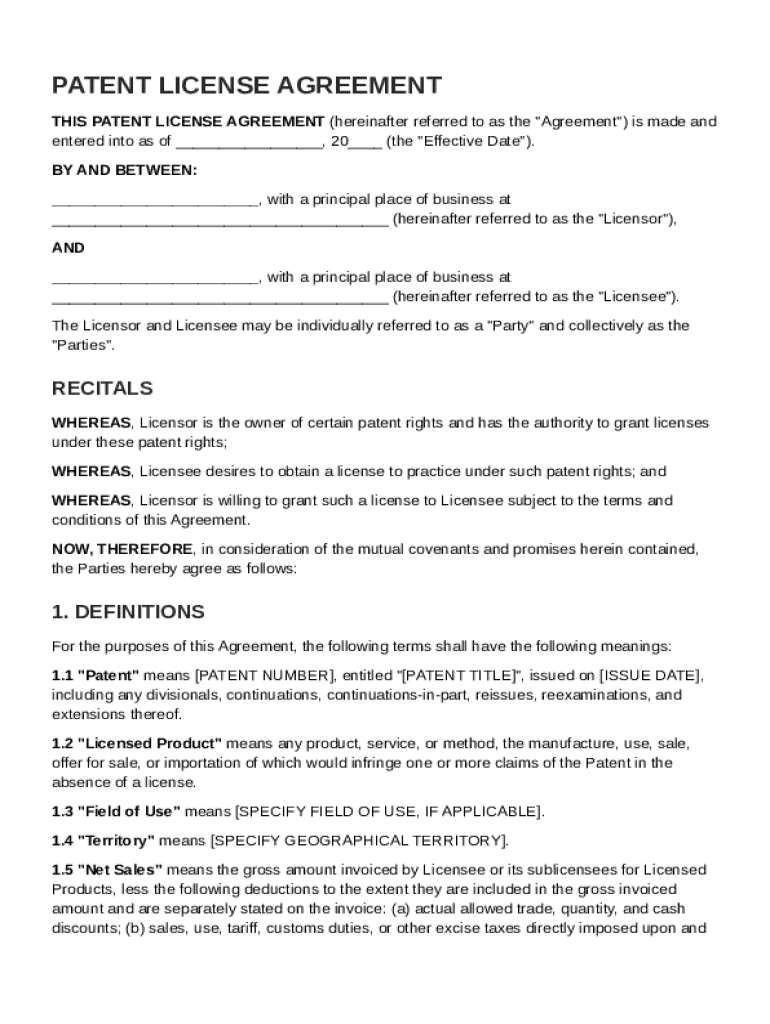
A Patent License Agreement is a legal document that outlines the terms and conditions under which one party, known as the Licensor, grants another party, the Licensee, the permission to use specific patent rights. This agreement plays a crucial role in commercializing an invention, allowing the Licensee to produce, use, or sell a product that incorporates the patented technology, while the Licensor receives compensation in the form of fees or royalties.
Key Elements of the Patent License Agreement
The Patent License Agreement includes several critical components to protect the interests of both parties involved. These typically encompass:
- Definitions of Key Terms: Clearly outlines the specific terms used throughout the agreement to avoid ambiguity.
- Grant of License: Specifies the scope of the license, including what rights are granted, any territorial limitations, and duration.
- Payment Terms: Details compensation structures such as initial fees, ongoing royalties, or milestone payments.
- Responsibilities of Both Parties: States the obligations and duties each party must uphold under the agreement.
- Confidentiality Obligations: Ensures any sensitive information shared during the agreement is protected.
- Termination Conditions: Describes the circumstances under which the agreement may be prematurely ended by either party.
- Indemnification Clauses: Protects against legal claims or damages that may arise during the agreement's term.
- Dispute Resolution Procedures: Outlines the methods for resolving any disagreements, including arbitration or litigation options.
Steps to Complete the Patent License Agreement
Completing a Patent License Agreement involves several methodical steps to ensure both legal and practical concerns are addressed effectively:
- Identify the Parties: Clearly define who the Licensor and Licensee are, including pertinent addresses and contact information.
- Describe the Patent: Clearly specify the patent or patents being licensed, including patent numbers and titles.
- Set the License Terms: Outline the scope, duration, and territory of the license.
- Define Payment Details: Specify how and when payments are to be made, including any upfront fees and royalty formulas.
- Confidentiality and IP Management: Establish guidelines for maintaining confidentiality and managing intellectual property.
- Specify Term and Termination: Describe how long the agreement lasts and the conditions under which it can be terminated.
- Review Legal Obligations: Ensure all legal requirements are fulfilled, including compliance with any state-specific laws.
- Final Review and Signatures: Have all parties review the document, making necessary amendments, followed by signatures to formalize the agreement.
Legal Use of the Patent License Agreement
The Patent License Agreement must comply with relevant legal standards to be enforceable and effective:
- Adherence to Federal and State Laws: Agreements should be drafted considering both federal patent laws and state contract laws.
- Compliance with the ESIGN Act: For digital contracts, ensure electronic signatures are legally binding.
- Incorporation of Industry Standards: Follow any industry-specific standards that may apply to patent licensing.
Important Terms Related to Patent License Agreements
Understanding certain terminologies related to Patent License Agreements is vital for clarity:
- Field of Use: The specific area or industry in which the Licensee is permitted to exploit the patent.
- Exclusive vs. Non-Exclusive License: Determines whether other parties can also be granted licenses.
- Royalty Rates: The percentage of revenue or profit the Licensee must pay the Licensor.
- Sub-License: The ability of the Licensee to grant licenses to third parties under agreed terms.
Examples of Using the Patent License Agreement
Real-world scenarios help illustrate the purpose and implementation of a Patent License Agreement:
- Technology Companies: Licensing a software patent to third-party developers for integration into their platforms.
- Pharmaceutical Firms: Allowing another company to manufacture and distribute a drug under patent.
- Automotive Industry: Granting rights to use patented engine technology in production vehicles.
State-by-State Differences in Patent Licensing
Certain aspects of Patent License Agreements may vary depending on state jurisdiction:
- Specific Contract Law Requirements: States may have different statutes affecting the formation or enforcement of contracts.
- Tax Implications: Royalties may be subject to state-specific taxes or tax treatment.
Who Typically Uses the Patent License Agreement
Patent License Agreements are utilized across various sectors by different entities:
- Inventors and Entrepreneurs: Seeking to commercialize their innovations by partnering with established businesses.
- Corporations: Licensing technology from startups to enhance their product offerings.
- Research Institutions: Granting licenses to commercial entities for technologies developed through academic research.
Each section comprehensively addresses the relevant aspects of Patent License Agreements, providing detailed insights and practical examples to enhance understanding and application.