
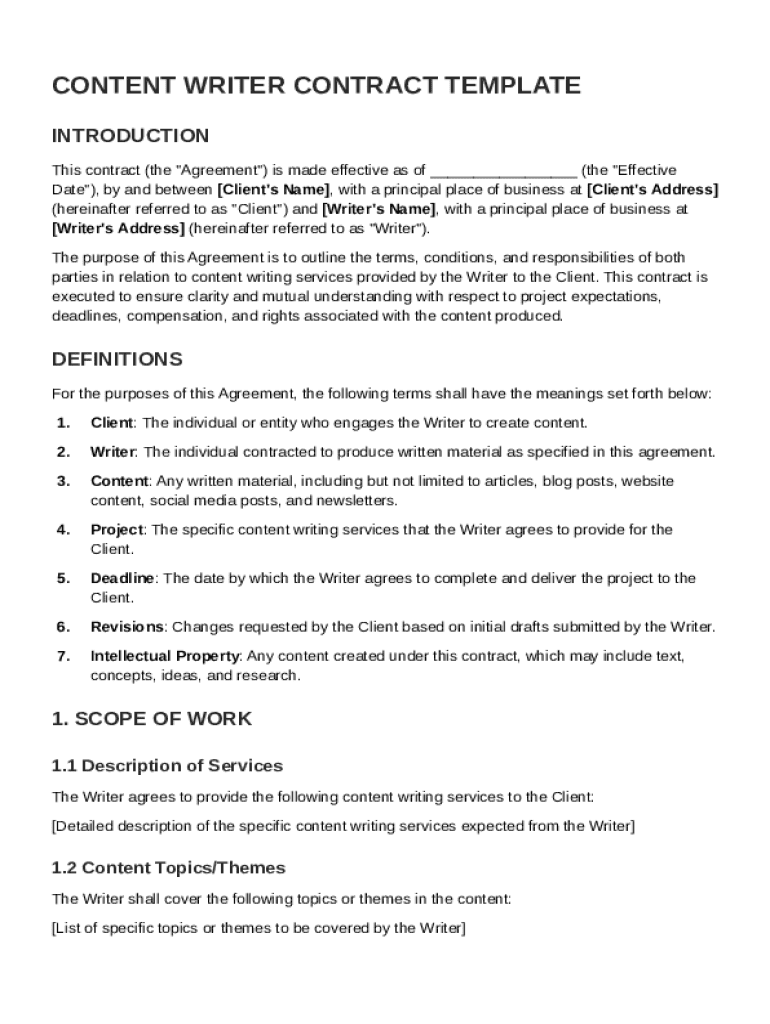







Key Elements of the Content Writer Contract Template
The Content Writer Contract Template outlines fundamental components crucial for both clients and writers. It specifies the scope of work, which details the topics, word count, and style guidelines the writer must follow. Payment terms define the writer's fees, payment methods, and timelines for compensation. Clear delivery timelines are established to ensure project deadlines are met. Revision policies identify the number of revisions allowed and any associated fees. Intellectual property clauses confirm content ownership post-completion. Confidentiality agreements ensure non-disclosure of sensitive information. Termination conditions outline scenarios that could lead to contract termination. Governing law dictates which jurisdiction’s laws apply to the contract, often based on the client’s location in the United States.
Scope of Work
- Defines project details such as topics and content length
- Specifies style guide adherence
- Provides clarity on content purpose and target audience
Payment Terms
- Details payment amount and method (PayPal, bank transfer)
- Specifies payment schedule (milestones, upfront)
- Includes conditions for late payments and penalties
Delivery Timelines
- Establishes deadlines for drafts and final content delivery
- Lists penalties or consequences for missed deadlines
- Allows for extensions under specific circumstances
Importance of Using the Content Writer Contract Template
Utilizing a Content Writer Contract Template can prevent misunderstandings and conflicts. It sets clear expectations and responsibilities for both parties, ensuring professional relationships remain amicable and productive. By having a formal agreement in place, both clients and writers can protect their interests and outline dispute resolution processes in advance. Additionally, it acts as a safeguard against potential legal disputes that can arise from misinterpretations of verbal agreements.
Benefits for Content Writers
- Provides clarity on job expectations and project requirements
- Protects writer’s rights to compensation for agreed services
- Establishes legal ground for work performance and delivery standards
Benefits for Clients
- Ensures receipt of content that meets specified criteria
- Facilitates structured revision and feedback process
- Protects intellectual property rights
Steps to Complete the Content Writer Contract Template
Completing the Content Writer Contract Template involves several critical steps to ensure all necessary details are correctly captured and agreed upon. Begin by thoroughly reviewing each section to understand its implications. Then, fill in the specifics, such as the writer’s name, client’s business name, and project details within the scope of work. Next, outline payment terms and timelines to avoid ambiguity. Both parties need to initial each section to denote agreement.
- Review template sections for clarity
- Fill in required details, including participant names and scope of work
- Explicitly state payment amounts and schedules
- Specify revision limits and fees for additional changes
- Agree on intellectual property rights and governing law
- Finalize by signing and dating the document
Who Typically Uses the Content Writer Contract Template
The Content Writer Contract Template is primarily used by freelance writers and businesses or individuals who hire them. Freelance writers rely on it to establish clear parameters for their work and protect their rights. Clients, such as startups, digital marketing firms, or content agencies, use the template to secure commitment on content delivery and quality standards from writers.


Freelancers
- Use contracts to formalize project details and expectations
- Benefit from legal protection over work agreements
Businesses and Agencies
- Ensure vendors meet their quality and completion timelines
- Protect company interests with clearly outlined legal clauses
Legal Use of the Content Writer Contract Template
The Content Writer Contract Template serves as a legally binding document governed by the laws of specified states within the U.S. It helps avert disputes and provides legal recourse should disagreements arise. Such contracts should comply with statutory regulations specific to hiring practices, intellectual property, and payment terms. Inclusion of a governing law clause is critical to clarify which state’s laws apply.
Ensuring Legal Compliance
- Include state-specific mandates in contract terms
- Ensure clauses adhere to U.S. contract law principles
- Utilize legal counsel to verify the contract’s legality
Examples of Using the Content Writer Contract Template
Real-world application of the Content Writer Contract Template can vary, reflecting different writing agreements. A content agency might use it for hiring freelance writers to create blog posts weekly. A marketing consultant might employ the contract template to engage a writer for a one-off company report. In each instance, the detailed contract upholds the agreement by clearly delineating obligations and expectations.
Case Studies
- Content Agency Usage: Engages multiple writers for ongoing blog series with pre-agreed content pipeline and payment terms.
- Marketing Firm: Hires a writer for a comprehensive brand audit report, specifying detailed project requirements and deadlines.
Software Compatibility
The Content Writer Contract Template is compatible with various digital and online platforms, enhancing convenience for signing and editing. Users commonly employ cloud-based document management services like DocHub to streamline this process. Such software ensures seamless integration with platforms like Google Drive, allowing for easy access and distribution between parties. The digital format supports swift updates and online signatures, offering greater flexibility than traditional paper contracts.
Benefits of Digital Versions
- Enables real-time edits and updates with collaborative tools
- Facilitates secure electronic signatures with audit trails
- Integrates easily with cloud systems for storage and access
State-Specific Rules for the Content Writer Contract Template
Contracts used in different U.S. states may be subject to unique local laws governing freelance agreements, payment terms, and intellectual property rights. Some states enforce stricter contractor classification laws which should be reflected in the contract terms. Awareness of regional legal requirements is crucial for drafting enforceable contracts and providing protection from legal challenges.
State Variations
- California: AB5 law implications on contractor classification
- New York: Specific guidelines on freelance payment practices




