






Definition & Meaning
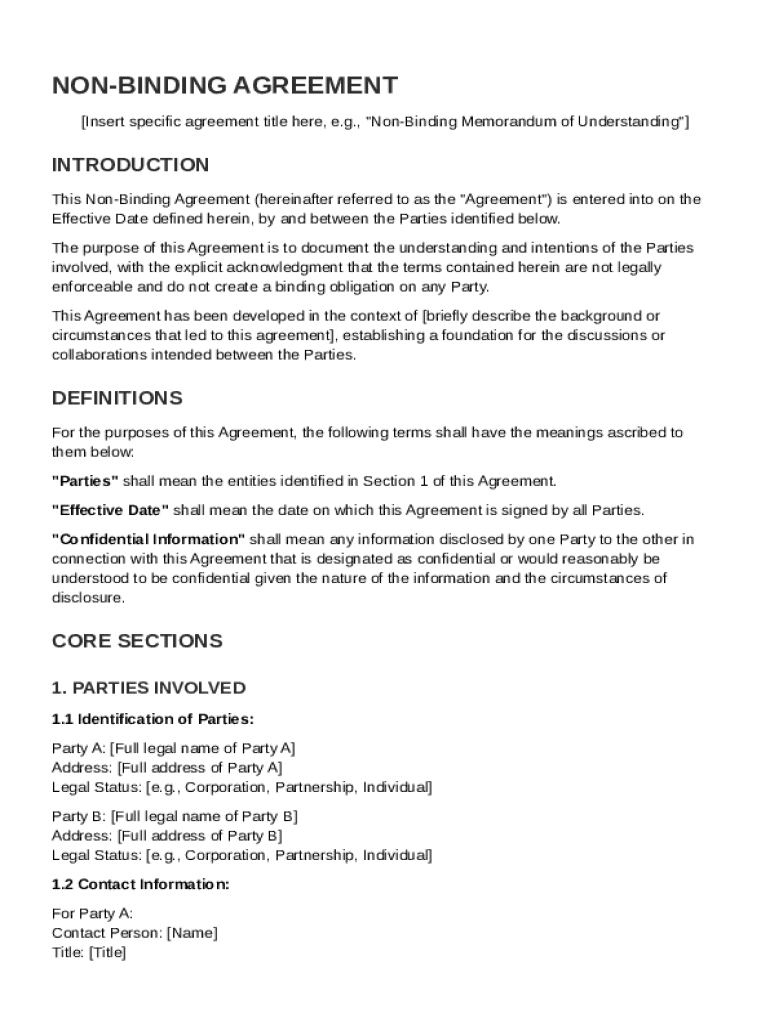
A Non-Binding Agreement Template is a formal document outlining the basic terms and understanding between two parties considering entering a future agreement. It serves as a preliminary framework for potential collaboration or negotiation, without imposing any legally enforceable obligations. Common components include definitions, objectives, and any agreed-upon confidentiality provisions. These templates are crucial tools in business contexts where clarity and mutual understanding are sought before finalizing legal contracts. Unlike binding contracts, these documents allow parties to negotiate freely without the fear of legal repercussions for backing out before finalization.
How to Use the Non-Binding Agreement Template
Utilizing a Non-Binding Agreement Template involves customizing it to fit the specific context of your proposed collaboration. Begin by identifying the parties involved and clearly define the purpose and scope of the agreement. The template should be tailored to include specific objectives, any necessary confidentiality clauses, and potential terms of a future binding agreement. Ensure all terms are clear and unambiguous to avoid any potential misunderstandings. Finally, both parties should review and acknowledge their understanding of the document, although a signature is typically not required since the agreement is non-binding.
Key Elements of the Non-Binding Agreement Template
Several critical elements are usually present in a Non-Binding Agreement Template:
- Understanding of Parties: Clearly state the names and roles of involved parties.
- Objectives: Explain the goals and intentions of the agreement.
- Confidentiality Clause: Specify how information exchanged will be protected, if necessary.
- Definitions: Provide precise definitions for terms used within the agreement.
- Termination Clauses: Describe scenarios under which the parties can opt-out of the agreement.
- Non-Binding Clause: Explicitly state that the agreement is not enforceable in a court of law.
- Governing Law: Indicate which legal jurisdiction will apply in cases of disputes.
Including these elements ensures clarity and mutual understanding, facilitating smoother negotiations.
Steps to Complete the Non-Binding Agreement Template
Completing a Non-Binding Agreement Template involves a structured process:
- Identify Parties and Context: Input details of all involved individuals or entities.
- Define Purpose: Clearly articulate the primary goals the agreement intends to achieve.
- Draft Main Clauses: Incorporate main elements such as confidentiality and termination conditions.
- Clarify Non-Binding Nature: Emphasize its status as a framework for potential agreement, not a legally binding contract.
- Review and Revise: Both parties should review and propose any necessary amendments for clarity and accuracy.
- Acknowledge Understanding: Parties sign a mutual acknowledgment for future reference, while understanding it is non-binding.
Following these steps helps ensure both parties have a clear understanding of the document’s intentions.
Legal Use of the Non-Binding Agreement Template
While non-binding, these agreements serve significant legal purposes. They facilitate preliminary discussions by establishing mutual intent and clarifying potential expectations and boundaries. Legally, they emphasize a commitment to negotiate in good faith without creating obligations beyond those expressly agreed upon. In the United States, these documents are often used in business ventures, potential mergers, or acquisitions, enabling parties to explore possibilities without definitive commitments. The non-binding clauses must be prominently indicated to avoid assumptions of enforceable obligations.
Who Typically Uses the Non-Binding Agreement Template
Non-Binding Agreement Templates are widely used across various sectors:
- Businesses: To explore potential partnerships or joint ventures without immediate legal commitments.
- Startups and Entrepreneurs: To engage in introductory discussions with investors or collaborators.
- Professional Services: Consultants and freelancers often use these agreements to outline potential project scopes.
- Corporate Entities: For merger and acquisition discussions where preliminary understanding is vital.
- Educational Institutions: When partnering with other organizations for research or academic purposes.
These templates offer a flexible approach for entities looking to gauge interest or flesh out preliminary ideas.


Examples of Using the Non-Binding Agreement Template
Non-Binding Agreement Templates see diverse practical applications:
- Business Partnerships: An initial agreement detailing proposed roles and contributions before finalizing a joint venture.
- Investment Discussions: Before committing funds, parties outline investment terms and expected returns.
- Mergers and Acquisitions: Preliminary agreements between companies to understand integrating processes.
- Real Estate Transactions: For preliminary talks regarding property sales, leases, or developments.
- Research Collaborations: Academic institutions or research firms may outline initial collaborative terms.
These examples demonstrate the diverse applications and value of non-binding agreements in navigating potential partnerships and projects.
Important Terms Related to Non-Binding Agreement Template
Understanding the following terms is vital when working with a Non-Binding Agreement Template:
- Non-Binding Clause: Specifies that the agreement imposes no legal obligation.
- Confidentiality: Legal framework to protect sensitive shared information.
- Term Sheet: A non-binding document outlining the terms of an investment or cooperation.
- Good Faith Negotiation: Parties agree to negotiate with honesty and intent to finalize a binding agreement.
- Governing Law: Jurisdictional laws under which any disputes will be resolved.
- Intent: The purpose and objectives each party brings to the agreement.
Knowledge of these terms helps in effectively drafting and using non-binding agreements, ensuring every aspect is covered and understood.