




01. Edit your form online
Type text, add images, blackout confidential details, add comments, highlights and more.

Type text, add images, blackout confidential details, add comments, highlights and more.

Draw your signature, type it, upload its image, or use your mobile device as a signature pad.

Send it via email, link, or fax. You can also download it, export it or print it out.
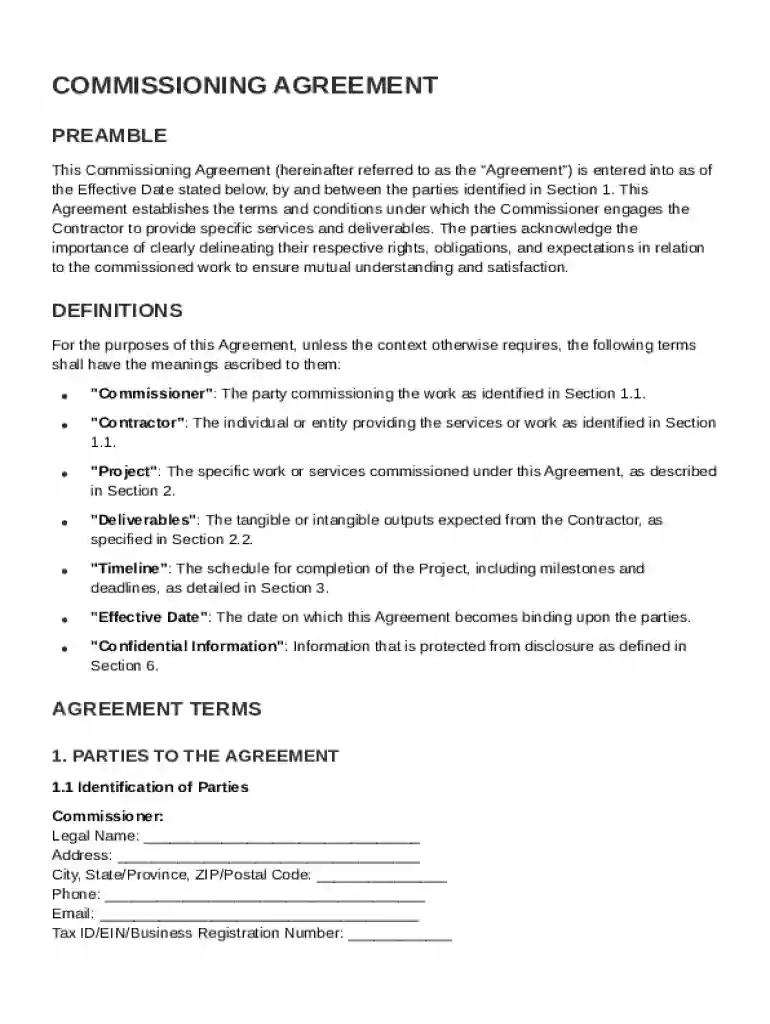
The Commissioning Agreement Template is a legally binding document that outlines the terms and conditions agreed upon by a Commissioner and a Contractor for the execution of certain services and deliverables. It serves as an essential tool in ensuring both parties have a clear understanding of their obligations, scope of work, compensation, timelines, and other critical project components. By defining these components, the agreement protects both parties’ interests and facilitates smooth project execution.
The document is particularly useful for projects requiring explicit deliverables, such as construction or engineering works, where both parties need to be on the same page to avoid potential disputes. It highlights the responsibilities each party holds and provides a framework within which the commissioned work must be completed.
The Commissioning Agreement Template contains several critical components that are essential to its efficiency and utility. These elements help standardize expectations, thus reducing miscommunications and disputes.
Project Scope and Deliverables: This section defines the specific tasks to be accomplished, detailing both the expected outcomes and the measurable deliverables. It ensures that both parties have a mutual understanding concerning the extent and limits of the work involved.
Roles and Responsibilities: Clarity around the responsibilities of the Commissioner and the Contractor is crucial. The agreement specifies who is responsible for what, minimizing overlaps and ensuring accountability throughout the project's lifecycle.
Compensation Terms: This outlines how and when the Contractor will be compensated. It details the payment schedule, terms such as net thirty days, and what constitutes a basis for withholding payment, if applicable.
Confidentiality Obligations: Protecting sensitive information exchanged during the project's duration is a must. This section details how private data will be handled and the repercussions of unauthorized disclosures.
Liability Limits: Identifying the extent of each party's liability offers protection in case something goes wrong, such as delivering subpar work or missing deadlines. This serves to allocate risk appropriately.
Dispute Resolution Mechanisms: To avoid litigation, this section usually specifies alternative methods for resolving conflicts, such as mediation or arbitration. This way, potential disputes can be settled more efficiently and with less public exposure.
Miscellaneous Provisions: This may include clauses that handle unforeseen circumstances, force majeure, or contractual amendments.
The Commissioning Agreement Template is designed for flexibility, allowing users to adapt it to a wide range of projects and service agreements. Here's a suggested approach to utilizing this template effectively:
Identify Project Requirements: Start by clearly understanding the needs and objectives of the project. This involves discussing with all stakeholders to ensure clarity on deliverables and expectations.
Customize the Template: Each project will have unique features; thus, the template requires customization to reflect specific roles, responsibilities, project scope, and timelines pertinent to the situation.
Draft Initial Agreement: Use the template to draft an initial version of the agreement. Make sure to fill out all sections comprehensively to cover the project's unique needs.
Review with Legal Counsel: Before finalizing, consult with legal advisors to ensure that the agreement is both legally sound and aligns with your project's goals. Any necessary modifications can be made at this stage.
Collaborative Review: Share the draft with the Contractor and discuss any concerns or alterations they might have. This collaborative approach encourages transparency and helps mitigate misunderstandings.
Finalize & Sign: After all parties agree on terms, each should sign the document. Both parties should keep a copy for their records. Digital signatures using platforms like DocHub can simplify this process.
Understanding the legal framework surrounding the Commissioning Agreement Template is crucial for its enforceability and the protection it provides to both parties.
Binding Commitment: Once signed, the document acts as a legally binding commitment between the parties involved. Breaches can result in legal repercussions, making it critical to include all necessary legal protections.
Compliance with Laws: The agreement must comply with applicable federal and state laws. Particularly in the U.S., various jurisdictions may have specific requirements for enforceability.
Integument Clauses: To prevent conflicts or complications, the agreement often includes integument clauses that ensure it is the sole or primary source of agreement between parties, overriding any previous negotiations or documents.
Amendment Procedures: Establish how future changes to the agreement can be made, including necessary approvals and documentation.
The Commissioning Agreement Template and its utilization can serve as a meaningful tool in fostering cooperation and agreement between a Commissioner and a Contractor. By clearly defining all anticipated aspects of the project, it mitigates risks, promotes transparency, and ensures the smooth execution of services and deliverables.
At DocHub, your data security is our priority. We follow HIPAA, SOC2, GDPR, and other standards, so you can work on your documents with confidence.

Jan 5, 2017 This agreement is for interconnection of distributed generation facilities (10 MW or less) at less than 60 kilovolts, between a company and a
This Agreement for Commissioning Services (the Agreement) is made and entered into this day of Month,. Year, by and between The University of


