




Definition & Meaning
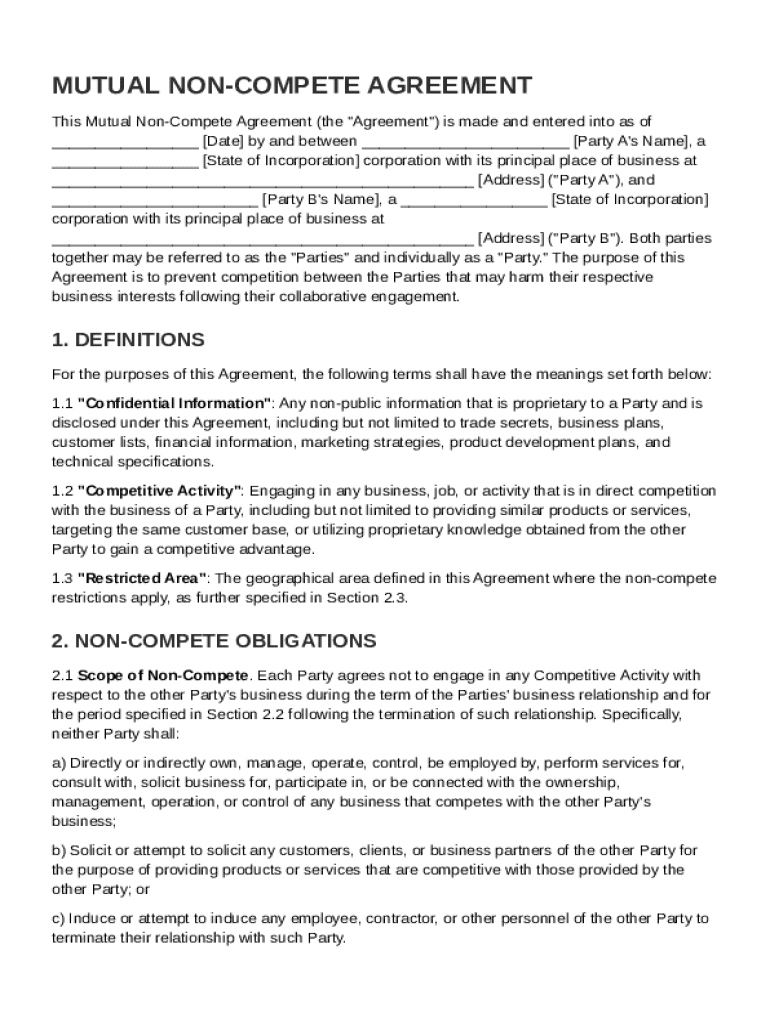
The Mutual Non-Compete Agreement Template is a legal instrument used by two parties seeking to establish parameters around competitive activity that could adversely impact their business relationships following a collaboration. This template lays out critical terms such as 'Confidential Information' and 'Competitive Activity,' ensuring both parties are clear about their obligations. It incorporates clauses that reinforce the privacy of shared information and provide guidelines for enforcing non-competition clauses. Such agreements are frequently utilized in business environments to secure trade secrets and maintain competitive advantage post-collaboration.
Key Elements of the Mutual Non-Compete Agreement Template
A comprehensive Mutual Non-Compete Agreement Template includes several key elements:
-
Confidential Information: Defines what constitutes confidential information that should remain undisclosed between parties.
-
Competitive Activity: Explicitly describes actions considered as competition, like starting a similar business or working with competitors.
-
Duration and Geographical Scope: Specifies the time period and geographical areas over which the non-compete obligations extend.
-
Non-Compete Obligations: Details the specific restrictions imposed on parties during and after the business relationship.
-
Enforcement and Remedies: Outlines the legal recourse available should a party breach the agreement terms.
-
Governing Law: Indicates which state's laws govern the contract and any disputes.
Steps to Complete the Mutual Non-Compete Agreement Template
-
Identify Parties: Clearly state the full legal names of all parties involved in the agreement.
-
Define Terms: Outline terms like 'Confidential Information' ensuring both parties have a mutual understanding.
-
Specify Restrictions: Detail the competitive activities restricted by the agreement.
-
Determine Scope and Duration: Set the geographical scope and duration for the non-compete obligations.
-
Draft Enforcement Clauses: Include clauses describing the actions that will be taken in case of a breach.
-
Review and Finalize: All parties should review the document for accuracy and understanding before signing.
-
Obtain Signatures: Have the document signed by all parties and possibly notarized for added legal strength.
Legal Use of the Mutual Non-Compete Agreement Template
A Mutual Non-Compete Agreement Template must be used in adherence to legal standards to ensure enforceability. Each agreement should comply with pertinent state laws governing non-compete terms. In some jurisdictions, non-compete agreements are carefully scrutinized to protect employee rights. Thus, ensuring that the agreement is reasonable in duration, geographical coverage, and the nature of restrictions is crucial. It's advisable to use this template alongside legal counsel to confirm it pertains to state laws and is fair to all parties involved.
State-Specific Rules for the Mutual Non-Compete Agreement Template
In the United States, rules regarding non-compete agreements can vary greatly from state to state. For example:
-
California: Generally prohibits non-compete clauses entirely, focusing instead on protecting trade secrets.
-
Texas: Permits non-competes under strict conditions that require them to be ancillary to another enforceable agreement.
-
Florida: Allows non-compete agreements but requires them to be reasonable in scope and duration.
Understanding state-specific regulations is vital to ensuring that these agreements are not only enforceable but also align with local laws.
Who Typically Uses the Mutual Non-Compete Agreement Template
The primary users of the Mutual Non-Compete Agreement Template include:
-
Business Partners: Collaborating companies aiming to prevent competition post-partnership.
-
Employers and Employees: Businesses wishing to protect sensitive information and prevent competitive employment post-termination.
-
Service Providers and Clients: Freelancers and consultants who gain access to confidential client information during a project.
This agreement is particularly useful across numerous industries such as technology, healthcare, and finance, where competitive advantage heavily relies on proprietary information.

Important Terms Related to the Mutual Non-Compete Agreement Template
Several terms are crucial for understanding and implementing a Mutual Non-Compete Agreement:
-
Exclusivity: An agreement that restricts parties from engaging with competitors.
-
Non-Solicitation: Prevents parties from soliciting business or employees from the other party.
-
Severability: Ensures that if parts of the agreement are deemed unenforceable, the remainder still holds legal force.
-
Assignment: Details whether the rights and obligations can be transferred to another party.
Understanding these terms is essential for accurately drafting and interpreting mutual non-compete agreements so all parties are well-informed.
Business Types that Benefit Most from Mutual Non-Compete Agreement Template
Businesses that generally derive the most benefit from Mutual Non-Compete Agreements include:
-
Technology Firms: Protecting software code and other intellectual property.
-
Manufacturing Companies: Safeguarding trade secrets and industrial processes.
-
Startups: Securing innovative concepts and preventing them from being utilized by competitors.
-
Financial Services: Maintaining confidentiality of proprietary models and market strategies.
Utilizing this template effectively can help secure competitive edges and safeguard proprietary interests within these business types.