
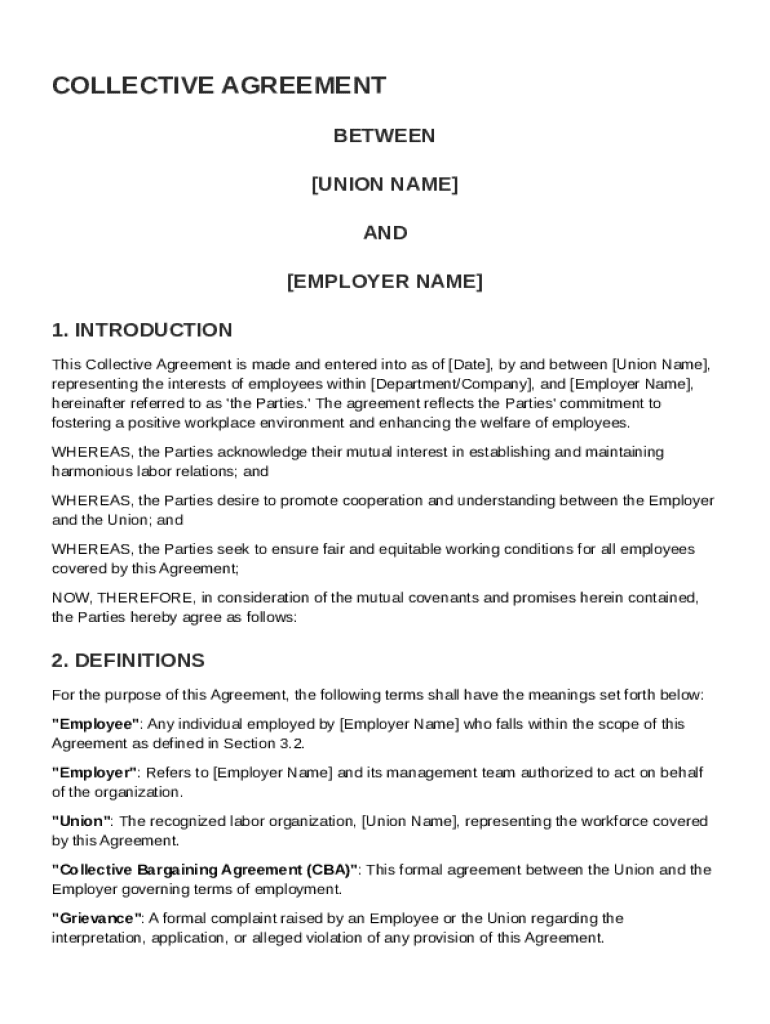







Definition & Meaning
A Collective Agreement Template serves as a foundational document designed to outline the terms of employment between a union and an employer. This agreement, often intricate in nature, aims to establish employer and employee roles, rights, and responsibilities. At its core, the Collective Agreement Template ensures mutual understanding and cooperation by detailing provisions related to wages, working conditions, benefits, and grievance procedures among other key elements. This document plays a vital role in promoting harmonious labor relations by providing a clear framework for addressing workplace issues and safeguarding fair treatment for employees covered under the union's representation.
Key Components Overview
- Recognition of Union: This section establishes the union as the official representative of the employees, giving them the authority to negotiate terms on their behalf.
- Employee Rights and Responsibilities: Defines what is expected of employees under the agreement, including conduct and performance standards.
- Employer Rights: Outlines the rights reserved by the employer, including management's authority to direct the workforce and make key business decisions.
Key Elements of the Collective Agreement Template
The structure of a Collective Agreement Template typically comprises several critical elements that ensure clarity and enforceability:
- Grievance Procedures: These are mechanisms established for resolving disputes between employees and management. The process often involves multiple stages, such as informal discussions, mediation, and arbitration, ensuring fair and systematic resolution.
- Wages and Benefits: Details regarding employee compensation such as salary scales, overtime pay, health insurance, retirement plans, and other benefits. These provisions strive to ensure competitive and equitable remuneration.
- Working Conditions: Specifications regarding work hours, break times, safety protocols, and equipment usage. These clauses ensure a safe, healthy, and productive work environment.
- Disciplinary Procedures: Guidelines on handling disciplinary actions, allowing for consistency and fairness in addressing employee conduct issues.
Practical Examples
- Scenario One: In a manufacturing setting, detailed wage scales ensure all machine operators receive fair compensation based on their skill level and experience.
- Scenario Two: An educational institution might use grievance procedures within the template to resolve conflicts between faculty members and administration, adhering to the outlined multi-level conflict resolution stages.
Steps to Complete the Collective Agreement Template
Completing a Collective Agreement Template effectively requires a strategic approach, ensuring all sections accurately reflect the agreed-upon terms:
- Initial Negotiations: Stakeholders, including union representatives and management, begin discussions to outline preliminary terms.
- Drafting the Agreement: Prepare an initial draft incorporating negotiated terms, ensuring comprehensive coverage of all necessary components.
- Review and Revisions: Both parties review the draft, making necessary revisions to address any ambiguities or concerns.
- Final Approval and Ratification: Once the template reflects consensus, it moves to formal approval and ratification procedures by both parties.
- Implementation and Monitoring: After ratification, the agreement is implemented, and mechanisms for ongoing monitoring and compliance are established.
Variations in Steps
- Addition of Specialized Clauses: In industries with specific regulatory requirements, additional clauses related to compliance might be negotiated and included.
- Consultation with Legal Experts: Engaging legal professionals to review the template for alignment with federal and state labor laws can ensure legality and efficacy.
Who Typically Uses the Collective Agreement Template
Collective Agreement Templates are primarily used by organizations with union representation, which include various sectors in the labor market:
- Manufacturing Firms: To negotiate terms related to shifts, safety standards, and productivity metrics.
- Public Sector Entities: Including schools, hospitals, and government offices where unions represent significant portions of the workforce.
- Service Industries: Such as transportation and hospitality, where employee representation focuses on working conditions and compensation fairness.


Use Cases
- Healthcare Facilities: Utilizing the template to regulate shifts, on-call duties, and overtime pay for nurses and other healthcare providers.
- Educational Institutions: Provisions governing academic freedom, tenure track terms, and faculty evaluation methods.
Legal Use of the Collective Agreement Template
The legal reinforcement of a Collective Agreement Template is crucial to ensure its enforceability and compliance with labor regulations:
- Adherence to Labor Laws: The template must comply with federal laws such as the National Labor Relations Act, ensuring it aligns with national labor rights and standards.
- State-Specific Regulations: Each state may have unique requirements or additional protections that need incorporation into the agreement.
- Resolution of Legal Disputes: Often includes detailed steps for legal redress in case of disagreements on interpretation or enforcement, reducing potential legal conflicts.
Legal Nuances
- Mediation Clauses: Many templates include clauses mandating mediation or arbitration rather than court litigation for disputes, streamlining resolution processes.
- Amendment Procedures: Legal frameworks for modifying the agreement, which often require mutual consent and documentation to amend standing contracts.
Why Use a Collective Agreement Template
Utilizing a Collective Agreement Template provides various benefits to both employers and employees:
- Standardization: Ensures uniformity in terms and conditions across the organization, promoting fairness and consistency.
- Protection of Rights: Clearly defined roles and responsibilities help protect the interests of both parties, reducing conflicts and potential litigation.
- Improved Communication: Establishes clear channels for dialogue between management and employees, enhancing the overall workplace environment.
Real-World Benefits
- Reduced Turnover: By creating a structured framework for employee satisfaction and well-being, the need for replacements is minimized.
- Enhanced Morale: Clarity in employment conditions fosters a more positive and productive workforce.
Important Terms Related to the Collective Agreement Template
A comprehensive understanding of the terminology used in the Collective Agreement Template aids in effective utilization and implementation:
- Arbitration: A method for resolving disputes outside the court system, often binding.
- Seniority: Refers to the length of service, which can influence pay scales, promotion opportunities, and job security.
- Bargaining Unit: The group of employees collectively represented by the union in negotiations.
Clarification of Terms
- Grievance: A formal complaint by an employee or union regarding the interpretation or application of the agreement.
- Ratification: The process by which union members vote to approve the negotiated agreement.
State-Specific Rules for the Collective Agreement Template
Each state in the U.S. may impose its unique requirements on collective agreements, reflecting regional labor policies and cultural norms:
- Variations in Employment Laws: States like California may impose stricter regulations around worker safety and minimum wage provisions within the agreement.
- Union Rights: States with strong union presence might reflect more robust protections and labor rights than those in right-to-work states, where union membership cannot be mandated.
State-Specific Considerations
- Case Study - New York: Collective agreements in New York may include specific disability benefits provisions that are aligned with state programs.
- Case Study - Texas: In right-to-work states such as Texas, union security agreements differ, impacting how dues are collected from members.




