
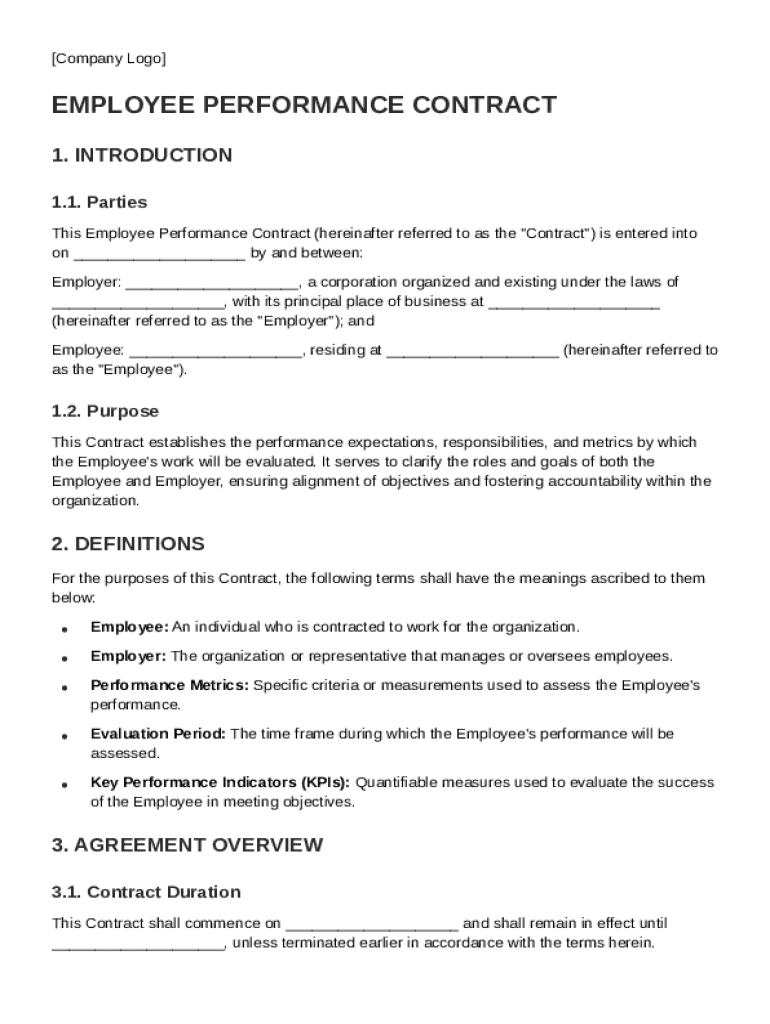







Definition and Meaning
An Employee Performance Performance Contract Template is a formal document used to set clear expectations between an employer and employee regarding the employee's performance. This template outlines the specific duties, responsibilities, and performance metrics expected from the employee. It aims to ensure alignment between both parties on performance standards and objectives, thereby enhancing accountability within the workplace.
The contract serves as a mutual agreement where both parties understand and agree to the standards set. It includes key performance indicators (KPIs) that employees are expected to meet. In essence, this contract creates a framework for evaluating employee performance over time and allows for structured feedback and development.
Key Features
- Performance Goals: Clearly defined targets the employee must achieve, providing direction and focus.
- Responsibilities: Detailed description of the employee's duties to prevent role ambiguity.
- Evaluation Metrics: Quantifiable measures such as sales targets or customer satisfaction scores used to assess performance.
- Support from Employer: Outlines resources and support provided by the employer to aid in achieving objectives.
How to Use the Employee Performance Performance Contract Template
Using the Employee Performance Performance Contract Template efficiently requires a systematic approach:
- Identify the Objectives: Before drafting the contract, understand the specific goals both the organization and employee aim to achieve.
- Customize the Template: Modify the template to address specific roles and industry standards. Tailoring ensures that the contract meets the unique needs of the position.
- Define Clear Metrics: Work with HR and department managers to determine the KPIs that align with overall business goals.
- Engage the Employee: Provide the employee an opportunity to review and discuss the terms, ensuring mutual understanding and agreement.
- Finalize and Sign: After making necessary adjustments, both parties should sign the contract to formalize the agreement.
Effective Implementation
- Arrange periodic reviews to assess progress against the agreed KPIs.
- Regularly update the contract to reflect any changes in role or organizational goals.
- Keep open lines of communication to address issues and adapt strategies where needed.
Key Elements of the Employee Performance Performance Contract Template
Several vital components should be present in a robust Employee Performance Performance Contract:
- Performance Goals and Targets: Clearly articulated goals that serve as benchmarks for success.
- Responsibilities List: Explicitly outlined duties and functions the employee is expected to perform.
- Review and Evaluation Protocols: Description of how and when performance will be reviewed.
- Consequences and Rewards: Outline what happens if expectations are either met or unmet — potential rewards or repercussions.
- Modification Procedures: Guidelines for how the contract can be amended if necessary.
Examples
- Sales Targets: For sales personnel, targets like annual sales figures or new clients acquired may be set.
- Operational Efficiency: For process managers, metrics could include project completion rates or process optimization results.
Steps to Complete the Employee Performance Performance Contract Template
- Gather Required Information: Collect details about the role, expectations, and relevant metrics.
- Fill Out Basic Information: Include names, positions, and department details for both the employee and employer.
- Define Performance Metrics and Goals: Clearly document the KPIs and expectations for the employee’s role.
- Detail Support and Resources: Specify the tools, training, and support the employer will provide.
- Include Review Mechanisms: Outline the schedule and procedure for performance reviews.
- Discuss with the Employee: Ensure the employee understands, agrees to, and signs the document.
- Finalize Documentation: Sign and store the document securely, ensuring both parties have copies.
Tips for Success
- Use clear, concise language to prevent misunderstandings.
- Ensure both short-term and long-term objectives are covered in the document.
Important Terms Related to the Template
Understanding specific terms is crucial for comprehending the contract fully:
- Key Performance Indicators (KPIs): Quantifiable measures that evaluate employee success in meeting performance objectives.
- Performance Evaluation: A systematic process to assess an employee's job performance and productivity.
- Responsibility: Specific tasks and duties assigned to an employee as part of their role.
Additional Considerations
- Look for terms specifying timeframes for performance reviews.
- Note any industry-specific terminology that aligns with organization standards.
Legal Use of the Employee Performance Performance Contract Template
The contract must comply with legal standards to ensure enforceability:
- Compliance with Labor Laws: Ensure terms align with federal or state employment regulations.
- Confidentiality Provisions: Include clauses to maintain the confidentiality of proprietary information.
- Dispute Resolution: Define processes for handling disagreements, whether through mediation or arbitration.
Best Practices
- Regularly consult HR experts to ensure legal compliances are up to date.
- Adapt contractual terms to reflect changing legal or organizational environments.
Who Typically Uses the Employee Performance Performance Contract Template
This template is widely utilized by various stakeholders within an organization:
- Human Resources Departments: For setting and managing employee performance expectations across the organization.
- Managers and Supervisors: To provide clear, measurable goals for team members and facilitate structured performance reviews.
- Employees: To understand their role, what is expected of them, and how they will be evaluated.


Usage Scenarios
- Small businesses use this template to standardize performance reviews.
- Large corporations apply it across departments to maintain consistent expectations.
State-Specific Rules for the Employee Performance Performance Contract Template
While the general principles of these contracts apply broadly, state-specific regulations might require adaptations:
- Wages and Hours Laws: Varying state laws can impact the stipulated working conditions and expectations.
- Right to Work Laws: Determine how employment terms are formalized and what conditions can be legally enforced.
Variations and Exceptions
- Adjustments may be required to align with state-specific nondisclosure requirements and employment conditions.
- Legal consultations are advised to navigate state complexities adequately.
By focusing on these structured blocks, the content related to the Employee Performance Performance Contract Template becomes comprehensive, providing depth across essential areas while ensuring practical application and adherence to legal standards.




