




01. Edit your form online
Type text, add images, blackout confidential details, add comments, highlights and more.

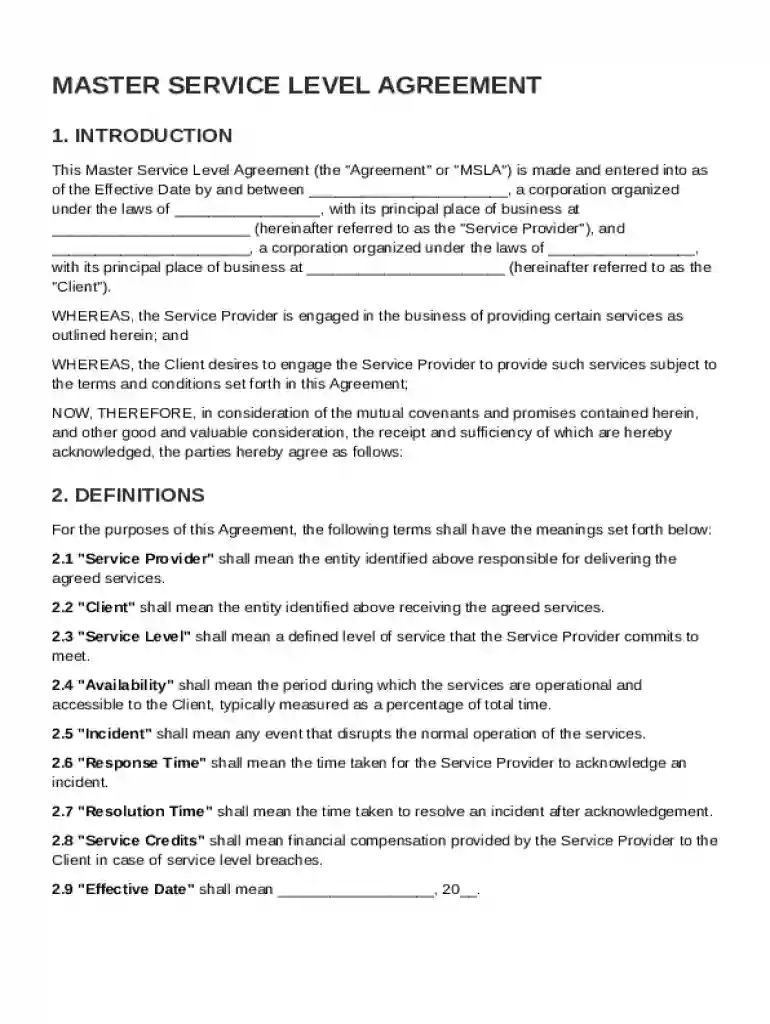
Type text, add images, blackout confidential details, add comments, highlights and more.

Draw your signature, type it, upload its image, or use your mobile device as a signature pad.

Send it via email, link, or fax. You can also download it, export it or print it out.
The Master Service Level Agreement (MSLA) Template serves as a foundational document establishing the relationship between a service provider and a client. Its core components ensure clarity in expectations and service delivery. Primarily, the MSLA delineates the scope of services, performance metrics, responsibilities, and incident management processes. Additionally, the agreement often includes confidentiality obligations and general provisions, which aim to establish mutual trust and accountability. For example, a section detailing service credits outlines actions to be taken if service levels are not met, fostering accountability in service delivery.
Utilizing the Master Service Level Agreement Template efficiently requires a clear understanding of the contractual relationship being formed. Begin by reviewing each section thoroughly to ensure all terms and responsibilities align with both parties' expectations. Customization is key; adjust performance metrics or service scopes as necessary to match specific business operations. Regular updates are also essential, particularly when service dynamics change, ensuring the document remains relevant and binding over time. This regular review can help avoid disputes and adapt to evolving service requirements.
Initial Review: Begin by conducting a detailed examination of the entire template to familiarize yourself with its structure and content.
Service Description: Clearly define the services to be provided, specifying all relevant details. This ensures both parties have a mutual understanding of expectations.
Performance Metrics: Set performance benchmarks and acceptable service levels. This section can include uptime requirements, response times, and support availability.
Define Responsibilities: Outline the roles and responsibilities of both the service provider and the client to avoid any ambiguity.
Confidentiality Clauses: Include clauses that protect sensitive information. Clearly state the obligations concerning the handling of data and breaches.
Finalize and Sign: Once both parties are satisfied with the content, finalize the document with signatures from authorized representatives.
Regular Updates: Schedule periodic reviews to update terms as necessary, reflecting any changes in service provision or client requirements.
Familiarizing yourself with key terms in the MSLA Template can greatly enhance understanding and execution. Notable terms typically include:
Understanding these terms helps ensure that all parties are clear on their obligations and expectations.
The legal framework surrounding the MSLA ensures that both parties are protected and that the agreement is enforceable. The template must comply with existing contract laws relevant to the jurisdiction in which the agreement operates. It's critical to consult with legal professionals during drafting to confirm legal adequacy and enforceability. Legal counsel can also assist in tailoring clauses specific to one's business context, like industry-specific regulations or compliance requirements.
A wide range of businesses and organizations rely on MSLAs to formalize service relationships. Typically used by both small and large enterprises, these templates are crucial for sectors like IT services, telecommunications, and cloud services. For example, an IT company might use an MSLA to guarantee uptime and support response times, establishing clear expectations with its clients. Customers also leverage these agreements to hold service providers accountable and ensure reliable service delivery.


Practical application of the MSLA template is varied and context-specific. For instance, a cloud service provider could engage in an MSLA that outlines data storage capacities, ensuring clients receive prompt and efficient data retrieval services. Alternatively, in telecommunications, the MSLA might specify minimum network uptime as a key performance criterion to guarantee uninterrupted connectivity for the client.
The enforceability and specifics of an MSLA can vary significantly based on state or local regulations. For example, certain states may have stringent requirements regarding data protection clauses or service credit calculations. It's essential to collaborate with legal experts familiar with state-specific laws to ensure conformity and address any regional compliance issues. Adjustments to the template may be necessary to align with these local legal expectations.
While the MSLA template provides a comprehensive foundation, businesses might explore alternative or more specialized agreements depending on need. For instance, a Service Level Agreement (SLA) offers a narrower focus primarily on the service deliverables and performance standards. Alternatively, a more generalized contract, like a Term Service Agreement, might suffice for less complex service relationships where formal performance metrics are less critical.
At DocHub, your data security is our priority. We follow HIPAA, SOC2, GDPR, and other standards, so you can work on your documents with confidence.
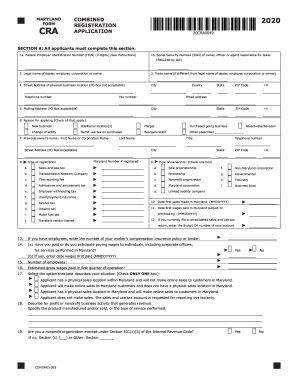
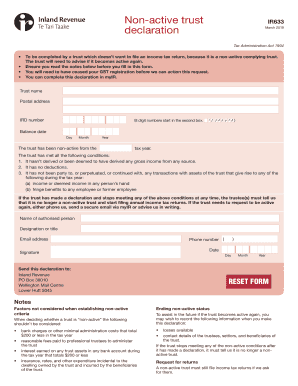


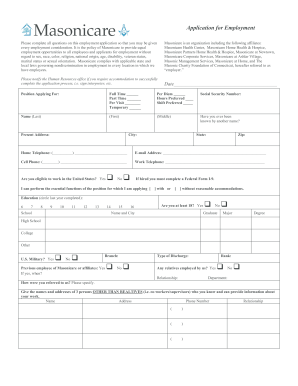
Initiates the creation of Service Level Agreements. Reports all system outages and degradation to the Enterprise Service Desk in a timely manner. Adheres to
The effective date of this Agreement shall be the date on which the last party signs this Agreement (Effective Date). 1. Scope and Performance of Services.
Mar 24, 2022 When working with a frame contract or Master Service Agreement (MSA), the statement of work will serve as a consulting agreement. It will


