







Definition and Purpose
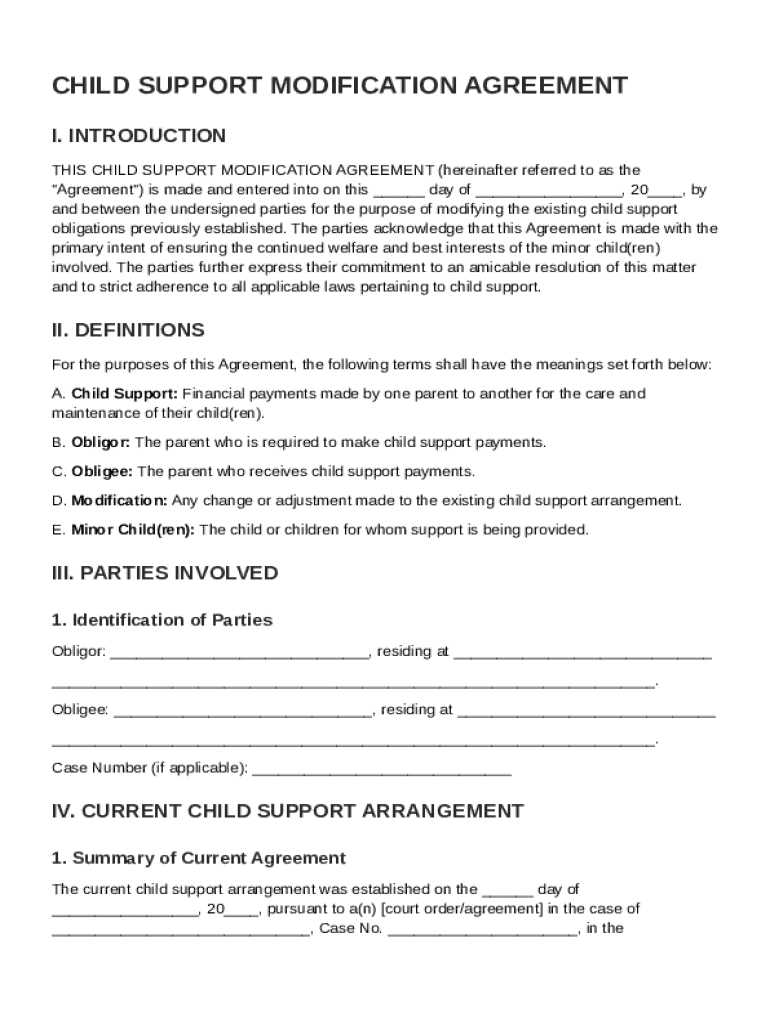
The Child Support Modification Agreement Template is a formal document used to modify existing child support arrangements between the obligor (the person required to pay support) and the obligee (the person receiving the support) to reflect changes in circumstances. This agreement focuses on the welfare of the child(ren) involved and outlines the new terms under which child support will be provided. It includes legal definitions, reasons for modification, current arrangements, and acknowledgment by both parties. This template is essential for ensuring the agreement complies with state laws and may need court approval to validate the changes.
When Modifications are Necessary
Modifications to child support agreements are often sought due to significant changes in financial situations or custodial arrangements. Reasons can include a change in either parent's income, loss of employment, the needs of the child(ren), or changes in custody. Each scenario requires careful documentation and justification within the agreement to be considered valid and enforceable. Understanding these conditions is crucial for both parties to agree upon a fair and legal modification.
How to Use the Template
Using the Child Support Modification Agreement Template involves several steps to ensure all necessary modifications are legally sound and agreed upon by both parties. The template is designed to guide users through each section, prompting for requisite details and facilitating a smooth process.
Steps to Complete the Template
- Download the Template: Access the Child Support Modification Agreement Template from DocHub, which provides a clear, fillable form.
- Identify Parties Involved: Clearly specify the obligor and obligee, including full names and contact information.
- Detail Current Support Arrangement: Document the existing terms of the child support agreement, including payment amounts and schedule.
- State the Reason for Modification: Clearly explain the basis for seeking changes to the agreement, such as altered income levels or custody arrangements.
- Define the New Terms: Outline the revised payment details, including amount, frequency, and payment method.
- Seek Legal Advice: Consider consulting a family law attorney to ensure the modifications adhere to legal standards.
- Sign and Notarize: Both parties should sign the agreement in the presence of a notary public to make it legally binding.
- Submit for Court Approval: File the agreement with the relevant court if required by state law, to obtain official approval.
Legal Use and Compliance
It is critical that the Child Support Modification Agreement Template is used in accordance with applicable legal standards. The agreement needs to conform to state-specific child support laws and guidelines, potentially requiring a family law attorney’s review. Legal compliance ensures that modifications are enforceable and protects the rights and responsibilities of all parties involved.
State-Specific Rules
Different states have varying requirements for child support modifications. These rules dictate how changes can be requested, processed, and approved. For instance, some states mandate a specific percentage change in the obligor's income before a modification is granted. Understanding these state-specific nuances is vital for a legally-valid modification process.
Key Elements of the Template
The Child Support Modification Agreement Template includes several critical components to ensure comprehensive coverage and enforceability.
- Definitions and Terms: Clearly defines essential terms such as Obligor, Obligee, and Minor Children.
- Current Support Details: Documents the existing support agreement terms.
- Modification Reasons: Outlines the justification for changes.
- New Support Arrangement: Describes the updated support terms.
- Legal Provisions: Includes a section on state and federal compliance.
- Acknowledgment Clause: Confirms that both parties understand and agree to the modifications.
- Signatures and Notarization: Ensures official recognition and potential court filing.
Important Terms
Some significant terms frequently used in these agreements include "Obligor," "Obligee," "Custodial Parent," "Non-Custodial Parent," and "Child Support Guidelines." These terms help frame the legal context and improve understanding between signatories.
Examples of Use
Real-world examples can demonstrate how this template has been effectively utilized to adjust child support agreements.
Example Scenarios
- Income Adjustment: An obligor who experiences a job change resulting in a different income level may use this template to adjust support payments accordingly.
- Custody Change: If the primary custodial parent changes, this agreement can facilitate the necessary revisions in support terms.
- Child’s Needs Evolve: Increased educational or healthcare needs for the child may prompt a review and modification using this document.
Required Documents
Supporting documents are crucial for a robust modification agreement. These may include financial records, custody orders, and any other evidence relevant to the proposed changes. Providing complete and accurate supporting documentation ensures that the modification request is credible and justifiable.
Collecting and Verifying Documents
- Income Proofs: Recent pay stubs, tax returns, or employment verification letters.
- Custody Proofs: Current custody agreements or court orders.
- Expense Records: Receipts for child-related expenses, medical bills, or school fees.
Conclusion
Ensuring thoroughness in each segment of the Child Support Modification Agreement Template maximizes the likelihood of acceptance and enforcement. Leveraging DocHub’s tools simplifies this process, allowing users to create a legally compliant, comprehensive agreement tailored to meet both parties’ needs efficiently.




