
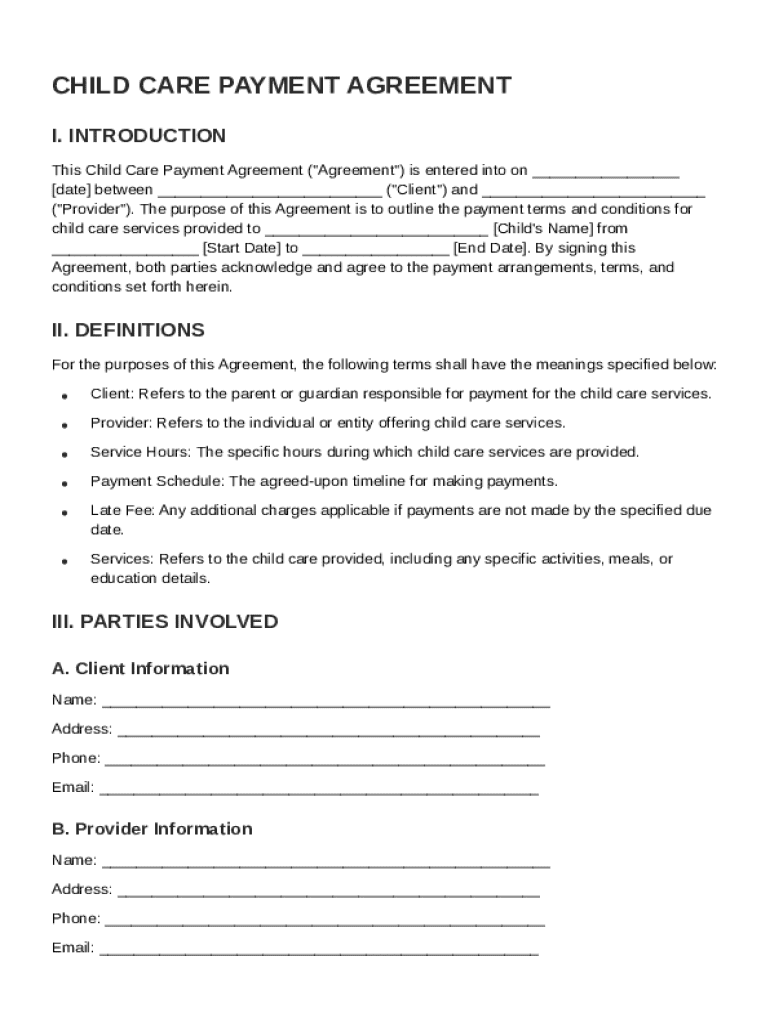







Key Elements of the Child Care Payment Agreement Template
The Child Care Payment Agreement Template delineates critical terms and conditions that govern the engagement between a client and a child care provider. Key components include:
-
Payment Schedules: Outlines when payments are due, whether on a weekly, bi-weekly, or monthly basis, including payment methods accepted such as checks, credit cards, or bank transfers.
-
Service Details: Describes the specific services provided, such as regular care hours, meals, educational activities, and additional services like weekend or overnight care.
-
Late Fees and Cancellation Policies: Specifies penalties for late payments and conditions under which the agreement can be terminated or rescheduled, with or without penalties. It may include a grace period for late payments.
-
Liability and Dispute Resolution: Details each party's responsibilities, especially regarding child safety and property damage, and outlines how disputes will be resolved—whether through mediation, arbitration, or court proceedings.
Upon finalizing these elements, both parties have a clear understanding of their financial obligations and operational expectations.
How to Use the Child Care Payment Agreement Template
Utilizing the Child Care Payment Agreement Template effectively involves several steps:
-
Initial Discussion: Engage in preliminary discussions between the client and provider to outline services, fees, and expectations.
-
Customization: Tailor the template to satisfy the specific needs of both parties. Ensure all relevant details like child’s name, agreed hours, and special requirements are accurately represented.
-
Review and Edit: Perform a thorough review to ensure all modifications are reflected accurately and that no section is incomplete.
-
Signatures: Obtain signatures from both parties to legally bind the agreement. Ensure each party retains a signed copy for their records.
-
Periodic Review: Continuously revisit the agreement to ensure ongoing compliance with its terms, making amendments as necessary to reflect any changes in services or circumstances.
This ensures that the child care agreement is properly executed and adhered to over its duration.
Who Typically Uses the Child Care Payment Agreement Template
Several groups find the Child Care Payment Agreement Template particularly useful:
-
Parents/Guardians: Ensure their child's needs are met within agreed financial terms and schedules.
-
Child Care Providers: Protect financial interests while delivering services as per agreed terms.
-
Legal Advisors: Assist clients in drafting and negotiating precise terms to avoid future disputes.
-
Daycare Centers and Nannies: Formalize service offerings through clearly defined terms, ensuring transparent financial and operational understanding.
Each user benefits from the structured format and clarity it provides, helping to maintain professional relationships.


Steps to Complete the Child Care Payment Agreement Template
Completing a Child Care Payment Agreement Template involves several identifiable steps:
-
Information Gathering: Collect necessary data such as the child's details, payment specifications, and service offerings.
-
Document Setup: Open the template in a compatible document editor like DocHub, and initially fill out sections with gathered data.
-
Personalization: Customize by adding specific service details, payment terms, and any unique conditions agreed upon.
-
Review Process: Both parties should review the agreement for errors or omissions.
-
Finalize and Print: Once finalized, print or digitally share the agreement to be signed by all parties involved.
-
Secure Storage: Store both digital and hard copies securely, ensuring easy retrieval for reference if needed.
Following these steps ensures the template is used correctly and efficiently.
Important Terms Related to the Child Care Payment Agreement Template
Understanding vital terms related to the Child Care Payment Agreement is crucial:
-
Client: The individual or party receiving child care services and responsible for payment.
-
Provider: The individual or organization offering child care services.
-
Service Hours: The specific hours and days when child care services will be provided.
-
Cancellation Notice: The period required for either party to officially inform the other of changes or cancellations in service.
-
Termination Clause: The conditions under which the agreement can be ended by either party, protecting interests under various scenarios.
Familiarity with these terms ensures clarity and reduces the likelihood of misunderstandings.
Legal Use of the Child Care Payment Agreement Template
The Child Care Payment Agreement Template should be used legally and appropriately to ensure all parties understand their rights and obligations:
-
Compliance with State Laws: Confirm the agreement adheres to state laws and regulations relevant to child care and contract formation.
-
Signature Validity: Ensure all signatures are obtained legally, with consent and clear understanding from all parties involved.
-
Binding Commitments: Recognize that once signed, the document becomes a legally binding agreement, enforceable in court if needed.
Proper legal use safeguards against disputes and potential legal issues arising from misunderstandings.
State-Specific Rules for the Child Care Payment Agreement Template
State laws and regulations can influence how the Child Care Payment Agreement Template is structured and implemented:
-
Licensing Requirements: Some states require child care providers to be licensed, impacting the agreement's terms.
-
Payment and Wage Laws: State regulations may dictate acceptable forms of payment or wage calculations for child care services.
-
Termination and Notice Periods: Specific state laws may impact cancellation policies and required notice periods.
Understanding state-specific considerations ensures the agreement complies with applicable laws and regulations.
Examples of Using the Child Care Payment Agreement Template
Real-world examples illustrate the template's application:
-
Scenario 1: A parent and a home-based daycare provider use the template to detail service hours, emergency protocols, and a bi-weekly payment schedule.
-
Scenario 2: A corporate daycare center employs the template to standardize agreements with several families, integrating specific clauses for additional services during holidays.
-
Scenario 3: A nanny service uses the template to align expectations with a family, including special conditions for overnight stays and last-minute requests.
Each scenario highlights how the template supports clear, customized communication between child care providers and clients.




