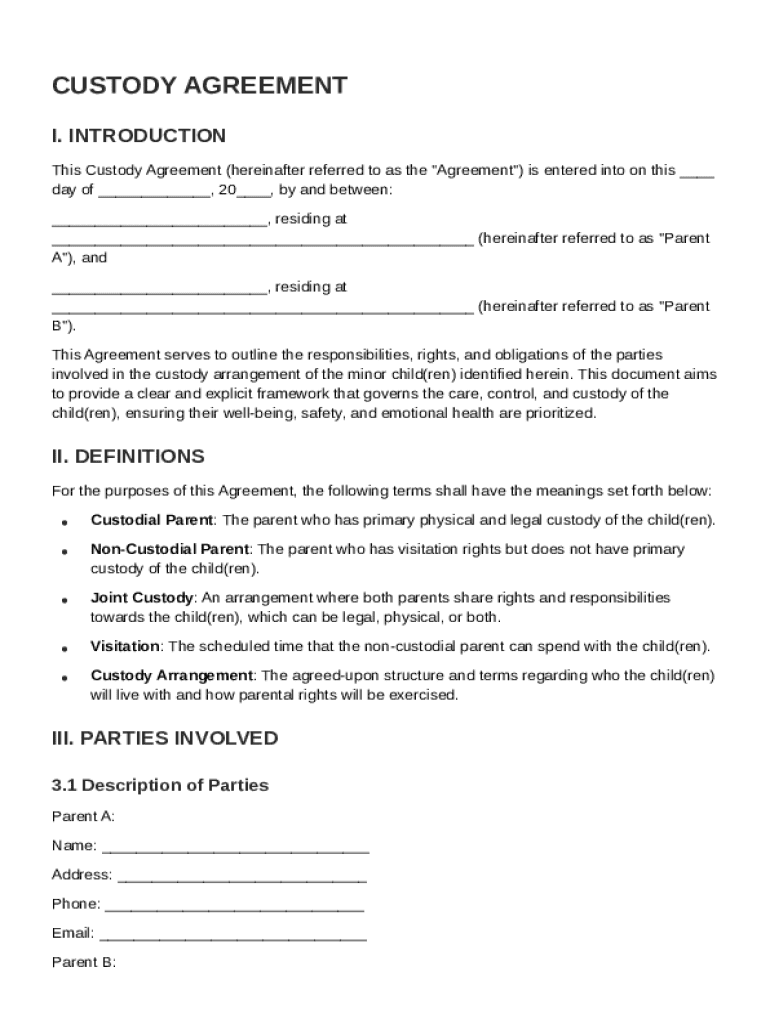







Definition and Meaning
A Custody Contract Template is a structured legal document that outlines the custodial arrangements between parents for their minor children. It defines key terms such as custodial parent, non-custodial parent, and establishes the framework for physical and legal custody. The document is essential for detailing how responsibilities are shared or divided, including details on visitation rights and financial commitments. It also serves as a legal avenue for parents to ensure smooth communication and avoid misunderstandings, thereby offering a reliable basis for resolving potential conflicts.
In practical terms, the Custody Contract Template acts as a parenting plan that guides parents in maintaining the welfare of their children in case of separation or divorce. This often involves clearly defined provisions for education, health care, and other essential aspects of the child's life. Legal compliance is a cornerstone of the template, as it aligns with local and federal regulations governing child custody.
Key Elements of the Custody Contract Template
The Custody Contract Template includes several critical elements that serve as the backbone of the document. Key components are:
- Physical Custody: Outlines where the child will live and how time will be split between parents.
- Legal Custody: Determines who has the decision-making authority over significant aspects of the child’s life, such as education and medical care.
- Visitation Rights: Specifies the schedule and conditions under which the non-custodial parent can visit the child.
- Financial Responsibilities: Details child support obligations, covering expenses related to education, health care, and general upkeep.
- Dispute Resolution: Establishes methods for dealing with disagreements, potentially involving mediation or other forms of conflict resolution.
These elements ensure that each party's rights and duties are clearly delineated, reducing confusion and fostering cooperation.
How to Use the Custody Contract Template
Using the Custody Contract Template involves understanding its sections and tailoring it to fit the specific needs of both parents and children. Here are steps to effectively use the template:
- Download: Obtain the template from a credible source, ensuring it aligns with legal requirements.
- Customizing Content: Modify sections like physical custody, legal custody, and financial responsibilities to reflect the unique circumstances of the family.
- Consult Legal Advice: Engage with legal professionals to verify that the customized template complies with state laws and accurately represents both parties' intentions.
- Review and Revise: Both parents should read through the document thoroughly and agree on the content before finalizing.
- Signing and Notarizing: Once agreed upon, both parties should sign, and consider getting the document notarized to ensure its enforceability.
Using the Custody Contract Template effectively helps in preventing disputes and providing a clear record of the agreed terms.
State-Specific Rules for the Custody Contract Template
Custody laws vary significantly across different states, so it's vital to align the Custody Contract Template with local regulations. Here are some state-specific considerations:
- Child's Best Interest Standard: While universal, how each state defines this standard can affect custody arrangements. Ensure your template reflects these specific criteria.
- Joint Custody Provisions: Some states may have a preference for joint custody, impacting how that's represented in the template.
- Residency Requirements: Custody agreements often require parents to reside in particular areas, affecting how relocation is handled.
- Modification Procedures: State laws will determine how easily custody agreements can be modified after being finalized.
Familiarizing oneself with these nuances ensures the agreement is legally sound and enforceable in the jurisdiction where it applies.
Important Terms Related to Custody Contract Template
Understanding the terminology used within a Custody Contract Template is pivotal for both comprehension and application. Key terms include:
- Custodial Parent: The parent with whom the child lives most of the time.
- Non-Custodial Parent: The parent who has visitation rights and/or pays child support.
- Joint Custody: Describes shared legal or physical custody, requiring collaboration for decision-making.
- Visitation Schedule: The plan outlining when and how the non-custodial parent will spend time with the child.
- Child Support: Financial contributions from one parent to another for child-related expenses.
A solid grasp of these terms helps both parties to communicate effectively and ensures clarity in the contract.
Steps to Complete the Custody Contract Template
Completing the Custody Contract Template is a detailed process requiring careful attention to each section. Follow these steps:
- Fill in Basic Information: Start by entering information about both parents and the children involved.
- Define Custody Arrangements: Clearly outline how physical and legal custody will be arranged.
- Establish Visitation Details: Detail the visitation schedule and any special conditions that apply.
- Specify Financial Arrangements: Include details on child support and how extra expenses will be handled.
- Settle on Dispute Mechanisms: Outline how disputes will be resolved, whether through mediation or court.
- Legal Review: Have a lawyer review the draft to confirm it complies with relevant laws.
- Finalize and Sign: Ensure both parties agree with the terms, sign the agreement, and keep a copy for personal records.
These steps guide users through crafting a comprehensive and enforceable custody agreement.
Legal Use of the Custody Contract Template
The Custody Contract Template serves a legal function by formally documenting parental agreements regarding child custody. It's crucial for:
- Ensuring Legal Compliance: The format and content must comply with state custody laws to ensure it holds up in court.
- Enforcing Parental Rights: By outlining each parent's rights and responsibilities, the document can be used to enforce these in legal disputes.
- Modifications and Amendments: Understanding the procedures for legal modifications, particularly in response to changing circumstances or needs.
Having a legal framework allows parents to navigate complex custody dynamics with confidence and ensures the child's best interests are prioritized.
Examples of Using the Custody Contract Template
Practical examples can illuminate how the Custody Contract Template is applied:
- Example 1: A divorced couple uses the template to establish a joint custody arrangement that ensures equal decision-making and alternating weekends with the child.
- Example 2: After a significant life change, such as the custodial parent moving to a different state, parents revise their existing template to reflect a new visitation schedule that accommodates travel.
- Example 3: Disputes arise over holiday schedules, prompting parents to incorporate detailed holiday rotation plans within the template to prevent future conflicts.
Examples help illustrate the flexibility and utility of the Custody Contract Template in real-world scenarios, emphasizing its role in facilitating amicable arrangements.