Split Custody Agreement Template 2026

Get Form
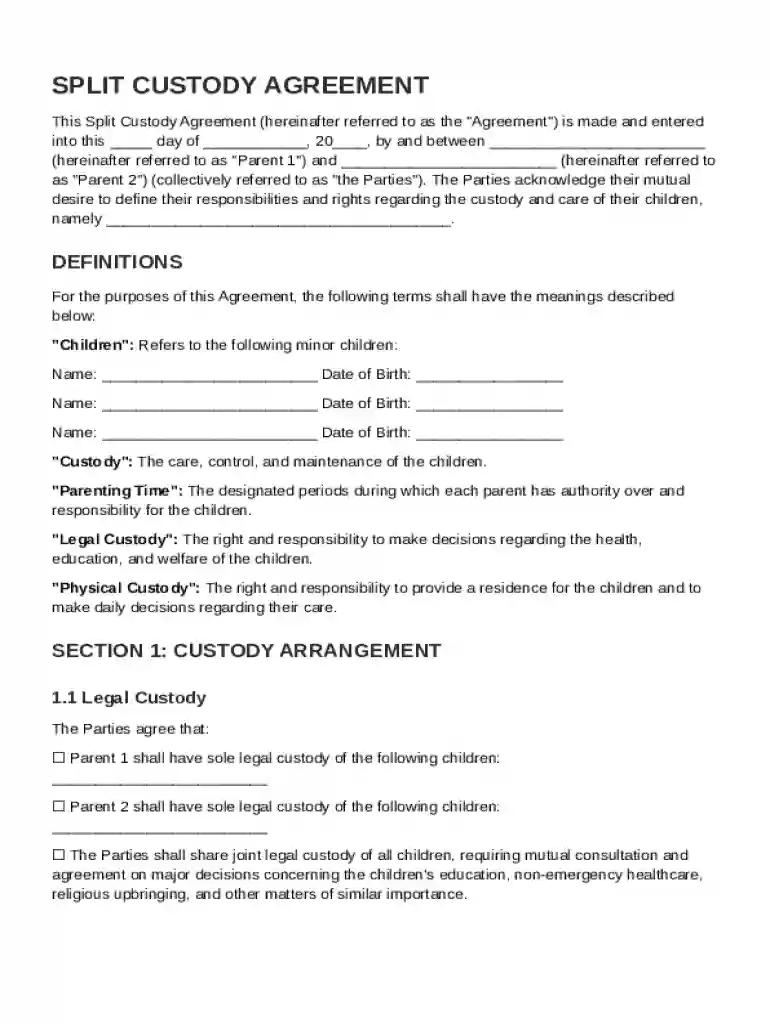
Split Custody Agreement Template Preview on Page 1

Here's how it works

01. Edit your form online
Type text, add images, blackout confidential details, add comments, highlights and more.

02. Sign it in a few clicks
Draw your signature, type it, upload its image, or use your mobile device as a signature pad.

03. Share your form with others
Send it via email, link, or fax. You can also download it, export it or print it out.

Definition and Purpose

A Split Custody Agreement Template is a legally binding document used to outline the custody arrangements for minor children when parents decide to share custody. It details how parents will divide their responsibilities and rights concerning the upbringing and care of their children. This template typically includes provisions for legal and physical custody, parenting schedules, and communication guidelines. The agreement serves to minimize conflicts by clearly defining expectations and obligations for each parent.

Key Elements of the Split Custody Agreement Template

Legal and Physical Custody Arrangements

  • Legal Custody: This specifies which parent has the authority to make decisions regarding the child's health, education, and welfare.
  • Physical Custody: This defines where and with whom the child will primarily reside, as well as the visitation schedule for the other parent.

Parenting Time Schedule

A detailed schedule outlining when each parent will have physical custody of the child, including weekends, holidays, and vacations. The agreement should be flexible enough to accommodate changes due to unforeseen circumstances.


Transportation and Exchange Logistics

  • Designated Pickup/Drop-off Locations: Specific locations where the child will be exchanged between parents.
  • Transportation Responsibilities: Specifies which parent is responsible for transporting the child to scheduled exchanges.

Steps to Complete the Split Custody Agreement Template

  1. Gather Background Information: Collect necessary details about each parent, the child, and any relevant court orders or past agreements.
  2. Define Custody Arrangements: Decide on legal and physical custody specifications in line with the child's best interests.
  3. Craft a Parenting Plan: Develop a detailed schedule that addresses regular custody, holiday arrangements, and school vacations.
  4. Set Communication Guidelines: Establish methods and frequency of communication between parents and between children and the non-custodial parent.
  5. Consult with Legal Counsel: Ensure that the agreement is checked by a lawyer to confirm compliance with state laws and the enforceability of its terms.
  6. Finalize and Sign: Both parents should review, agree upon, and sign the finalized document to formalize the agreement.

Who Typically Uses the Split Custody Agreement Template

  • Divorced or Separated Parents: To formalize custody arrangements without continual conflict or miscommunication.
  • Unmarried Parents: Non-married couples sharing parenting responsibilities often utilize these agreements to define parenting roles explicitly.
  • Family Law Attorneys: Legal professionals assisting clients in creating legally sound custody agreements.
decoration image ratings of Dochub

Legal Use and Enforcement

Jurisdiction and Governing Law

The Split Custody Agreement is governed by the family law statutes of the state where it is executed. Each party must ensure that the terms comply with the local jurisdiction to be enforceable.

Dispute Resolution Procedures

  • Mediation Requirement: Many agreements include clauses requiring mediation before pursuing further legal action in the event of disputes.
  • Modification Protocols: Processes for amending custody terms, ensuring both parties consent to the adjustments.

Important Terms Related to Split Custody

  • Joint vs. Sole Custody: Differentiates between shared responsibilities or assigning them to one parent.
  • Primary Caregiver: Refers to the parent designated for daily childcare responsibilities.
  • Visitation Rights: Explains the context of scheduled visits for a non-custodial parent.

State-Specific Rules and Differences

Custody laws can vary significantly between states in the United States. For example:

  • California: Prioritizes joint custody to ensure children have continued contact with both parents.
  • New York: Judges focus on the best interests of the children, taking into account stability, siblings, and parental involvement.

Examples and Case Studies

Real-World Scenarios

  • Split Custody Between States: Cases where parents reside in separate states and how agreements adapt to handle long-distance parenting challenges.
  • High-Conflict Divorces: Examples of how the agreements can resolve issues when parents have difficulty cooperating.

Practical Examples

  • Holiday Rotations: A plan detailing alternating holidays to ensure fairness and continuity in children's lives.
  • Summer Vacation Plans: Specific arrangements that allow extended time with non-custodial parents during out-of-school periods.

In creating a comprehensive and well-structured Split Custody Agreement Template, the focus should be on clear communication, practical logistics, and legal compliance to ensure that both parents can effectively co-parent in the best interests of their children.

be ready to get more

Complete this form in 5 minutes or less

Get form

Got questions?

We have answers to the most popular questions from our customers. If you can't find an answer to your question, please contact us.
Contact us
The following are six common ways for parents to split child custody evenly using a two-week time frame. Splitting Child Custody Every Other Week. Splitting Custody Every Other Week Plus One Overnight. A 3-3-4-4 Custody Schedule. A 2-2-5-5 Child Custody Schedule. A 2-2-3 Custody Schedule. Splitting Custody Every Other Day.
So, most divorcing parents hope for amicable child custody arrangements. The child custody arrangement you settle on will depend on your family. However, joint custody tends to be the most common child custody arrangement.
The inability of parents to consistently control their emotions, and avoid emotional decision making, is the most common mistake we see in child custody cases. The reason: it is such an easy mistake to make, and so pervasive in all aspects of the case.
It can be particularly challenging for children during what is often considered the worst age for divorce. Younger children between the ages of 6 and 12 tend to feel a sense of confusion, guilt, and sadness. They may blame themselves for their parents separation and struggle with feelings of abandonment.
70/30 Parenting Schedule The child spends the week (Monday - Friday) with parent A, and the weekend (Saturday and Sunday) with parent B. The child spends two consecutive weeks (14 days) with parent A and one week (7 days) with parent B.

Security and compliance

At DocHub, your data security is our priority. We follow HIPAA, SOC2, GDPR, and other standards, so you can work on your documents with confidence.

Learn more
ccpa2
pci-dss
gdpr-compliance
hipaa
soc-compliance

People also ask

Like a biweekly routine, schedules with a 2-2-3 rotation enables parents to split time with their kids 50/50. In each routine, each parent would have their kids for a couple of days, then they would go to be with the other parent for a couple of days, and the cycle continues from there.
The 2-2-5-5 joint custody schedule is a parenting plan used to split child custody time equally between two parents. Its a good option for parents who want to maintain a close relationship with their children and share responsibilities fairly.

Related links