






Definition and Meaning
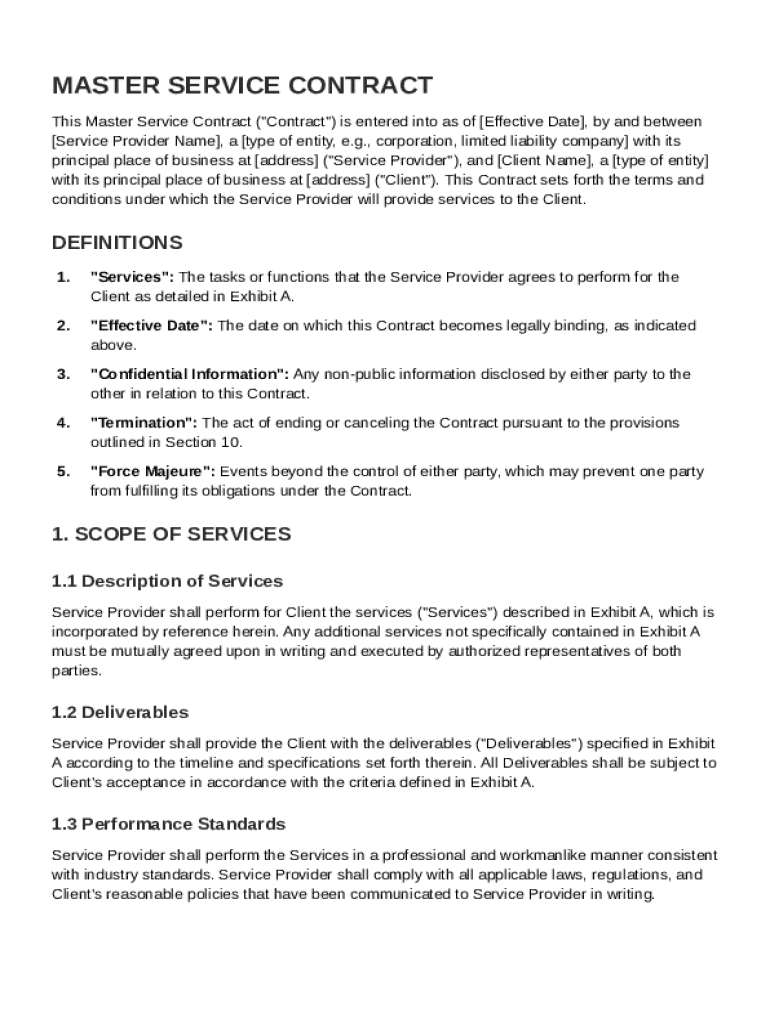
A Master Service Contract (MSC) is a comprehensive agreement between a service provider and a client. It outlines the terms and conditions under which services will be provided, ensuring clarity and understanding between both parties. The agreement covers various aspects, such as the scope of services, payment terms, confidentiality obligations, intellectual property rights, and dispute resolution processes. By defining the roles and responsibilities, an MSC aims to prevent misunderstandings and legal disputes, promoting a smooth business relationship.
Key Components
- Scope of Services: This section clearly delineates what services will be offered and includes any limitations or exclusions to avoid potential disputes.
- Payment Terms: Details about the payment schedule, methods, and conditions for additional charges or late fees.
- Confidentiality Obligations: Specifications on how sensitive information should be handled by both parties.
- Dispute Resolution: Pre-agreed methods for resolving any conflicts, such as mediation or arbitration.
How to Use the Master Service Contract Template
Using a master service contract template involves several critical steps to customize it to your specific business needs. A reliable template acts as the foundation, which users must adapt to reflect the transaction's unique elements.
- Review the Template: Begin by reading through the entire contract to understand each clause and section.
- Customize Clause Details: Tailor the template by filling in details like the named parties, service descriptions, and financial agreements.
- Consult Legal Advisors: Seek professional assistance to ensure all contract terms are clear and legally enforceable.
Steps to Complete the Master Service Contract Template
Completing a master service contract requires careful attention to each section to ensure all relevant details are precisely documented.
- Information Gathering: Collect all necessary information related to the contracting parties and the services to be provided.
- Draft Specific Terms: Enter specific terms for project timelines, deliverables, and any unique conditions.
- Review for Ambiguities: Analyze the contract thoroughly to eliminate ambiguous language that could lead to misunderstandings.
- Finalization and Signature: Once reviewed, both parties should sign the document, agreeing to adhere to the outlined terms.
Key Elements of the Master Service Contract Template
A well-constructed master service contract template includes several essential elements, which provide the foundation for the partnership between a service provider and client.
Main Sections
- Introduction: Defines parties and agreement purpose.
- Services Description: Detailed explanation of services the provider will deliver.
- Compensation Structure: Outlines how and when payments will be made.
- Termination Clauses: Conditions under which the agreement can be ended by either party.
Supporting Clauses
- Indemnification: Protects parties against potential losses due to the other's actions.
- Liability Limitations: Sets boundaries on the extent and conditions of liability.
- Governing Law: Specifies which jurisdiction's laws will apply to the contract.
Legal Use of the Master Service Contract Template
Utilizing the master service contract template legally requires compliance with applicable laws and regulations. The contract should align with local, state, and federal laws to ensure enforceability and protect both parties' interests.
Regulatory Compliance
- State Laws: Laws may vary depending on the state; ensure the template complies with local regulations.
- Industry Standards: Adhere to regulatory guidelines specific to your industry to ensure legality.
Common Legal Issues
- Breach of Contract: Failure to adhere to the agreed terms could result in litigation.
- Intellectual Property Rights: Clear handling instructions and rights allocation prevent legal disputes.
State-Specific Rules for the Master Service Contract Template
While a master service contract template provides a general standard, certain states may impose additional requirements or variations.
Notable Variations
- Governing Laws: Each state may have differing rules that affect contract enforceability.
- Filing Requirements: Some states require specific disclosures or filings for transparency and compliance.
Adaptation Suggestions
- Custom Clauses: Modify the template to reflect state-specific laws for tailor-made compliance.
- Professional Assessment: Seek legal guidance to ensure the contract meets state regulations.
Business Types that Benefit Most from the Master Service Contract Template
A broad array of business types can utilize a master service contract to manage their client-service provider relationships effectively.
Ideal Industries
- IT and Tech Services: Regular and evolving service provisions benefit from a clearly defined agreement.
- Consulting Firms: Standardize engagement terms to streamline business operations.
- Construction: Given the project's complexity, a master service contract helps delineate responsibilities and timelines.
Small vs. Large Enterprises
- Small Businesses: Use the contract to instill professionalism without investing heavily in legal resources.
- Large Corporations: Strong contracts minimize risks associated with large, complex projects.
Examples of Using the Master Service Contract Template
Understanding how to employ a master service contract template in real-world scenarios adds practical value to its application.
Scenario Applications
- Software Development: Defining deliverables, timelines, and version control expectations.
- Marketing Services: Outlining campaign objectives and metrics for success measurement.
- Freelance Work: Freelancers can define their roles, client expectations, and payment schedules clearly to avoid misunderstandings.
Best Practices
- Ongoing Revisions: Update contracts regularly to reflect changing business needs or regulatory changes.
- Clear Communication: Ensures that both parties understand every detail of the agreement to prevent future disputes.