






Definition and Meaning of the Business Consulting Agreement Template
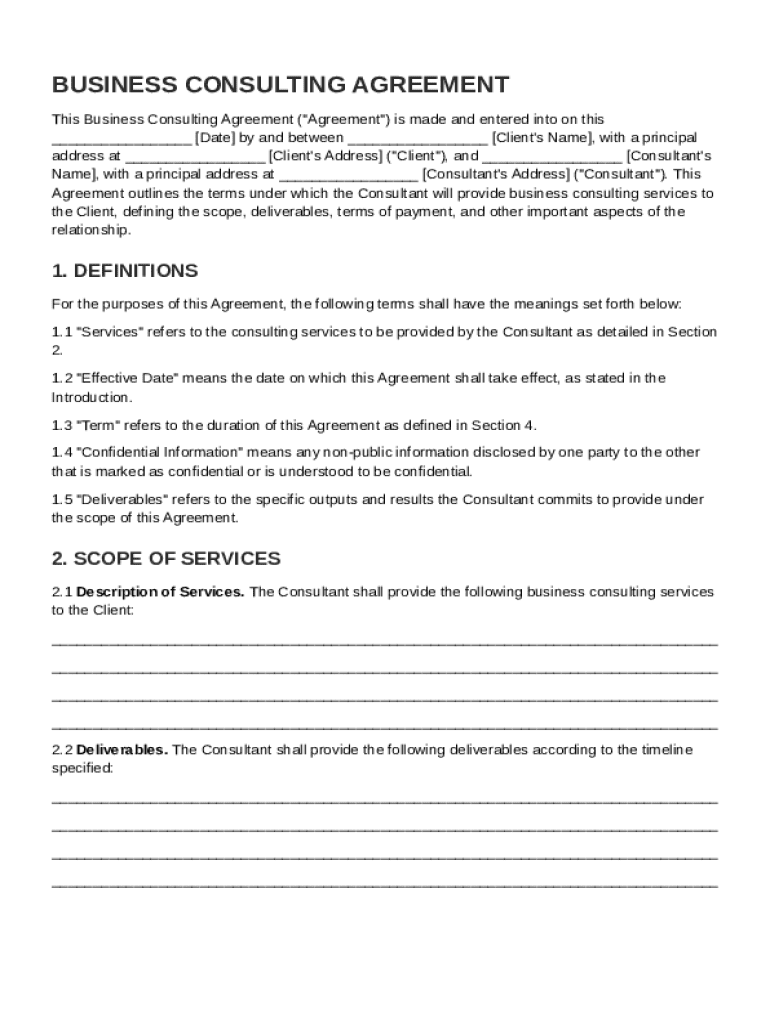
The Business Consulting Agreement Template is a standardized document that formalizes the relationship and expectations between a client and a consultant providing business consulting services. This template outlines the terms and conditions under which the consultancy will take place, offering a structured framework that ensures both parties' roles and responsibilities are clearly defined. The agreement typically covers aspects such as the scope of services, compensation details, confidentiality obligations, and general provisions like dispute resolution mechanisms. By providing a consistent format, the Business Consulting Agreement Template helps streamline negotiations and create a shared understanding between involved parties.
How to Use the Business Consulting Agreement Template
Using the Business Consulting Agreement Template effectively involves customizing the document to meet the specific needs and circumstances of the client-consultant relationship. Here are detailed steps to ensure you use the template correctly:
-
Identify the Parties: Begin by clearly identifying the client and the consultant. Include full legal names and contact information for precision and accountability.
-
Define the Scope of Services: Specify the services that the consultant will provide, giving detailed descriptions to prevent any misunderstandings about the consultant’s role and responsibilities.
-
Set Compensation Terms: Outline the payment structure, including hourly rates, fixed fees, or payment milestones. Clarify any conditions under which payment can be withheld, ensuring all financial matters are agreed upon in advance.
-
Establish a Timeline: Share a project start and end date, including key milestones and deadlines to keep the project on track and provide clear expectations for the consultant's deliverables.
-
Include Confidentiality Clauses: Establish guidelines for how sensitive information will be handled to protect both parties’ proprietary data and interests.
-
Insert Dispute Resolution Mechanisms: Determine ways disputes will be resolved, such as through mediation or arbitration, to prevent potential conflicts from escalating.
Practical Examples
- A consulting firm might modify the template to include industry-specific performance metrics.
- An IT consultant and a startup client could adjust the timeline section to reflect the agile development cycles common in tech projects.
Key Elements of the Business Consulting Agreement Template
This template is composed of several key components that form the foundation of a sound consulting agreement. Here are the primary elements you should pay attention to:
-
Parties Involved: The legal names and addresses of both the client and consultant.
-
Description of Services: In-depth explanation of the consulting services provided.
-
Terms of Payment: How and when the consultant will be compensated.
-
Term and Termination: The agreement duration and circumstances under which it can be terminated.
-
Confidentiality: Protections related to sharing and using sensitive information.
-
Indemnification: Provisions that protect against legal claims arising from the work performed.
-
Intellectual Property Rights: Agreements on ownership of any new IP generated through the consultancy.
-
General Provisions: Additional clauses covering amendments, notices, and the governing law.
Detailed Examples
- A large corporation may emphasize indemnity clauses in case of data breaches resulting from consultancy.
- A creative agency could focus on intellectual property rights to ensure all campaign materials remain under company ownership.
Steps to Complete the Business Consulting Agreement Template
When filling out the Business Consulting Agreement Template, follow these steps to ensure each section is addressed accurately:
-
Filling in Basic Information: Start by entering the names and addresses of the parties involved.
-
Detail the Services: Specify the consulting services to be rendered, including methods, goals, and any deliverables.
-
Outline Financial Arrangements: Include all compensation-related details — hourly rates, payment schedules, and reimbursement procedures for expenses.
-
Set the Duration: Include a timeline outlining when services begin and end.
-
Add Legal Terms: Input all necessary legal terms, including confidentiality, liability, and dispute resolution.
-
Review and Modify: Go through the document to tailor it to your specific needs, ensuring all regulatory requirements are met.
-
Signatures: Finalize the document with signatures from both parties to formalize the agreement.
Who Typically Uses the Business Consulting Agreement Template
The template is versatile and widely used across various industries and scenarios. The primary users typically include:
-
Independent Consultants: Individuals offering specialized knowledge or services to businesses.
-
Consulting Firms: Organizations providing professional advice to clients across various sectors such as technology, healthcare, or finance.
-
Corporate Clients: Businesses requiring specialized expertise to improve operations, enter new markets, or launch new products.
-
Startups: Emerging companies leveraging consultants for strategic growth advice.
-
Nonprofits: Organizations seeking expert input for enhanced operational efficiency or fundraising strategies.


Industry Applications
- Financial institutions may use the agreement to onboard strategy consultants for market analysis.
- Healthcare organizations could rely on it to engage medical consultants for improving patient care systems.
Legal Use of the Business Consulting Agreement Template
The legal enforceability of the Business Consulting Agreement Template is critical to its function. In the U.S., it must comply with various federal and state laws to be considered binding. Key legal components include:
-
Compliance with State Laws: Adhering to the local jurisdiction’s contract laws and any industry-specific regulations.
-
Clear Legal Language: Utilizing straightforward, unambiguous language to diminish potential misinterpretation.
-
Consideration: Ensuring there is an exchange of value, typically the consultant’s services for payment.
-
Capacity: Both parties must have the legal capacity to enter into the contract without restrictions such as bankruptcy.
Legal Scenarios
- A consulting agreement in California might need to comply with specific state labor laws regarding independent contractors.
- An international consultancy should consider including a jurisdiction clause to determine which country's laws apply.
State-Specific Rules for the Business Consulting Agreement Template
While the Business Consulting Agreement Template provides a universal foundation, adaptations might be necessary to comply with state-specific legal requirements. Below are examples of considerations unique to certain U.S. states:
-
California: Regulations regarding the classification of independent contractors versus employees are particularly stringent. Ensure your agreement clearly defines the nature of the relationship and complies with California Labor Code.
-
New York: Contracts should include specific terms detailing the consultant's operational independence to meet state labor policies.
-
Texas: Incorporation of Texas’s unique non-compete agreements and confidentiality clauses is crucial to prevent legal challenges.
Examples of State Variations
- In Massachusetts, recent legal changes require specific prerequisites for non-compete clauses, which must be reflected in the agreement.
Versions or Alternatives to the Business Consulting Agreement Template
Apart from the traditional Business Consulting Agreement Template, there are several versions or alternatives that could better suit different scenarios:
-
Short-Form Consulting Agreement: Ideal for short-term projects or when consulting services are straightforward and limited in scope.
-
Retainer Agreement: Used when services are ongoing and the consultant is paid a regular retainer.
-
Project-Based Agreement: Tailored for one-off projects with specific deliverables and defined timelines.
Alternative Application Scenarios
- A digital marketing consultant working on a comprehensive year-long strategy might prefer a retainer agreement.
- An IT consultant working on a singular task, like setting up a server, could employ a short-form agreement for simplicity and clarity.