






Definition and Meaning
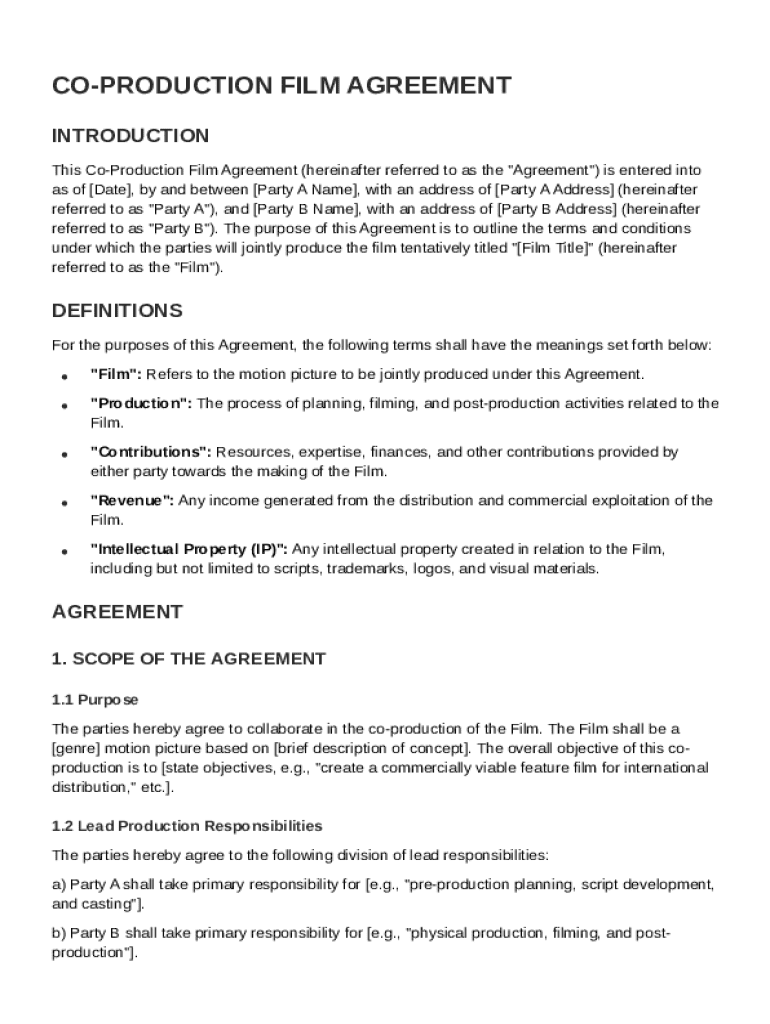
A Co-Production Film Agreement Template is a standardized legal document used as a blueprint for collaborations between two or more parties in the film industry. This template outlines the shared responsibilities and contributions necessary for producing a film together. It addresses various aspects, such as financial investment, technical skills, creative input, and marketing efforts, ensuring that each party understands their roles and expectations. By providing a structured framework, this template minimizes potential misunderstandings and disputes, facilitating a smoother production process.
How to Use the Co-Production Film Agreement Template
To utilize a Co-Production Film Agreement Template effectively, start by customizing the template to reflect the specific details of your film project. This involves editing sections to include the legal names of the co-producing parties, the working title of the film, budget details, and specific roles and contributions of each entity. Utilize the template’s commentary and annotation features to add or modify clauses based on the unique needs of your project. For instance, if you are addressing intellectual property rights, specify who retains rights to different creative elements. Save and store the customized agreement securely, and ensure all parties involved review and agree to the terms before signing.
Important Terms Related to Co-Production Film Agreement Template
Familiarity with key legal and industry-related terms is crucial when dealing with a Co-Production Film Agreement Template:
- Intellectual Property Rights: Legal rights providing creators protection over their original works, a crucial element in film production.
- Gross Revenue: Total revenue generated from the film before deductions, often discussed in revenue-sharing agreements.
- Joint Ownership: A legal structure where co-producers share ownership of the film project.
- Arbitration: A method for resolving disputes outside of court, which can be included as a means of settling disagreements in the agreement.
Understanding these terms helps ensure that all parties accurately interpret the agreement.
Key Elements of the Co-Production Film Agreement Template
The Co-Production Film Agreement Template comprises several critical components that establish the foundation for a successful partnership:
- Responsibilities and Contributions: Detailed roles and tasks assigned to each party, whether financial, creative, or logistical.
- Revenue Sharing: Outlines how profits from the film are to be divided among parties.
- Dispute Resolution: Procedures for handling conflicts, often including mediation or arbitration clauses.
- Termination Clauses: Conditions under which the agreement can be ended.
- Management Structure: Defines decision-making processes and how creative control is exercised.
These elements are essential in mitigating risks and ensuring clarity.
Legal Use of the Co-Production Film Agreement Template
In the United States, using a Co-Production Film Agreement Template requires adherence to specific legal standards to be enforceable in courts. It must comply with contract law principles, including offer, acceptance, mutual consent, and consideration. Parties should ensure the agreement includes legally binding signatures and, if necessary, is notarized to prevent challenges to its validity. Additionally, the agreement should align with federal and state laws regarding labor and employment, intellectual property, and entertainment law.
Steps to Complete the Co-Production Film Agreement Template
- Identify the Parties: Clearly state the parties involved, including legal names and roles in the production.
- Define the Project: Include the film's working title, genre, and a brief outline of the production scope.
- Detail Financial Contributions: Specify each party's financial investment and how costs will be managed and shared.
- Outline Creative and Technical Roles: Describe individual responsibilities in areas such as script development, directing, and cinematography.
- Establish Revenue Sharing Plans: Agree on how gross and net revenues will be distributed.
- Create a Conflict Resolution Framework: Decide on mediation or arbitration to resolve disputes.
- Finalize the Document: Review, make necessary adjustments, and ensure all parties sign the document.
Who Typically Uses the Co-Production Film Agreement Template
This template is predominantly used by independent filmmakers, production companies, and sometimes international co-productions seeking joint ventures. It suits various film projects, from small indie films to larger studio collaborations. Both established production houses looking for creative partnerships and novice filmmakers seeking financial backing can benefit from such an agreement. The template ensures all parties are legally protected and have a clear understanding of their business arrangement.


Examples of Using the Co-Production Film Agreement Template
Consider a scenario where an American production company partners with a British studio to create a new feature film. By utilizing a Co-Production Film Agreement Template, both parties can outline their contributions, such as the U.S. company providing primary funding and distribution networks while the UK studio offers talent and location resources. Another example includes film schools partnering with production veterans, the agreement template helping structure roles, resource sharing, and educational credits. By standardizing the terms, the template sets a clear path, addressing potential complications before they arise.