




01. Edit your ct 945 online
Type text, add images, blackout confidential details, add comments, highlights and more.

Type text, add images, blackout confidential details, add comments, highlights and more.

Draw your signature, type it, upload its image, or use your mobile device as a signature pad.

Send ct 945 form via email, link, or fax. You can also download it, export it or print it out.
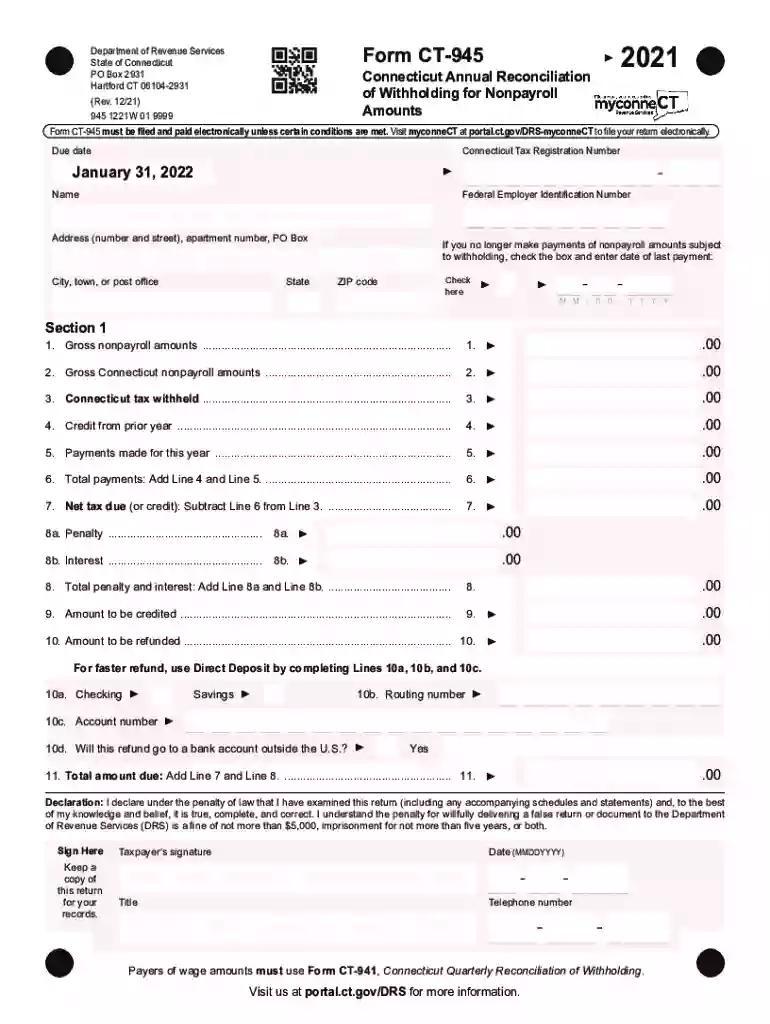
Form CT-945 is an important document issued by the Connecticut Department of Revenue Services. It is utilized for the annual reconciliation of withholding for nonpayroll amounts. The primary purpose of this form is to report and reconcile Connecticut tax withheld on nonpayroll payments, ensuring that the correct tax amounts are accounted for and paid to the state. This form is essential for businesses and entities operating within Connecticut that are responsible for withholding taxes on various nonpayroll payments such as pensions, annuities, and gambling winnings.
Filing Form CT-945 in a timely manner is crucial to avoid penalties. The deadline for submission is January 31st of the year following the tax period covered by the form. Failure to meet this deadline may result in penalties and interest charges. It is advised to file early to account for any potential issues that might arise during the electronic submission process.
Non-compliance with CT-945 filing requirements can lead to several penalties from the Connecticut Department of Revenue Services. Common penalties include monetary fines for late submissions and interest charges on overdue payments of withheld taxes. Furthermore, incorrect or incomplete filing can also lead to additional scrutiny from the state, possibly resulting in audits.
The form is used by a wide variety of entities, including corporations, partnerships, and sole proprietorships that are required to withhold Connecticut state tax from nonpayroll payments. Organizations such as pension fund managers, insurance companies, and gambling establishments often use this form to report the withholding tax amount to the state.


Connecticut has particular regulations regarding the types of nonpayroll payments subject to withholding, which must be followed closely when completing Form CT-945. The state requires electronic filing unless a waiver is granted, and all figures reported must be in accordance with state-specific guidelines and calculation methods. Entities must ensure they are using the correct rates and categories for withholding to stay compliant with state laws.
Many businesses find it beneficial to use tax software to assist with completing and submitting Form CT-945. Compatibility with established financial software platforms can simplify the reporting process and ensure accuracy. Programs such as QuickBooks and TurboTax often provide features for state-specific tax filings, including CT-945, helping to streamline the preparation and submission process. Be sure that your software is updated and aligned with the current year’s tax guidelines for Connecticut.
We've got more versions of the ct 945 form. Select the right ct 945 version from the list and start editing it straight away!
| Versions | Form popularity | Fillable & printable |
|---|---|---|
| 2025 | 4.7 Satisfied (24 Votes) | |
| 2024 | 4.9 Satisfied (45 Votes) | |
| 2023 | 4.2 Satisfied (39 Votes) | |
| 2022 | 4.3 Satisfied (24 Votes) | |
| 2021 | 4.8 Satisfied (90 Votes) | |
| 2020 | 4.4 Satisfied (300 Votes) | |
| 2018 | 4.4 Satisfied (173 Votes) | |
| 2015 | 4.4 Satisfied (397 Votes) | |
| 2014 | 4 Satisfied (24 Votes) | |
| 2013 | 4.1 Satisfied (70 Votes) | |
| 2012 | 4.2 Satisfied (68 Votes) |
At DocHub, your data security is our priority. We follow HIPAA, SOC2, GDPR, and other standards, so you can work on your documents with confidence.
Jan 31, 2023 Form CT-945 is used to reconcile annual Connecticut income tax withholding from nonpayroll amounts only. Payers of nonpayroll amountsRead more
On or before the last day of January following the end of each calendar year, the designated withholding agent must file Form CT-945 ATHEN,. Connecticut AnnualRead more
Dec 2, 2016 Mummies from the Collection of Egyptian Antiquities of the National Archaeological Museum of Greece are on their way to the CT scanner.


