
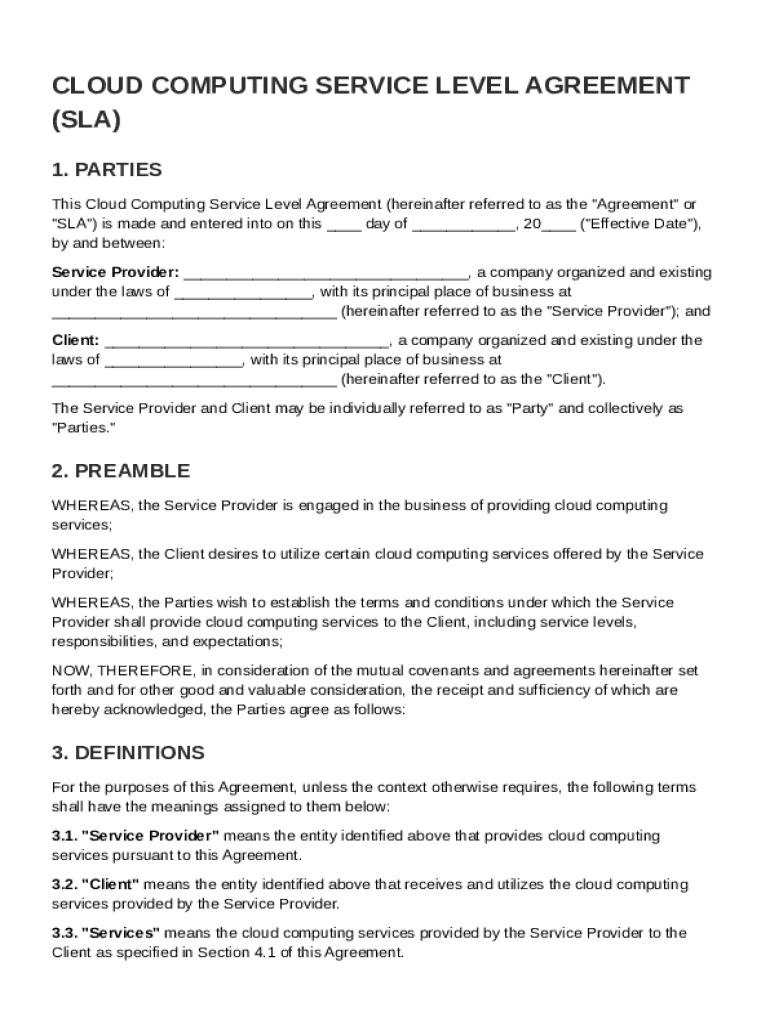







Definition & Meaning
A Cloud Computing Service Level Agreement (SLA) is a detailed document that formalizes the conditions under which cloud computing services are provided. It defines performance metrics, availability guarantees, responsibilities of both the provider and the client, and the terms for service disruption. By setting clear expectations, it helps ensure that the service provider delivers consistent and reliable performance. SLAs serve as a critical reference during disputes, offering both parties a mutual understanding of expected service levels.
Key Elements of the Cloud Computing Service Level Agreement Template
An effective Cloud Computing SLA template incorporates several essential components:
- Service Scope: Specifies the services covered, including operational levels and network availability.
- Performance Metrics: Outlines specific criteria such as uptime percentages, response times, and throughput.
- Responsibilities: Details the duties of the service provider and the client, including security measures and data backup responsibilities.
- Support & Maintenance: Defines support procedures, maintenance schedules, and escalation processes for technical issues.
- Data Security: Encompasses confidentiality provisions, encryption standards, and access controls for safeguarding sensitive data.
- Indemnification & Liability: Clarifies the extent of liability coverage and indemnity clauses to protect against potential losses.
- Dispute Resolution: Describes mechanisms for resolving disagreements, including mediation, arbitration, or legal proceedings.
- Termination Conditions: Specifies circumstances under which the agreement can be terminated and the implications for each party.
Steps to Complete the Cloud Computing Service Level Agreement Template
To effectively complete a Cloud Computing SLA template, follow these steps:
- Identify Needs: Determine specific service requirements and expectations from the cloud provider.
- Gather Information: Compile data on the services offered, performance standards, and support options available.
- Draft Initial Agreement: Use the template to outline the service obligations, performance metrics, and security measures.
- Review with Stakeholders: Collaborate with legal and IT departments to ensure that all facets of the agreement reflect client needs and legal compliance.
- Negotiate Terms: Engage with the service provider to finalize terms, focusing on contentious aspects such as liability limits or performance guarantees.
- Finalize the Document: Make necessary revisions and obtain signatures from authorized representatives of both parties.
- Regular Updates: Reassess and update the SLA periodically to align with evolving business needs or technology upgrades.
Important Terms Related to Cloud Computing Service Level Agreement Template
Understanding specific terminology is crucial for navigating a Cloud Computing SLA:
- Uptime/Downtime: Measures service availability, typically represented as a percentage.
- Service Credits: Compensation offered to clients when SLAs are not met.
- Recovery Point Objective (RPO): Maximum tolerable period in which data might be lost due to an incident.
- Recovery Time Objective (RTO): Target duration to restore a service after a disruption.
- Data Sovereignty: Legal concept that information is subject to the laws of the country where it is located.
- Multitenancy: Architecture where multiple clients use shared resources on a single infrastructure.
Examples of Using the Cloud Computing Service Level Agreement Template
A variety of scenarios demonstrate the practical use of a Cloud Computing SLA:
- Educational Institutions: Universities using cloud platforms for virtual classrooms may establish SLAs to guarantee availability during peak examination seasons.
- Healthcare Providers: Hospitals require high-performance standards and data security to manage patient records, necessitating robust SLAs.
- E-commerce Platforms: Online retailers using cloud services rely on SLAs to uphold performance levels critical during events like Black Friday sales.
- Startups: Emerging tech companies might negotiate SLAs focusing on scalability and support to accommodate rapid growth.
Legal Use of the Cloud Computing Service Level Agreement Template
In the U.S., a Cloud Computing SLA must comply with various legal standards:
- Data Protection Laws: Ensure adherence to regulations like HIPAA for healthcare data or GDPR for handling EU citizens' data.
- Contract Law: The SLA must constitute a legally binding contract with appropriately authorized signatures.
- Compliance Audits: Regular assessments ensure ongoing compliance with industry standards and legal obligations.
Software Compatibility
The effectiveness of a Cloud Computing SLA can be enhanced by ensuring compatibility with various business software, such as:
- Document Management Systems: Integration with tools like DocHub streamlines updates and signature collection.
- Project Management Platforms: Synchronization with software like Asana or Jira helps track SLA compliance and support tickets.
- Security Software: Compatibility with cybersecurity tools is vital for implementing SLA-enforced data protection measures.
Business Types That Benefit Most from Cloud Computing Service Level Agreement Template
While Cloud Computing SLAs are valuable across industries, certain business types see enhanced benefits:
- Enterprises: Large corporations use detailed SLAs to handle complex IT infrastructure and ensure provider accountability.
- SMEs: Small and medium-sized enterprises rely on SLAs to secure necessary services without heavy investment in IT resources.
- Finance Sector: Banks and financial institutions prioritize SLAs for data integrity and uninterrupted service.
- Manufacturing Firms: As they adopt IoT and cloud-based automation, SLA terms guide service quality and reliability standards.




