
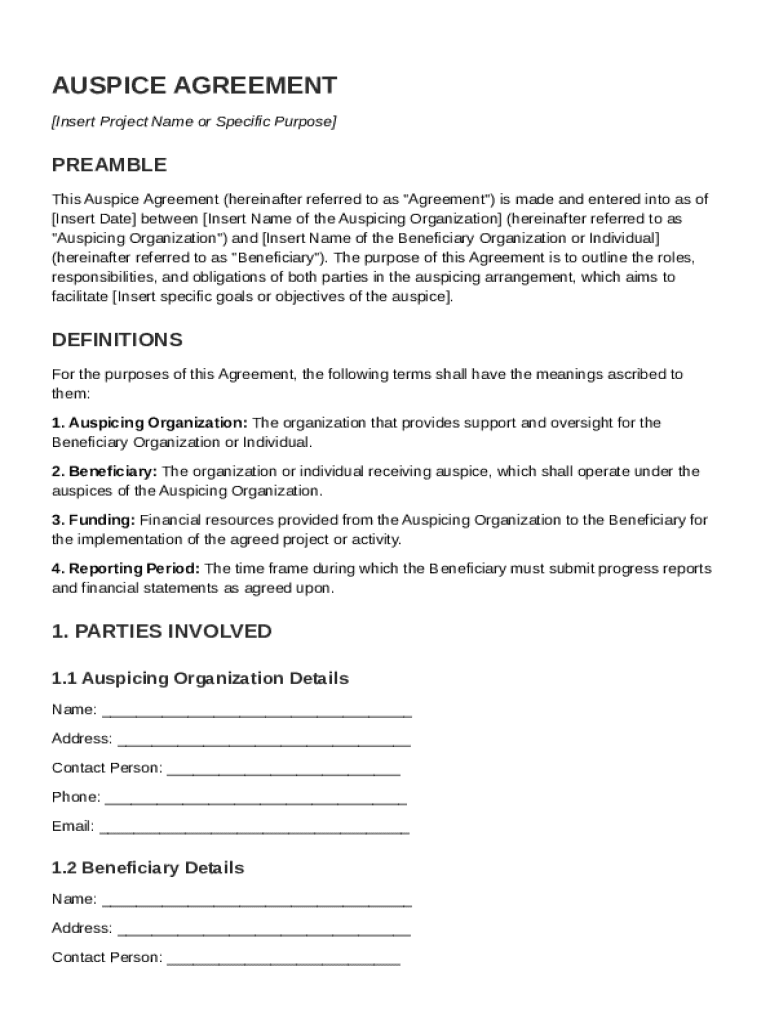







Definition and Meaning
An Auspice Agreement is a legal document that formalizes the relationship between an Auspicing Organization, typically a nonprofit or funding entity, and a Beneficiary Organization or Individual. This agreement delineates roles, responsibilities, and obligations, thereby providing a structured approach to their partnership. The primary aim of the auspicing arrangement is to facilitate the oversight and management of projects, ensuring that resources are allocated efficiently and objectives are achieved within the defined scope. Additionally, the agreement addresses financial management, intellectual property rights, and compliance with applicable laws, setting a clear foundation for successful collaboration.
Key Elements of the Auspice Agreement Template
The Auspice Agreement Template encompasses several vital components to ensure clarity and effectiveness in the relationship between parties:
- Purpose and Objectives: Clearly outlines the reason for the auspicing arrangement and the specific goals to be achieved.
- Scope of Work: Details the tasks, responsibilities, and deliverables expected from both parties.
- Financial Management: Specifies budgeting, funding distribution, and financial reporting requirements.
- Intellectual Property Rights: Defines the ownership and usage rights of any intellectual property created during the project.
- Duration and Termination: States the time frame for the agreement and conditions under which it can be terminated.
- Dispute Resolution: Provides mechanisms for resolving disagreements amicably.
- Amendments: Describes how the agreement can be modified or updated as needed.
These elements ensure that the agreement serves as a comprehensive guide for all involved parties.
Steps to Complete the Auspice Agreement Template
Completing the Auspice Agreement Template involves a series of methodical steps:
- Gather Necessary Information: Collect all relevant details, including the names and contact information of both the Auspicing Organization and the Beneficiary.
- Define Objectives and Scope: Clearly articulate the purpose of the arrangement and outline the specific responsibilities of each party.
- Outline Financial Details: Specify the budget, funding sources, and any financial responsibilities.
- Discuss Intellectual Property: Agree on the terms of intellectual property rights and ownership.
- Set the Terms and Conditions: Define the duration of the agreement, and the procedures for amendments and termination.
- Include Dispute Resolution Procedures: Clearly state how disputes will be handled.
- Review and Revise: Ensure both parties review the document thoroughly for accuracy and completeness.
- Finalize and Sign: Both parties should sign the document to make the agreement legally binding.
Following these steps ensures that the agreement is completed correctly and is enforceable.
Legal Use of the Auspice Agreement Template
The legal use of the Auspice Agreement Template is essential to uphold its enforceability and legitimacy:
- Compliance with Laws: The agreement must adhere to relevant federal, state, and local laws.
- Binding Agreement: It serves as a legally binding contract that can be presented in court if necessary.
- Documentation of Intentions: Provides formal documentation of the intentions and expectations of both parties, reducing the potential for future disputes.
- Clear Dispute Resolutions: Including legally recognized dispute resolution mechanisms ensures issues are handled appropriately.
Using the template to draft an auspice agreement can safeguard both parties' interests and ensure compliance with legal standards.
Examples of Using the Auspice Agreement Template
The Auspice Agreement Template is adaptable to a wide range of scenarios, providing structure and clarity:
- Grant Management: A nonprofit organization may use the template to formalize an arrangement with a research group for managing grant funds and implementing a project.
- Collaborative Projects: Two nonprofits might collaborate on a community development initiative, utilizing the agreement to define roles and responsibilities.
- Fiscal Sponsorship: An independent artist could partner with a fiscal sponsor to manage the finances of a public art installation.
These examples demonstrate the versatility and practical application of the template in various contexts.
Who Typically Uses the Auspice Agreement Template
The Auspice Agreement Template is predominantly used by:
- Nonprofit Organizations: To manage collaborative projects and ensure proper project oversight.
- Funding Agencies: To establish clear financial management protocols and reporting structures.
- Educational Institutions: For research collaborations that involve external funding and resource sharing.
- Government Agencies: When partnering with civic groups on community projects.
Understanding who uses this template can aid in appreciating its relevance and utility in various professional partnerships.


State-Specific Rules for the Auspice Agreement Template
State-specific rules may impact the implementation of the Auspice Agreement Template:
- Regulatory Compliance: Different states may have unique laws governing nonprofit activities and fiscal arrangements.
- Registration Requirements: Some states require nonprofits participating in auspice arrangements to register or report their activities.
- Tax Implications: Variations in state tax laws may affect financial aspects of the agreement, such as funding distribution and expense reporting.
Addressing these differences is crucial to ensure the agreement is compliant with local regulations.
Important Terms Related to Auspice Agreement Template
Understanding key terms associated with the Auspice Agreement Template can enhance comprehension and application:
- Auspicing Organization: The entity responsible for managing the project resources and ensuring compliance with financial and legal obligations.
- Beneficiary Organization: The party benefiting from the auspicing arrangement, focusing on project implementation.
- Fiscal Sponsorship: A financial arrangement where a recognized nonprofit provides oversight and legal support to groups undertaking charitable projects.
- Scope of Work: The defined tasks and deliverables expected of both parties.
- Dispute Resolution: Procedures outlined to resolve any disagreements effectively.
Familiarity with these terms can facilitate a smoother project collaboration process.




