01. Edit your form online
Type text, add images, blackout confidential details, add comments, highlights and more.

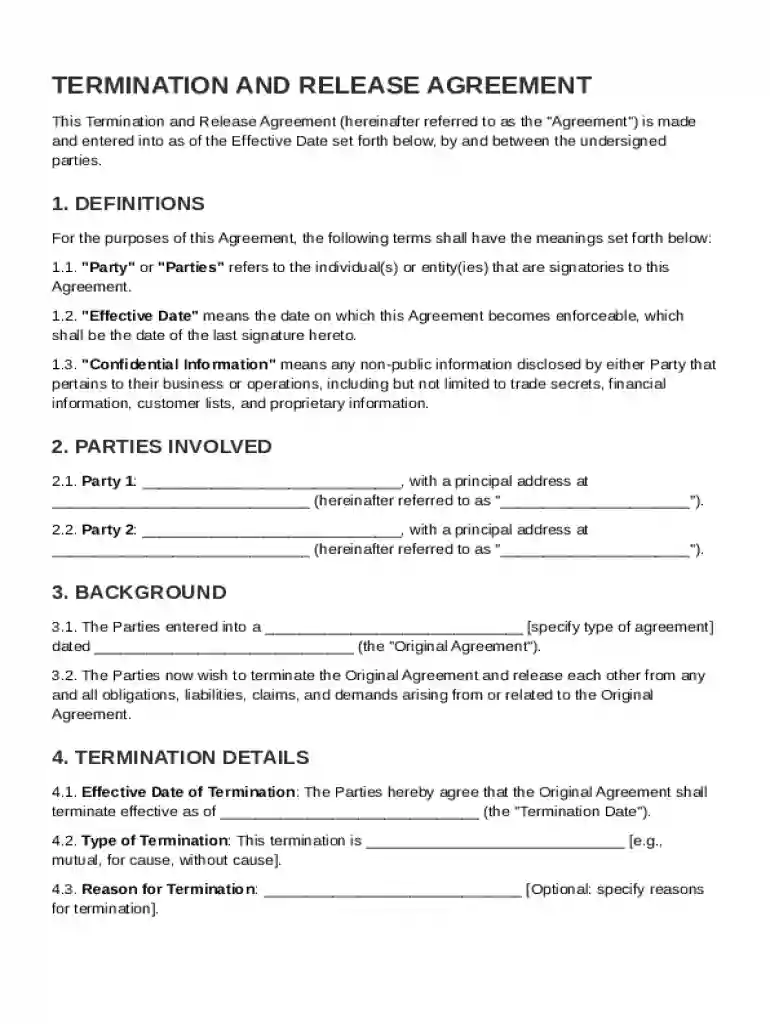
Type text, add images, blackout confidential details, add comments, highlights and more.

Draw your signature, type it, upload its image, or use your mobile device as a signature pad.

Send it via email, link, or fax. You can also download it, export it or print it out.
A Termination and Release Contract Template is a legal document outlining the terms for terminating an original agreement between two parties. This template is essential in clearly defining the rights and obligations of involved parties upon ending a contractual relationship. It ensures that both parties mutually consent to terminate their agreement, mitigating future disputes by releasing claims related to the original contract.
Such a document typically incorporates terms surrounding the termination process. It might include the conditions under which the termination can occur and any actions required by each party upon severance of the contract. It is critical to ensure all relevant laws are adhered to, providing a comprehensive framework for executing the termination smoothly.
The template includes several crucial components to ensure the termination process is clear and thorough:
The template is commonly used by:
These parties benefit from using such templates by ensuring that all potential liabilities are addressed and minimized.


Legal compliance is critical when utilizing a Termination and Release Contract Template. U.S. laws require that both parties understand their rights and obligations when terminating a contract. Ensuring that the document is duly signed and executed as per state-specific regulations will uphold its legality and binding nature.
The legality also extends to electronic forms, which are increasingly favored due to efficiency. The ESIGN Act supports the use of electronic signatures, giving electronic contracts the same legal standing as paper ones.
Different states may have variations in laws affecting contract terminations, thus influencing the template:
To ensure state compliance, parties are advised to consult with a local legal expert familiar with regional law nuances.
Understanding key terms within the template is crucial for clarity:
Grasping these terms aids in comprehending the full extent of the contract’s provisions, reducing misunderstandings.
Utilizing such a template offers several advantages:
By adopting a Termination and Release Contract Template, organizations and individuals safeguard their interests while ensuring a swift and effective contract termination procedure.
Real-world applications of the Termination and Release Contract Template abound:
These examples illustrate the template’s versatility across different sectors, enhancing contract management practices.
At DocHub, your data security is our priority. We follow HIPAA, SOC2, GDPR, and other standards, so you can work on your documents with confidence.