Courts.IN.gov: Indiana Trial Courts: Types of Courts 2026

Get Form
courts.IN.gov: Indiana Trial Courts: Types of Courts Preview on Page 1

Here's how it works

01. Edit your form online
Type text, add images, blackout confidential details, add comments, highlights and more.
02. Sign it in a few clicks
Draw your signature, type it, upload its image, or use your mobile device as a signature pad.
03. Share your form with others
Send it via email, link, or fax. You can also download it, export it or print it out.

How to use or fill out courts.IN.gov: Indiana Trial Courts: Types of Courts with our platform

Form edit decoration
9.5
Ease of Setup
DocHub User Ratings on G2
9.0
Ease of Use
DocHub User Ratings on G2
  1. Click ‘Get Form’ to open it in the editor.
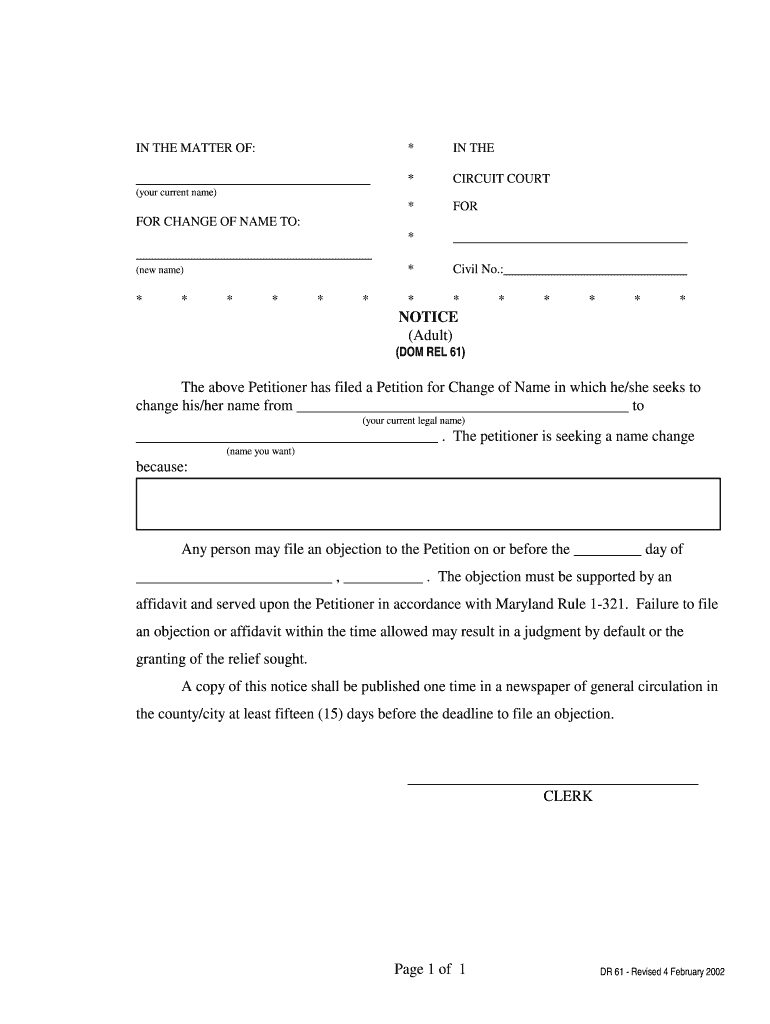
  2. Begin by entering your current legal name in the designated field labeled 'your current name'. This is essential for identifying the name you wish to change.
  3. Next, fill in the new name you desire in the section marked 'new name'. Ensure that this is the exact name you want to be legally recognized.
  4. In the 'Civil No.' field, input your case number if applicable. This helps in tracking your petition within the court system.
  5. Provide a brief explanation for your name change in the specified area. This should clarify your reasons and support your petition.
  6. Finally, review all entered information for accuracy before submitting. Once satisfied, save and export your document directly from our platform.

Start using our platform today to easily complete and manage your court documents online for free!

See more courts.IN.gov: Indiana Trial Courts: Types of Courts versions

We've got more versions of the courts.IN.gov: Indiana Trial Courts: Types of Courts form. Select the right courts.IN.gov: Indiana Trial Courts: Types of Courts version from the list and start editing it straight away!
Versions Form popularity Fillable & printable
2020 4.8 Satisfied (87 Votes)
2019 4 Satisfied (46 Votes)
2002 4.2 Satisfied (97 Votes)
be ready to get more

Complete this form in 5 minutes or less

Get form

Got questions?

We have answers to the most popular questions from our customers. If you can't find an answer to your question, please contact us.
Contact us
The nations 94 district or trial courts are called U.S. district courts. District courts resolve disputes by determining the facts and applying the law to those facts. Learn more about district courts.
Today, a total of 94 district courts exist; they are staffed by more than 600 judges. Some circuits have more than others, based on population, but each circuit still has only one court of appeals. Cases not settled in the courts of appeal may be appealed further, but only to the Supreme Court.
There are two primary levels of Indiana state courts: trial courts and appellate courts. The Supreme Court of Indiana, the Court of Appeals of Indiana, and the Indiana Tax Court are appellate-level courts. For the most part, appellate courts only handle cases that have already been decided in a trial court.
There are 94 district courts, 13 circuit courts, and one Supreme Court throughout the country. Courts in the federal system work differently in many ways than state courts. The primary difference for civil cases (as opposed to criminal cases) is the types of cases that can be heard in the federal system.
Criminal courts try cases in which individuals are accused of a crime whereas civil courts oversee legal cases that are between two parties that result from wrongdoing such as in cases of divorces, contract disputes, personal injury claims, or eviction proceedings.

Security and compliance

At DocHub, your data security is our priority. We follow HIPAA, SOC2, GDPR, and other standards, so you can work on your documents with confidence.

Learn more
ccpa2
pci-dss
gdpr-compliance
hipaa
soc-compliance

People also ask

State Courts Texas court system has three levels: trial, appellate, and supreme. Trial: The trial level, or local, courts are the most numerous, consisting of over 450 state district courts, over 500 county courts, over 800 Justice of the Peace courts, and over 900 municipal courts.
There are 89 districts in the 50 states, which are listed with their divisions in Title 28 of the U.S. Code, Sections 81-144. District courts also exist in Puerto Rico, the Islands, the District of Columbia, Guam, and the Northern Mariana Islands. In total there are 94 U.S. district courts.
Trial Courts Superior Courts handle: All criminal cases (felonies, misdemeanors, and traffic tickets) All civil cases (family law, probate, juvenile, and other civil cases) Appeals of small claims cases and other civil cases worth $25,000 or less.

Related links