
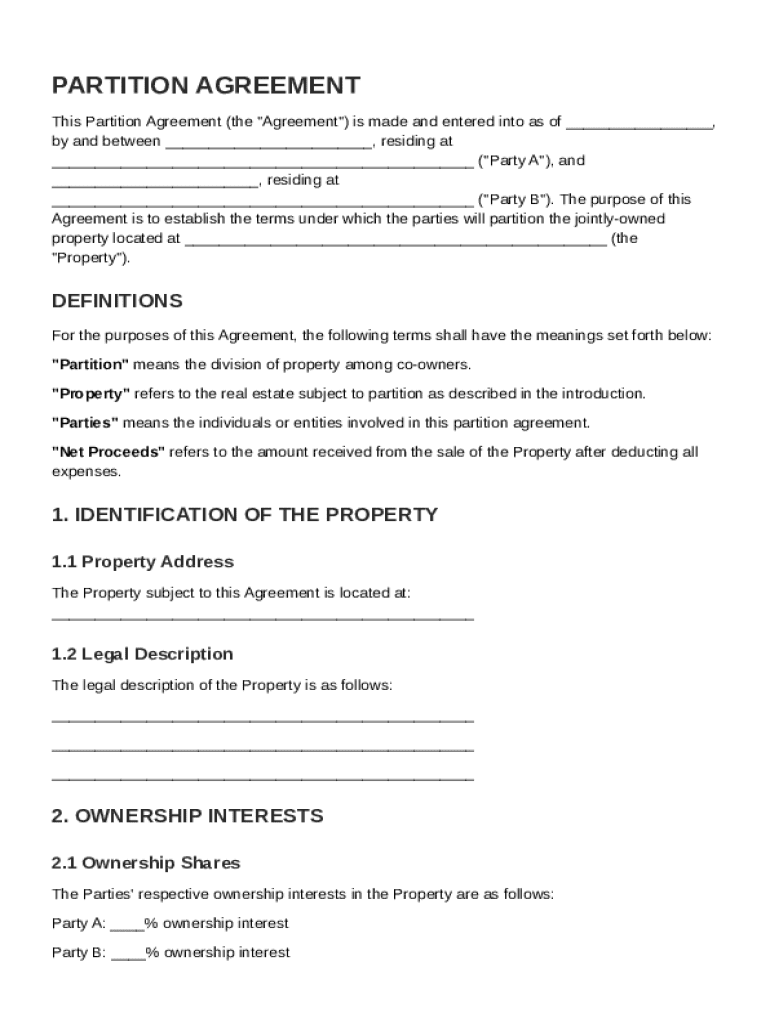







Definition and Meaning
A Partition Agreement Template is a legal document that outlines the conditions under which jointly-owned property is divided between two or more parties. This agreement applies when co-owners, typically referred to as Party A and Party B, decide to distribute their ownership interests in shared property. This could involve physically dividing the property or selling it and dividing the proceeds. The document is essential for clarifying ownership stakes, delineating responsibilities, and ensuring a fair distribution process.
Key Elements of the Partition Agreement Template
The Partition Agreement Template encompasses several critical components that facilitate a seamless division of property:
-
Property Identification: Clearly mentions the property in question, providing its location, dimensions, and legal descriptions to avoid any ambiguity.
-
Ownership Interests and Contributions: Establishes each party’s ownership percentage and financial contributions towards the property, which can impact how the property is partitioned.
-
Method of Partitioning: Specifies whether the property will be divided physically or sold, with proceeds distributed based on ownership percentages.
-
Role of a Real Estate Agent: Details the process of selecting a real estate agent for property sale and managing associated expenses.
-
Cost Management: Outlines how costs related to partitioning or selling the property will be handled and divided among parties.
Steps to Complete the Partition Agreement Template
-
Identify Parties: Clearly list all parties involved in the property and their respective interests.
-
Describe the Property: Provide a detailed description of the property, including plots, boundaries, and any noteworthy features.
-
Outline Financial Contributions: Document each party's financial contributions towards the property, which could include purchase prices, mortgage payments, and improvements.
-
Select Method for Partitioning: Choose between a physical division or sale of the property, detailing how proceeds will be split.
-
Address Dispute Resolution: Include provisions for mediation or arbitration to resolve any disagreements during the process.
-
Draft Miscellaneous Clauses: Add statements on amendments, binding effects, and execution to ensure legal robustness.
Legal Use of the Partition Agreement Template
This template serves as a legally binding document in real estate transactions involving shared ownership. It conforms to the legal standards set by various jurisdictions in the United States, providing a structured framework for property division. By using this template, parties can avoid lengthy and costly litigation, as the document stipulates dispute resolution methods like mediation. It can be presented in court if disputes arise, thus making it a critical component in property negotiations and transactions.
State-Specific Rules for the Partition Agreement Template
Laws governing the use and enforceability of partition agreements vary by state. It is crucial to tailor the template to adhere to specific state laws:
-
California: Offers comprehensive statutory provisions for partition actions, focusing on fair market value.
-
New York: Requires judicial proceedings for partition actions, emphasizing equitable distribution.
-
Texas: Allows for either court-ordered or voluntary partition instructions, with specifics outlined in state property codes.
Owners must ensure the agreement aligns with respective state statutes to avoid void or unenforceable contracts.
Important Terms Related to Partition Agreement Template
Several legal and real estate terms are pertinent when working with a Partition Agreement Template:
-
Partition by Sale: Selling property and dividing proceeds among owners based on their ownership percentages.
-
Partition in Kind: Physically dividing property so each owner gets a specific portion, maintaining tangible ownership.
-
Joint Tenancy: Form of property co-ownership where parties have equal shares, typically with rights of survivorship.
-
Tenancy in Common: Form of ownership in which each party owns a share independently that can be transferred or inherited.
Examples of Using the Partition Agreement Template
Practical scenarios where a Partition Agreement Template can be pivotal include:
-
Family Disputes: Resolving ownership among siblings who inherit family property, ensuring equitable shares.
-
Business Partnerships: Dividing real estate assets between partners exiting a joint venture, clarifying ownership stakes.
-
Divorce Settlements: Allocating jointly-owned marital property in divorce proceedings, based on contribution and agreement.
Software Compatibility and Digital Version
Using the Partition Agreement Template in a digital format streamlines the documentation process. Compatibility with software like DocHub provides enhanced flexibility:
-
Editing Tools: Modify documents with advanced tools for text, images, and annotations.
-
Collaboration Features: Multiple users can comment and edit simultaneously, ensuring input from all parties.
-
Electronic Signatures: Utilize legally binding e-signatures to finalize agreements without physical paperwork.
These tools accelerate the drafting and execution of partition agreements, making them suitable for modern, digital workflows.




